Vintage 1930s Swedish classroom scene with a teacher at the chalkboard, students at wooden desks, educational butterfly charts on the wall, and a hardcover butterfly journal on a desk in the foreground.

The Art of Teaching Nature: Max Richter’s 1939 Swedish Butterfly Charts

In 1939, Swedish publisher Norstedts released a series of school charts documenting the country’s butterflies and insects with scientific precision and artistic beauty. Illustrated by Max Richter, the Insekter skolplansch became enduring masterpieces — and a window into a tradition of natural history education that stretches back to Linnaeus himself.

The Art of Teaching Nature: Max Richter’s 1939 Swedish Butterfly Charts Read More »

Standing hardcover botanical oak journal on a rustic wooden desk surrounded by acorns, oak leaves, inkwell, feather quill, magnifying glass, and candlestick holder.

The Oak and the Long Game: What the Oldest Trees Can Teach Us

A mature English oak can live for more than a thousand years, support over 2,300 species, and produce its first significant acorn crop only at the age of forty. The great botanical illustrators of the eighteenth and nineteenth centuries understood the oak as both scientific subject and cultural symbol — and the naturalists who documented it carried notebooks into the field, returning to the same trees across seasons and years, building a relationship with the landscape that was, in its own way, a form of wisdom.

The Oak and the Long Game: What the Oldest Trees Can Teach Us Read More »

Flat lay editorial composition featuring two Meiji-era woodblock prints of pink and red chrysanthemums by Keika Hasegawa, paired with a brass magnifying glass, dried flower, and antique book.

Keika Hasegawa and the Lost Art of One Hundred Chrysanthemums: A Meiji Legacy in Ukiyo-e

In 1893, as Japan navigated the profound transformations of the Meiji era, an artist whose name barely survived time completed one of the most exquisite botanical series in the late ukiyo-e tradition: Keika Hyakugiku — One Hundred Chrysanthemums. Hasegawa’s life remains largely undocumented; only his work survives, and it is enough to establish him as a master of the mokuhanga woodblock technique applied to botanical documentation with a precision and luminosity that no other medium of the period could achieve.

Keika Hasegawa and the Lost Art of One Hundred Chrysanthemums: A Meiji Legacy in Ukiyo-e Read More »

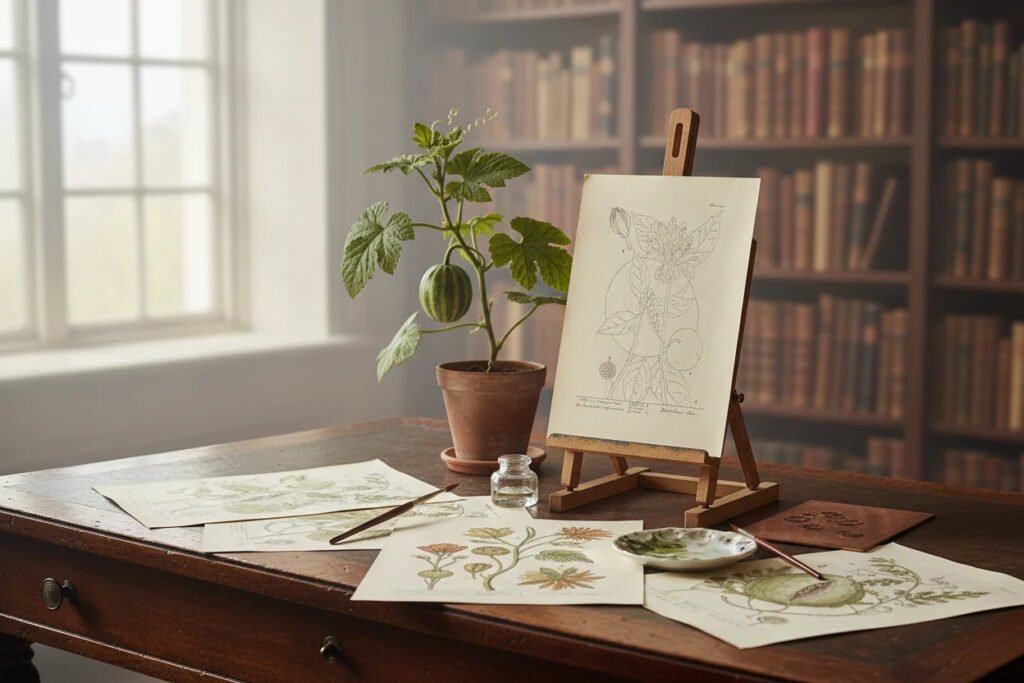
Hand-colored antique botanical plate illustrating Ficus carica fig anatomy, featuring detailed cross-sections of the syconium fruit, internal floral structures, seeds, and lobed leaves in the style of Georg Dionysius Ehret.

The Hidden Anatomy of the Fig: Ehret, Macfarlane, and Two Centuries of Botanical Illustration

The fig holds a secret that eluded casual observation for centuries: it is not, in the strict botanical sense, a fruit at all. What we eat is a syconium — an inverted floral receptacle enclosing hundreds of tiny flowers within its fleshy walls. To reveal this hidden architecture, eighteenth-century botanical science turned to dissection. In 1750, Georg Dionysius Ehret made the invisible visible.

The Hidden Anatomy of the Fig: Ehret, Macfarlane, and Two Centuries of Botanical Illustration Read More »

Colorized vintage photograph of two men in 1920s outdoor attire with brimmed hats paddling a wooden canoe on a calm misty wilderness lake surrounded by evergreen pine trees

The Golden Age of Canoes: Mail-Order Catalogs and the Making of North American Wilderness Culture

In the 1920s and 1930s, North American canoe manufacturers produced some of the most compelling commercial art of the interwar period: illustrated mail-order catalogs that sold not merely watercraft, but an entire philosophy of wilderness living. These catalogs — distributed by post to hundreds of thousands of homes — were among the primary instruments through which a generation of North Americans learned to imagine, desire, and pursue the outdoor life.

The Golden Age of Canoes: Mail-Order Catalogs and the Making of North American Wilderness Culture Read More »

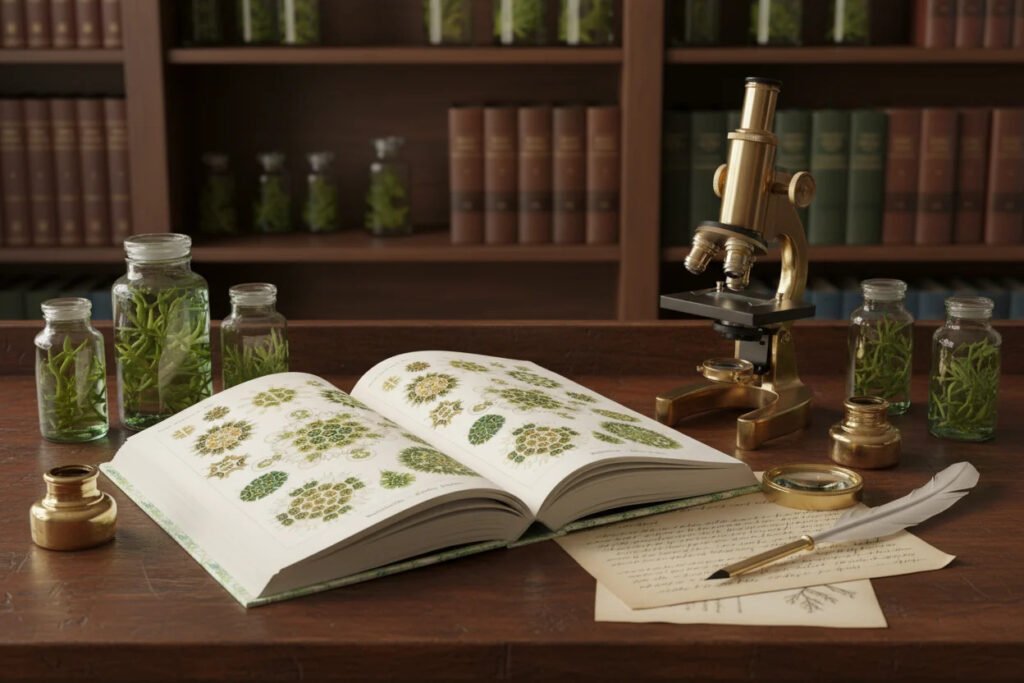
A 19th-century Victorian naturalist laboratory desk featuring an open book with Ernst Haeckel Kunstformen der Natur botanical algae illustrations, a brass microscope, specimen jars, inkwells, and handwritten notes.

The Geometry of Life: Ernst Haeckel, Kunstformen der Natur, and the Algae That Inspired Art Nouveau

Between 1899 and 1904, Ernst Haeckel published Kunstformen der Natur — 100 lithographic plates that revealed the hidden geometry of the living world. His algae illustrations inspired Art Nouveau, influenced a generation of designers, and documented organisms that produce most of the oxygen we breathe. This is the story of the book, the biologist, and the microscopic beauty that changed how we see nature.

The Geometry of Life: Ernst Haeckel, Kunstformen der Natur, and the Algae That Inspired Art Nouveau Read More »