victorian laboratory tray with mineral specimens sowerby mineralogy

The Mineral Kingdom: Henry Sowerby, Popular Mineralogy, and the Victorian Science of Crystals

In 1850, Henry Sowerby published Popular Mineralogy — a visual catalog of the mineral kingdom designed to make geological science accessible to the educated general reader, at the precise moment when lithographic illustration had reached its technical peak.

The Mineral Kingdom: Henry Sowerby, Popular Mineralogy, and the Victorian Science of Crystals Read More »

victorian english wall gallery twelve robert tyas 1896 language of flowers

The Secret Language of Bouquets: Robert Tyas and the Floral Emblems of 1896

In Victorian England, flowers were not merely decorative. They were a language — precise, codified, and capable of conveying emotions that the strict social etiquette of the era made impossible to express directly. Robert Tyas’s The Language of Flowers, or, Floral Emblems of Thoughts, Feelings, and Sentiments, published in London in 1896, was one of the most beautiful documents of this tradition: twelve hand-coloured plates showing bouquets of garden and wild flowers, each combination a message composed as carefully as any letter.

The Secret Language of Bouquets: Robert Tyas and the Floral Emblems of 1896 Read More »

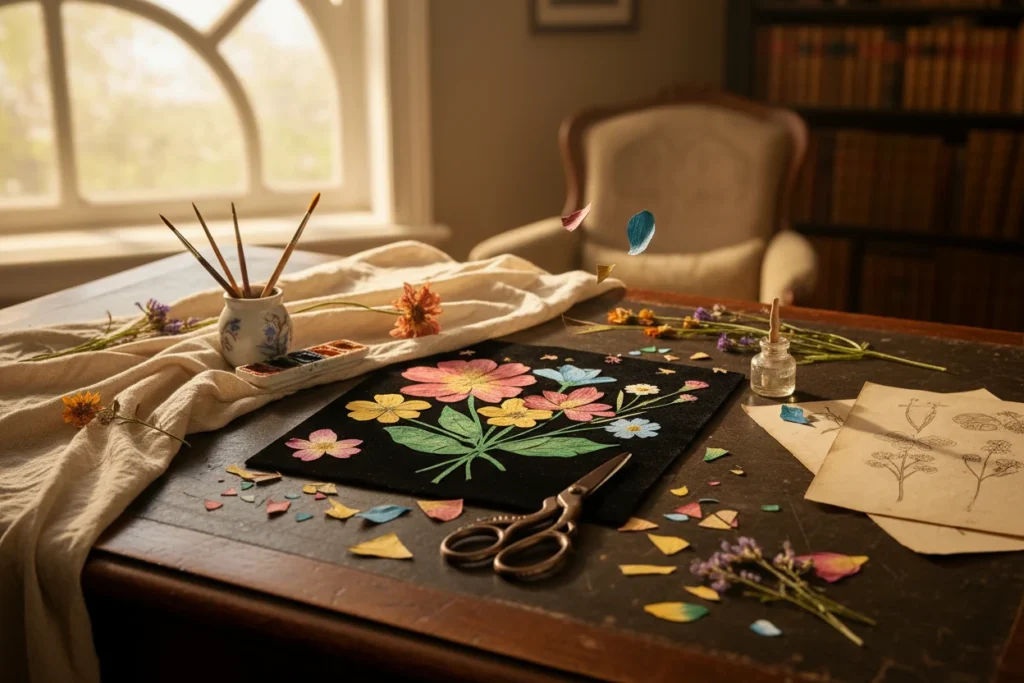
A Victorian-era artist desk bathed in warm sunlight, featuring a colorful cut-paper floral artwork mounted on black paper next to crafting scissors, paper scraps, botanical sketches, paintbrushes, and dried flowers.

Scissors and Black Paper: The Mysterious Ellen W. and Her 1835 Album of Cut-Paper Flowers

She is known only as Ellen W. — no surname, no biography, no portrait. And yet the album of 26 cut-paper flower compositions she created in Great Britain in 1835 is among the most extraordinary examples of botanical art of the early Victorian era: each petal individually cut, each composition arranged against stark black paper that makes the colours appear almost luminous.

Scissors and Black Paper: The Mysterious Ellen W. and Her 1835 Album of Cut-Paper Flowers Read More »

Vibrant angelfish and various tropical marine species swim through clear turquoise water above a colorful coral reef with pink, yellow, and brown corals.

The Most Fantastical Fish Ever Painted: Louis Renard’s Poissons, Écrevisses et Crabes (1719)

In 1719, a Franco-Dutch bookseller named Louis Renard published in Amsterdam what would become one of the most extraordinary — and most debated — works of natural history ever printed. Its plates show fish with nearly human lips, crabs with carapaces like ceremonial shields, a unicorn fish, and even a mermaid — and yet modern ichthyologists have identified the genus of nearly every animal depicted.

The Most Fantastical Fish Ever Painted: Louis Renard’s Poissons, Écrevisses et Crabes (1719) Read More »

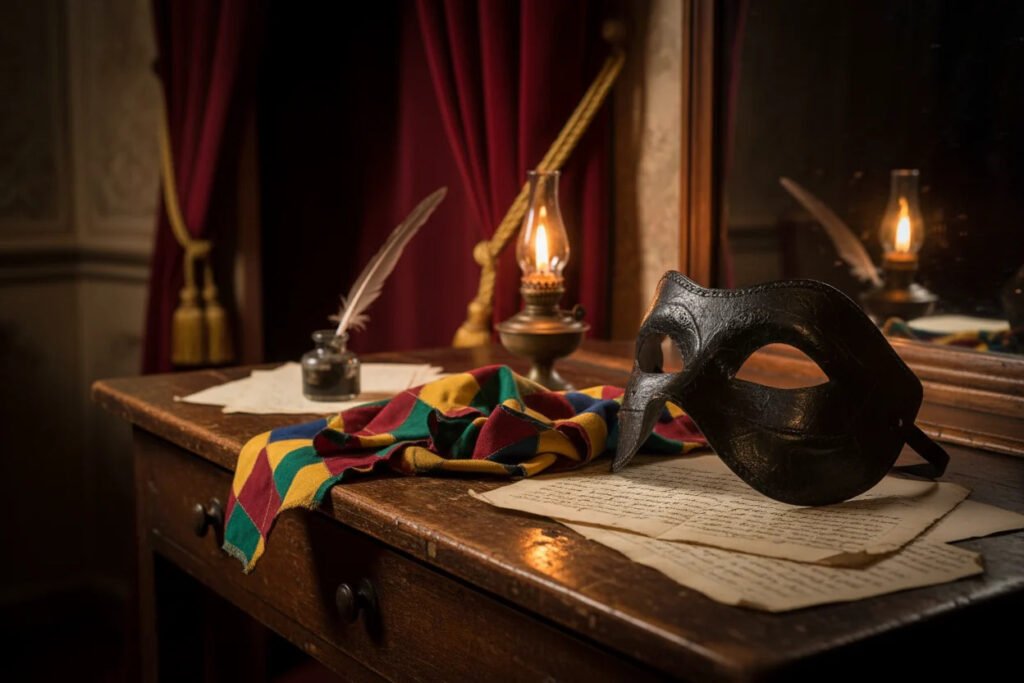
Traditional Commedia dell’Arte mask displayed on a theatrical dressing table with a colorful costume, handwritten scripts, quill pen, and oil lamp.

The Masks of the Piazza: Commedia dell’Arte and the Birth of Modern Theater

In the summer of 1545, a group of professional performers signed a contract in Padua that would change the history of theater. The tradition they inaugurated — the Commedia dell’Arte — gave us Arlecchino, Pantalone, Colombina, and the Innamorati. It also gave us Molière, Chaplin, and the Marx Brothers. This is the story of the masks that invented modern comedy.

The Masks of the Piazza: Commedia dell’Arte and the Birth of Modern Theater Read More »

Vintage-style bird study scene with watercolor illustrations of colorful birds in an open sketchbook, surrounded by pinecones, pencils, magnifying glass, and old books on a rustic wooden table.

The Father of European Ornithology: Johann Friedrich Naumann and the Art of Knowing a Bird

Johann Friedrich Naumann spent a lifetime watching birds in the fields and forests of Saxony. In 1841, he and Gotthilf Heinrich von Schubert published Naturgeschichte der Vögel in Bildern — hand-coloured copper engravings designed to bring the living forest into the homes and schoolrooms of a generation. This is the story of a man who taught Europe to see its birds.

The Father of European Ornithology: Johann Friedrich Naumann and the Art of Knowing a Bird Read More »