Sciences

victorian laboratory tray with mineral specimens sowerby mineralogy

The Mineral Kingdom: Henry Sowerby, Popular Mineralogy, and the Victorian Science of Crystals

In 1850, Henry Sowerby published Popular Mineralogy — a visual catalog of the mineral kingdom designed to make geological science accessible to the educated general reader, at the precise moment when lithographic illustration had reached its technical peak.

The Mineral Kingdom: Henry Sowerby, Popular Mineralogy, and the Victorian Science of Crystals Read More »

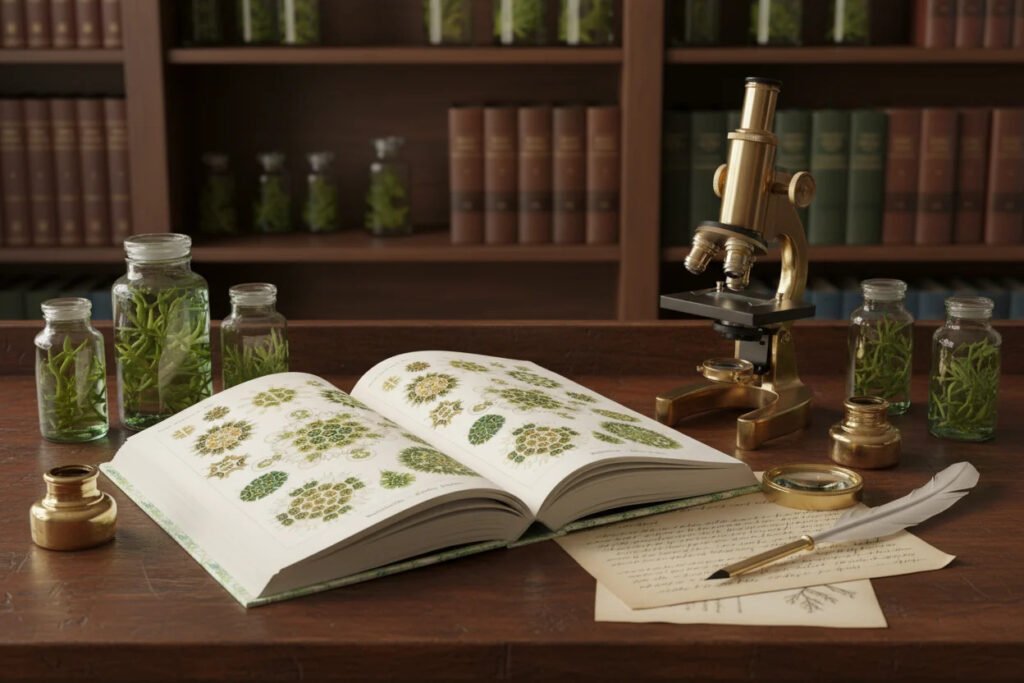
A 19th-century Victorian naturalist laboratory desk featuring an open book with Ernst Haeckel Kunstformen der Natur botanical algae illustrations, a brass microscope, specimen jars, inkwells, and handwritten notes.

The Geometry of Life: Ernst Haeckel, Kunstformen der Natur, and the Algae That Inspired Art Nouveau

Between 1899 and 1904, Ernst Haeckel published Kunstformen der Natur — 100 lithographic plates that revealed the hidden geometry of the living world. His algae illustrations inspired Art Nouveau, influenced a generation of designers, and documented organisms that produce most of the oxygen we breathe. This is the story of the book, the biologist, and the microscopic beauty that changed how we see nature.

The Geometry of Life: Ernst Haeckel, Kunstformen der Natur, and the Algae That Inspired Art Nouveau Read More »

Open Victorian geological atlas showing colorful cross-section strata diagrams on a wooden desk surrounded by an ammonite fossil, rock samples, quartz cluster, brass magnifying glass, rock hammer, and antique specimen jars.

Reading the Earth: Vuillemin, Mantell, and the Victorian Invention of Deep Time

In 1788, James Hutton looked at a rock face at Siccar Point and discovered deep time. The Victorian geologists and illustrators who followed him — Vuillemin in France, Emslie and Reynolds in Britain — invented the visual language that made that discovery legible. This is the story of the geological cross-section and the two traditions that shaped it.

Reading the Earth: Vuillemin, Mantell, and the Victorian Invention of Deep Time Read More »

Anatomy hardcover journal centered on an antique wooden scholar desk surrounded by vintage medical books, a brass lamp, a microscope, inkwell, and handwritten notes.

Cœur et Nerfs: How French Medical Publishing Taught a Nation to See the Human Body

At the turn of the twentieth century, the house of Larousse and physician Galtier-Boissière set out to make the human body visible to everyone. Through chromolithography and the work of artist Leuba, the cardiovascular and nervous systems became art. This is the story of how French medical publishing democratized anatomy.

Cœur et Nerfs: How French Medical Publishing Taught a Nation to See the Human Body Read More »