Art & Design

victorian english wall gallery twelve robert tyas 1896 language of flowers

The Secret Language of Bouquets: Robert Tyas and the Floral Emblems of 1896

In Victorian England, flowers were not merely decorative. They were a language — precise, codified, and capable of conveying emotions that the strict social etiquette of the era made impossible to express directly. Robert Tyas’s The Language of Flowers, or, Floral Emblems of Thoughts, Feelings, and Sentiments, published in London in 1896, was one of the most beautiful documents of this tradition: twelve hand-coloured plates showing bouquets of garden and wild flowers, each combination a message composed as carefully as any letter.

The Secret Language of Bouquets: Robert Tyas and the Floral Emblems of 1896 Read More »

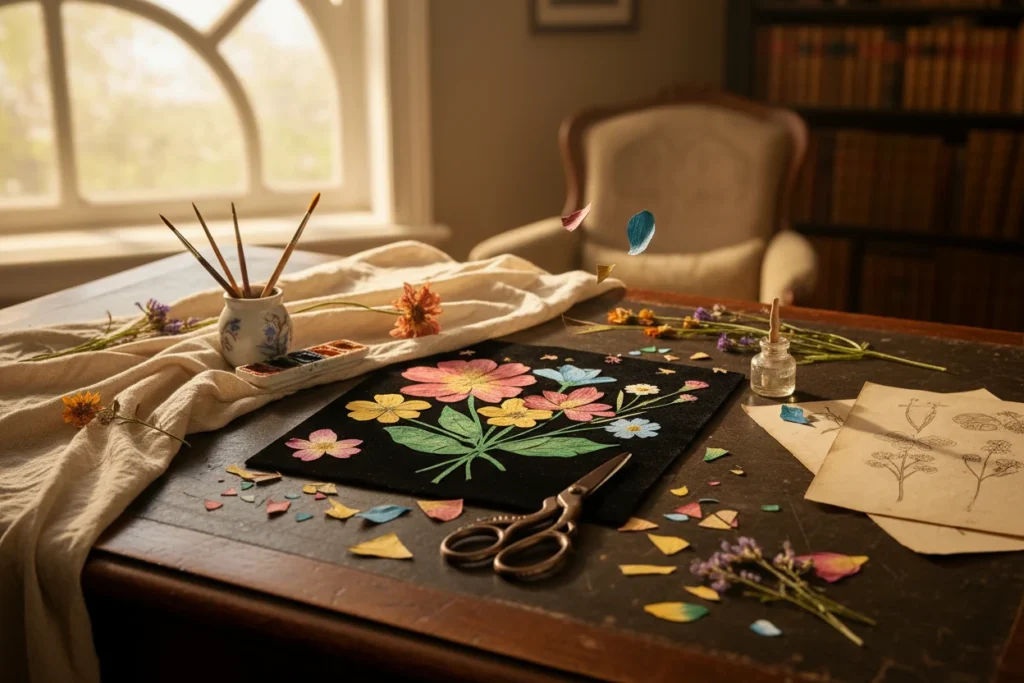
A Victorian-era artist desk bathed in warm sunlight, featuring a colorful cut-paper floral artwork mounted on black paper next to crafting scissors, paper scraps, botanical sketches, paintbrushes, and dried flowers.

Scissors and Black Paper: The Mysterious Ellen W. and Her 1835 Album of Cut-Paper Flowers

She is known only as Ellen W. — no surname, no biography, no portrait. And yet the album of 26 cut-paper flower compositions she created in Great Britain in 1835 is among the most extraordinary examples of botanical art of the early Victorian era: each petal individually cut, each composition arranged against stark black paper that makes the colours appear almost luminous.

Scissors and Black Paper: The Mysterious Ellen W. and Her 1835 Album of Cut-Paper Flowers Read More »

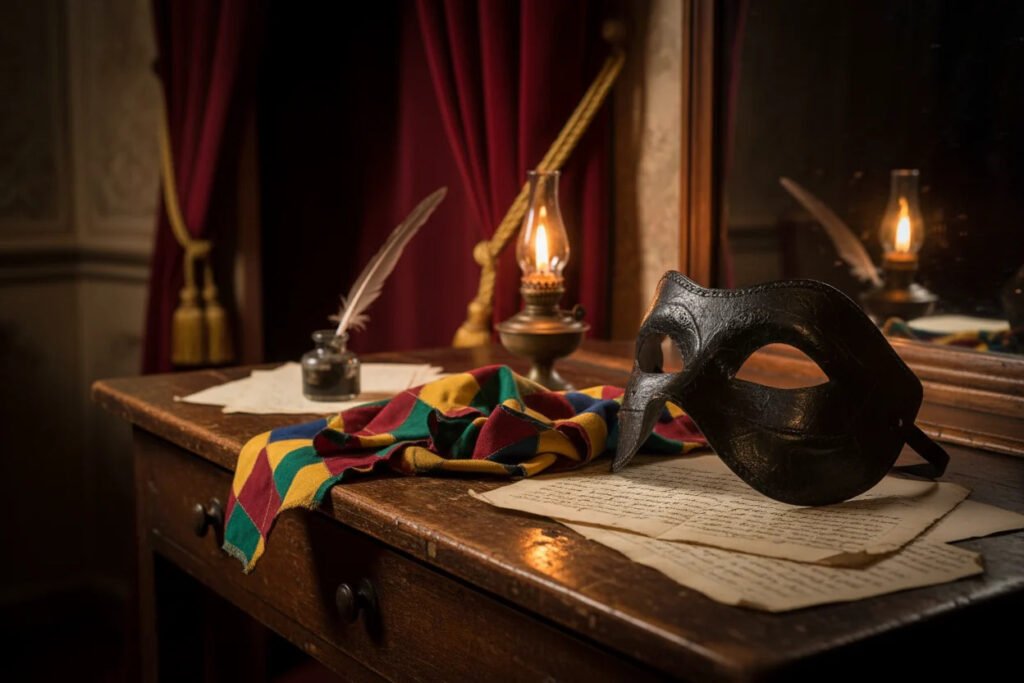
Traditional Commedia dell’Arte mask displayed on a theatrical dressing table with a colorful costume, handwritten scripts, quill pen, and oil lamp.

The Masks of the Piazza: Commedia dell’Arte and the Birth of Modern Theater

In the summer of 1545, a group of professional performers signed a contract in Padua that would change the history of theater. The tradition they inaugurated — the Commedia dell’Arte — gave us Arlecchino, Pantalone, Colombina, and the Innamorati. It also gave us Molière, Chaplin, and the Marx Brothers. This is the story of the masks that invented modern comedy.

The Masks of the Piazza: Commedia dell’Arte and the Birth of Modern Theater Read More »

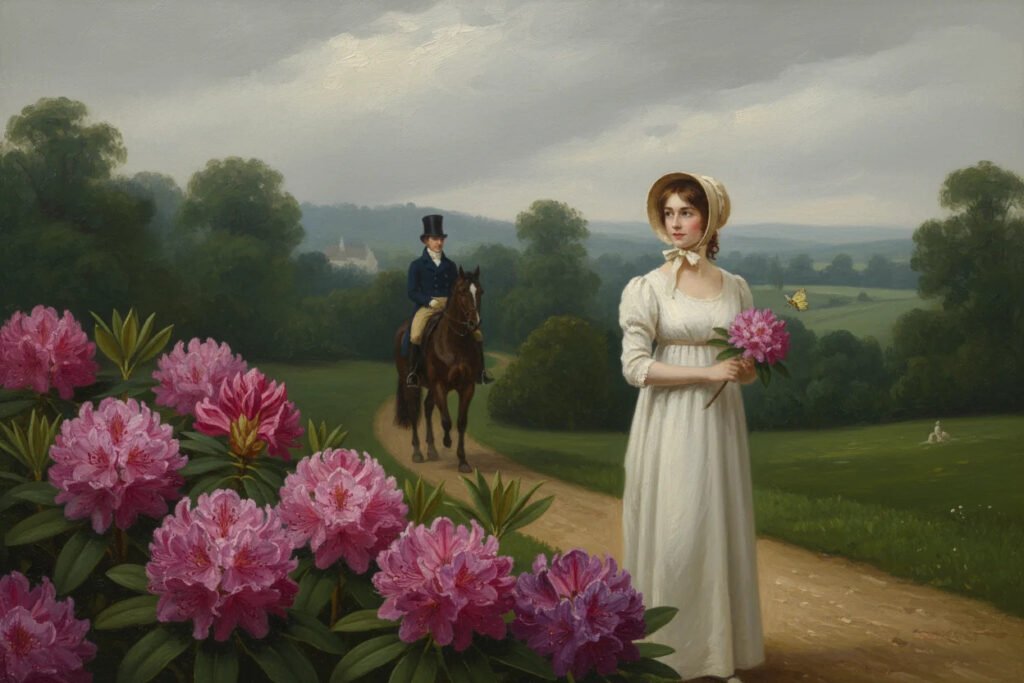
A Regency-era woman in a white dress and bonnet holding pink rhododendrons on a country path, while a gentleman on horseback approaches in the background near lush green fields and flowering bushes.

The Most Expensive Flower Book Ever Made: Thornton’s Temple of Flora

Robert John Thornton spent a decade and his entire fortune producing The Temple of Flora — the most ambitious and expensive botanical book of the Georgian era. A look at the mezzotint masterpiece, the Pontic Rhododendron, and the visionary ruin behind one of the greatest achievements in natural history illustration.

The Most Expensive Flower Book Ever Made: Thornton’s Temple of Flora Read More »

Flat lay editorial composition featuring two Meiji-era woodblock prints of pink and red chrysanthemums by Keika Hasegawa, paired with a brass magnifying glass, dried flower, and antique book.

Keika Hasegawa and the Lost Art of One Hundred Chrysanthemums: A Meiji Legacy in Ukiyo-e

In 1893, as Japan navigated the profound transformations of the Meiji era, an artist whose name barely survived time completed one of the most exquisite botanical series in the late ukiyo-e tradition: Keika Hyakugiku — One Hundred Chrysanthemums. Hasegawa’s life remains largely undocumented; only his work survives, and it is enough to establish him as a master of the mokuhanga woodblock technique applied to botanical documentation with a precision and luminosity that no other medium of the period could achieve.

Keika Hasegawa and the Lost Art of One Hundred Chrysanthemums: A Meiji Legacy in Ukiyo-e Read More »

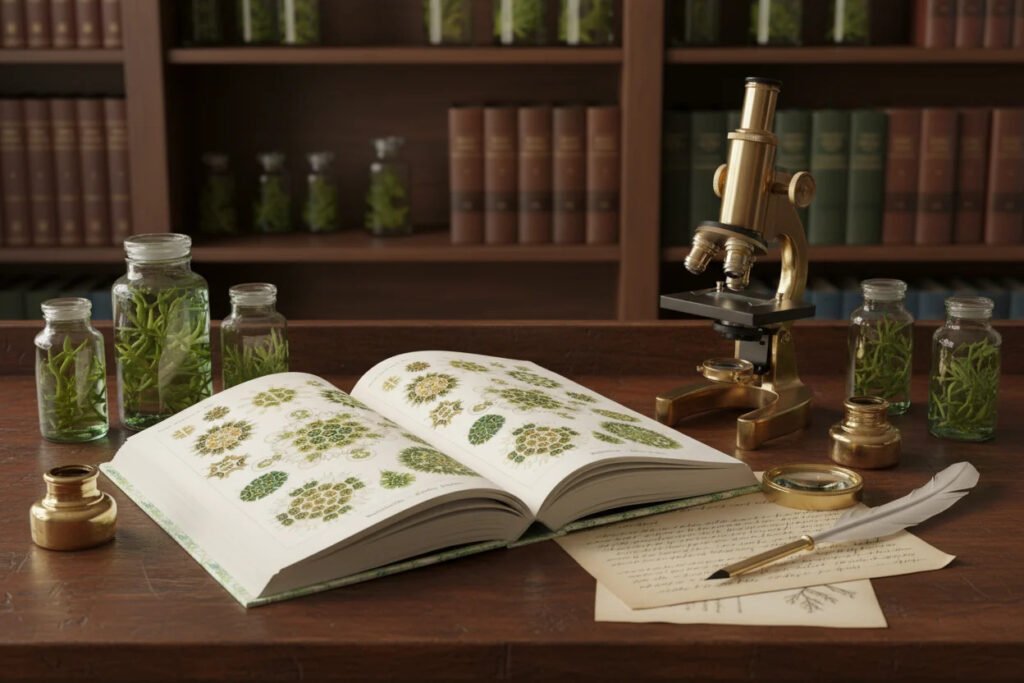
A 19th-century Victorian naturalist laboratory desk featuring an open book with Ernst Haeckel Kunstformen der Natur botanical algae illustrations, a brass microscope, specimen jars, inkwells, and handwritten notes.

The Geometry of Life: Ernst Haeckel, Kunstformen der Natur, and the Algae That Inspired Art Nouveau

Between 1899 and 1904, Ernst Haeckel published Kunstformen der Natur — 100 lithographic plates that revealed the hidden geometry of the living world. His algae illustrations inspired Art Nouveau, influenced a generation of designers, and documented organisms that produce most of the oxygen we breathe. This is the story of the book, the biologist, and the microscopic beauty that changed how we see nature.

The Geometry of Life: Ernst Haeckel, Kunstformen der Natur, and the Algae That Inspired Art Nouveau Read More »