
The iconography of the North American wild turkey (Meleagris gallopavo) holds a privileged place not only in seasonal folklore but in the evolution of nineteenth-century graphic arts. Far from being merely decorative, imagery surrounding the Thanksgiving tradition served as a mirror for shifting printing technologies, commercial ephemera, and natural history illustration during the Victorian era.
By pairing two distinct visual documents—one from the sphere of popular street advertising and the other from elite chromolithographic publishing—our latest hardcover notebook examines the rich interplay between mass-market utility and fine-art printing heritage.
J. Molten and the Vernacular Woodcut Tradition
The front cover features “Raffle this Evening” (c. 1880–1900), an exemplary piece of American popular ephemera originating from Rhode Island.
- The Artist: Designed and engraved by J. Molten, whose signature (“Molten Eng. Del.”) inscribed within the matrix confirms his dual mastery as both illustrator and wood engraver (delineavit and engraved).
- Technique: Executed as a color woodcut (xilografía a color), the piece relies on dense network cross-hatching to render the volume of the bird’s plumage, balanced by a striking, vibrant red applied to the caruncles and decorative framing.
- Historical Context: Published in Providence by the legendary commercial printing house What Cheer Show Printing House, this broadside was originally deployed as a public street placard. It advertised traditional “turkey raffles”—communal holiday lotteries where participants rolled dice (depicted in the upper corners) to win the holiday centerpiece. It represents vernacular, high-impact graphic design intended for immediate civic engagement.
L. Prang & Co. and the Chromolithographic Pinnacle
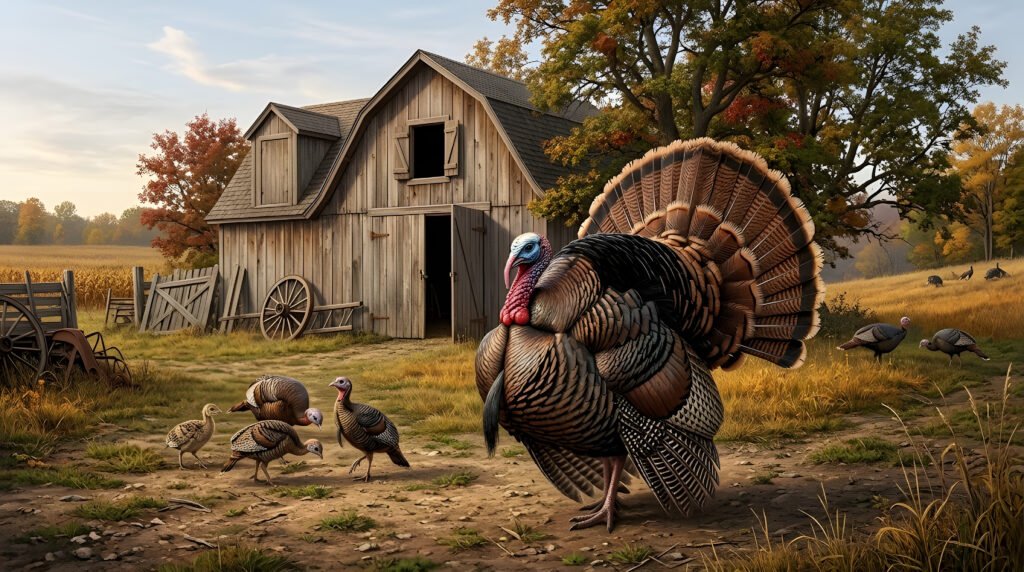
In stark contrast, the back cover presents “Wild Turkey” (1872), published by Louis Prang & Company of Boston.
- The Publisher: Founded by Prussian immigrant Louis Prang—often celebrated as the “Father of the American Christmas Card”—the firm revolutionized color printing in the United States, elevating mass reproduction into an artistic medium.
- Technique: Created via chromolithography (Cromolitografía), the print utilized upwards of twenty distinct limestone plates, applying successive layers of oil-based inks. This complex process achieved an iridescent sheen, a tactile depth, and tonal gradients that successfully emulated original oil and watercolor paintings.
- Aesthetic Value: The plate embodies Victorian natural history illustration at its zenith. The bronze, iridescent sheen of the wild turkey’s plumage and the precise barring of the tail feathers display an almost scientific rigor combined with romantic ornamentation.
A Dialectic of 19th-Century Print Culture
Uniting J. Molten and L. Prang within a single object establishes a compelling conceptual dialogue between two divergent streams of nineteenth-century visual culture:
- The Popular and Commercial Sphere (Molten): Exemplifies the robust, direct nature of block printing and broadside typography. It speaks to community rituals, street-level advertising, and the rugged materiality of popular culture.
- The Institutional and Fine-Art Sphere (Prang): Represents the refined pinnacle of color reproduction, bringing elite natural history and domestic aesthetic education into the Victorian parlor.
Together, these artifacts preserve distinct facets of nineteenth-century American print history, bound by the cultural resonance of the turkey as both a costumbrista symbol and a biological specimen.
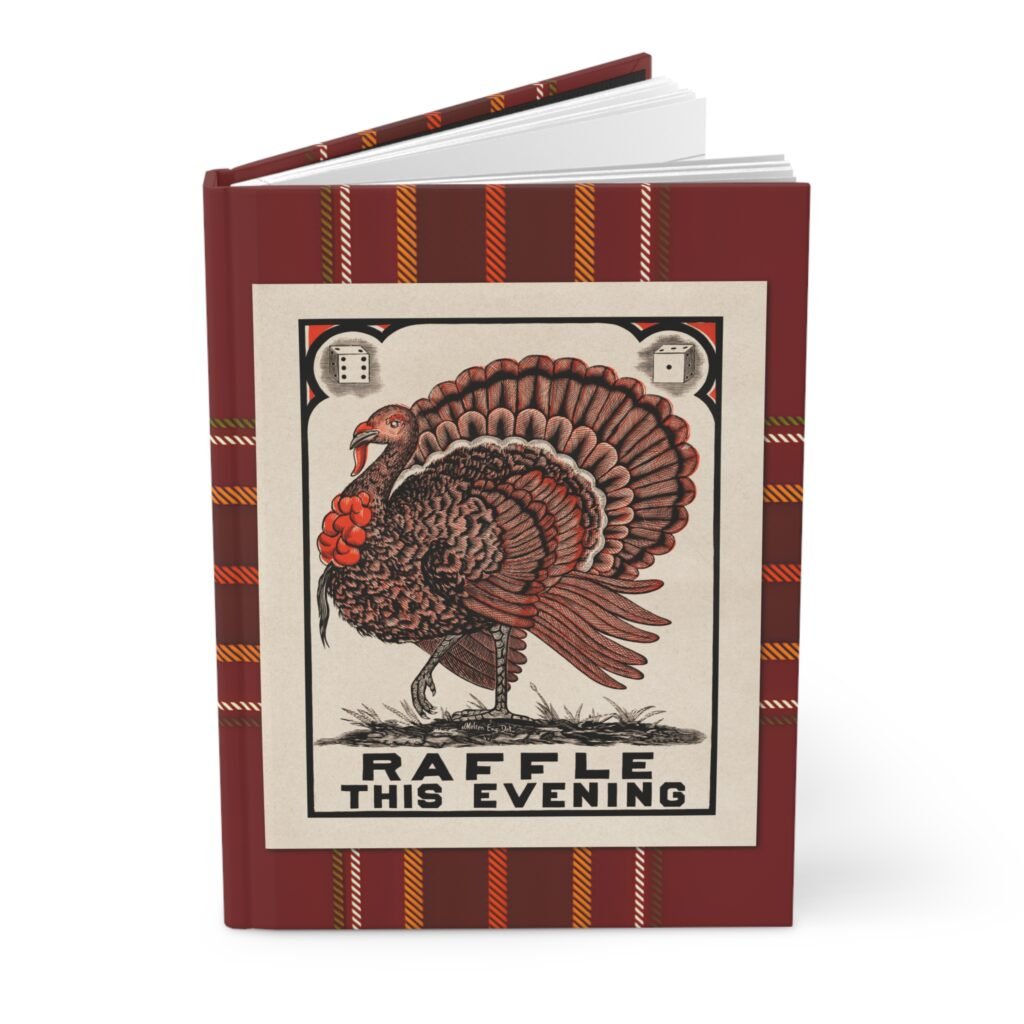
For those interested in the material culture of nineteenth-century printing and historic illustration, our research and archival reproductions are compiled within the Vintage Turkey Journal & Thanksgiving Recipe Book.
References & Primary Sources
- Library of Congress, Prints and Photographs Division. Popular Graphic Arts Collection. Washington, D.C. (Holding institution for the original J. Molten Raffle this Evening broadside, What Cheer Show Printing House, Providence).
- Marston, R. B. The History of Chromolithography in America. Boston: L. Prang & Co. Archives, 1895.
- Last, Jay T. The Color Explosion: Nineteenth-Century American Lithography. Santa Ana, CA: Fine Arts Press, 2005.
- Reilly, Bernard F. American Political Prints, 1766–1876: A Catalog of the Collections in the Library of Congress. Boston: G.K. Hall, 1991.