Botanical School Chart Journal — Harper & Brothers 1890 Marcius Willson Educational Charts
Botanical School Chart Journal — Harper & Brothers 1890 Marcius Willson Educational Charts
Couldn't load pickup availability
Shipping & Returns
Shipping & Returns
• Production Time: All journals are printed on demand and shipped from Maryland, USA, within 1–3 business days.
• Estimated Delivery: 3–5 business days for the US, 7–12 business days for Europe, and 10–20 business days for the rest of the world.
• Free Shipping: Enjoy free shipping on orders over $75 to the US, and over $120 worldwide! (Standard shipping starts at $5.29 for the US and $13.99 worldwide).
• Damages & Returns: As each item is made to order, we do not accept returns for change of mind. However, if your order arrives damaged or incorrect, please contact us within 14 days at hello@lebonjournal.com and we will resolve it immediately.
In 1890, Harper & Brothers published a series of large-format school charts by Marcius Willson and N.A. Calkins that transformed the way American children learned about the natural world — part of the object-lesson movement, the pedagogical revolution that held that children learn best from direct observation of real things. The front cover features Chart No. XXII — Economical Uses of Plants — a comprehensive chromolithographic survey of the plant kingdom’s economic importance, from medicinal plants and beverage crops (tea, coffee, cacao) to textile fibres (cotton, flax, hemp) and spices, each specimen labelled with its common and scientific name; the back cover features Chart No. XIX — Forms of Leaves, Stems, Roots, and Flowers — a masterwork of botanical morphology documenting the structural diversity of the plant kingdom with the pedagogical clarity that defined the object-lesson method, the two charts together wrapping the journal in a complete portrait of Victorian botanical education.
Product Details
- Format: Hardcover journal
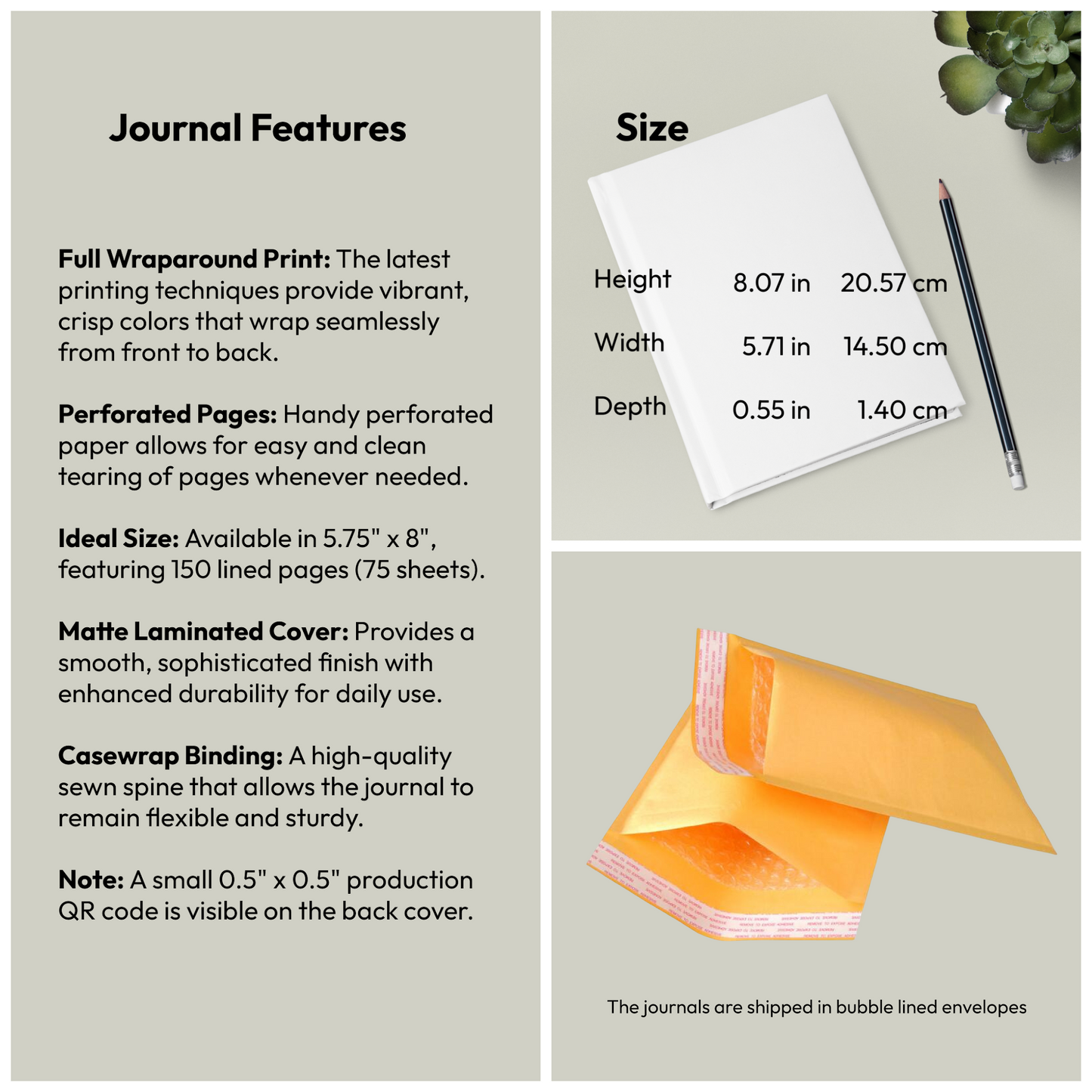
- Pages: 150 lined pages (75 sheets) with perforations for easy removal
- Binding: Casewrap sewn binding — flexible and lay-flat
- Dimensions: 5.75 × 8 inches
- Weight: 250 g
- Cover: Matte laminated full-wrap print
Perfect For
- Botanists, plant scientists, and nature study enthusiasts celebrating the Gilded Age tradition of object-lesson teaching
- Teachers and educators inspired by the pedagogical clarity of Victorian botanical education and 19th-century American school charts
- Homeschool families seeking a beautifully designed journal for nature study and botanical observation notes
- Vintage educational chart collectors and admirers of the Harper & Brothers 1890 school series
- Thoughtful gift seekers looking for a journal for botanists, teachers, and lovers of the history of science education
- Anyone who finds beauty in leaves and inspiration in the quiet precision of Victorian botanical illustration
EU Compliance
EU Compliance
Representative: HONSON VENTURES LIMITED, gpsr@honsonventures.com, 3 Gnaftis House flat 102, Limassol, Mesa Geitonia, 4003, CY.
Product information: Generic brand, 2-year warranty in EU and Northern Ireland as per Directive 1999/44/EC.
Care instructions: Use a soft, clean and dry cloth to gently brush any dust or dirt off from the center of book outwards.
Share