Learning by Looking: Marcius Willson, the Object-Lesson Method, and the Art of Victorian Botanical Education
In the autumn of 1890, a teacher in an American schoolroom pulled down a large printed chart from the wall and pointed to a cotton plant. The chart — one of a series published by Harper & Brothers, designed by the educator Marcius Willson and his collaborator N.A. Calkins — showed the cotton plant in full: its leaves, its bolls, its fibers, its relationship to the textile industry that clothed the industrializing world. The teacher did not ask the children to memorize a definition. She asked them to look.
This was the object-lesson method, and it was one of the most radical ideas in the history of education.
The Object-Lesson Revolution
The object-lesson method had its origins in the educational philosophy of Johann Heinrich Pestalozzi, the Swiss educator who argued in the early 19th century that children learn best not from abstract verbal instruction but from direct sensory experience of real things. Pestalozzi’s ideas were developed and systematized by his followers — most notably Friedrich Fröbel, the inventor of the kindergarten — and spread across Europe and America in the middle decades of the 19th century.
The core principle was simple: before you teach a child the word “leaf,” show them a leaf. Before you teach them the concept of “root,” let them hold a root. Before you teach them the economic importance of cotton, show them a cotton plant. The object — the real, tangible, observable thing — was the foundation of all genuine learning.
In practice, this meant that the object-lesson classroom was a very different place from the traditional schoolroom. Instead of rows of children reciting definitions from textbooks, the object-lesson classroom was organized around observation and discussion. The teacher presented objects — natural specimens, manufactured goods, models, pictures — and guided the children through a process of careful observation, description, and classification.
Marcius Willson and the Harper & Brothers Charts
Marcius Willson (1813–1905) was one of the most prolific and influential American educators of the 19th century. A schoolteacher, textbook author, and educational reformer, he produced a series of readers, geographies, and natural history texts that were used in American schools for decades. His collaboration with N.A. Calkins — another leading figure in the object-lesson movement — produced the Harper & Brothers school chart series that represents the high point of Victorian American educational design.
The charts were large-format chromolithographic prints, designed to be hung on the classroom wall and used as the basis for object-lesson discussions. Chromolithography — the color printing technique that had been perfected in the 1860s and 1870s — allowed the charts to be produced in vivid, accurate color at a cost that made them accessible to ordinary schools. The result was a series of teaching tools that were simultaneously scientifically accurate, pedagogically effective, and visually beautiful.
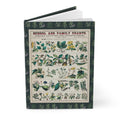
Chart No. XXII — Economical Uses of Plants — is a comprehensive survey of the plant kingdom’s economic importance. Medicinal plants, beverage crops, textile fibres, spices — each category is represented by carefully rendered specimens, labelled with their common and scientific names, arranged in a composition that is both a scientific reference and a visual celebration of the plant world’s extraordinary diversity and usefulness. The chart was designed to be used in conjunction with a discussion of the ways in which plants sustain human civilization — from the tea that fueled the British Empire to the cotton that drove the American economy to the medicinal plants that formed the basis of 19th-century pharmacology.
Chart No. XIX — Forms of Leaves, Stems, Roots, and Flowers — is a masterwork of botanical morphology. The structural diversity of the plant kingdom — the extraordinary variety of leaf shapes, stem types, root structures, and floral arrangements that evolution has produced — is documented with the precision of a scientific atlas and the clarity of a teaching tool. The chart was designed to give students the vocabulary they needed to describe and classify plants: to see, in the leaf they held in their hand, not just a leaf but a specific form — ovate, lanceolate, palmate, pinnate — that connected it to a broader system of botanical knowledge.
The Art of Victorian Educational Design
The Harper & Brothers charts are beautiful objects as well as effective teaching tools. The chromolithographic color — the rich greens of the leaves, the warm browns of the roots, the vivid reds and yellows of the flowers — gives the charts a visual quality that no black-and-white illustration could achieve. The compositions are carefully designed: each chart is organized to guide the eye through the material in a logical sequence, from the general to the particular, from the familiar to the unfamiliar.
This attention to visual quality was not accidental. The object-lesson educators believed that beauty was itself a form of education — that exposure to well-designed, visually compelling materials trained the eye and the mind simultaneously. A beautiful chart was not merely more pleasant to look at than an ugly one; it was more effective as a teaching tool, because it engaged the student’s attention and rewarded careful observation.
In this sense, the Harper & Brothers charts belong to a broader tradition of Victorian educational design that included the natural history illustrations of Lorenz Oken, the astronomical diagrams of Asa Smith, and the architectural plates of the Leseine brothers — a tradition that held that knowledge should be beautiful, that the visual and the intellectual were not separate but complementary, and that the best education was one that trained both the eye and the mind.
The Legacy of the Object-Lesson Method
The object-lesson method fell out of fashion in the early 20th century, replaced by more systematic approaches to curriculum design. But its core insight — that children learn best from direct observation and experience — has never been superseded. It lives on in the hands-on learning of progressive education, in the inquiry-based science curriculum, in the nature study movement that continues to inspire educators and parents who believe that the best classroom is the natural world itself.
The Harper & Brothers charts survive as documents of a moment when American education was genuinely ambitious — when educators believed that every child deserved access to beautiful, scientifically accurate, visually compelling teaching materials, and when publishers like Harper & Brothers were willing to invest in the chromolithographic technology that made that vision possible.
Our Botanical School Chart Journal carries Charts No. XXII and No. XIX from Marcius Willson’s 1890 Harper & Brothers series — the Economical Uses of Plants and the Forms of Leaves, Stems, Roots, and Flowers, preserved in a journal you can carry to every garden, every field, and every classroom.
References
- Calkins, N.A. Primary Object Lessons for Training the Senses and Developing the Faculties of Children. Harper & Brothers, 1861.
- Willson, Marcius. Harper’s School and Family Charts. Harper & Brothers, 1890.
- Rudolph, John L. How We Teach Science: What’s Changed, and Why It Matters. Harvard University Press, 2019.
- Kliebard, Herbert M. The Struggle for the American Curriculum, 1893–1958. Routledge, 2004.