Vesuvius Journal — Sir William Hamilton 1779 Campi Phlegraei Peter Fabris Aquatint
Vesuvius Journal — Sir William Hamilton 1779 Campi Phlegraei Peter Fabris Aquatint
Couldn't load pickup availability
Shipping & Returns
Shipping & Returns
• Production Time: All journals are printed on demand and shipped from Maryland, USA, within 1–3 business days.
• Estimated Delivery: 3–5 business days for the US, 7–12 business days for Europe, and 10–20 business days for the rest of the world.
• Free Shipping: Enjoy free shipping on orders over $75 to the US, and over $120 worldwide! (Standard shipping starts at $5.29 for the US and $13.99 worldwide).
• Damages & Returns: As each item is made to order, we do not accept returns for change of mind. However, if your order arrives damaged or incorrect, please contact us within 14 days at hello@lebonjournal.com and we will resolve it immediately.
In 1776, Sir William Hamilton — British diplomat, antiquarian, and the man who climbed Vesuvius sixty times — published Campi Phlegraei, his systematic documentation of the volcano rendered in aquatints by Peter Fabris with hand-applied watercolour and gouache: the front cover shows the 1779 eruption with serpentine lava flows tracing their descent along the slopes and the incandescent glow of molten rock against the nocturnal sky, while the back shows a companion plate documenting the vertical eruptive column — dark ash clouds contrasting with the luminous core, incandescent rock fragments following parabolic trajectories — together forming a complete portrait of Vesuvius at its most sublime, as observed by the diplomat who invented modern volcanology.
Product Details
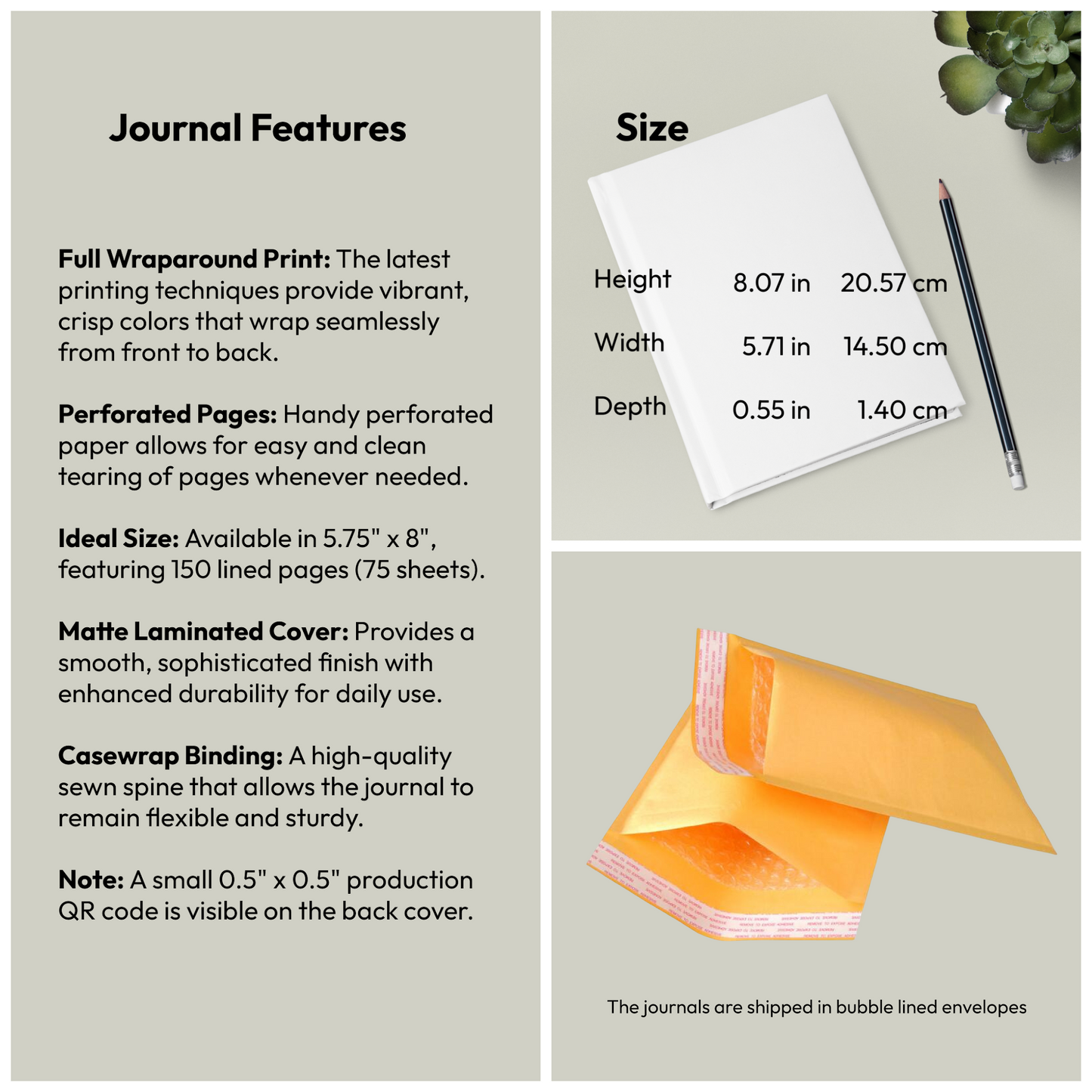
- Format: Hardcover journal with matte laminated full-wrap cover
- Pages: 150 lined pages (75 sheets) with perforations for easy removal
- Binding: Casewrap sewn binding — flexible and lay-flat
- Dimensions: 5.75 × 8 inches
- Weight: 250 g (0.55 lbs)
- Cover: Matte laminated full-wrap print
- Note: small production barcode (0.5" × 0.5") on back cover
Perfect For
- Geologists, volcanologists, and earth science enthusiasts
- Natural history collectors and Enlightenment science admirers
- Grand Tour history lovers and Italian culture aficionados
- Gift for anyone captivated by the history of earth science and scientific illustration
- Students and educators of geology, volcanology, and 18th-century natural philosophy
- Museum lovers and collectors of historic scientific documentation
EU Compliance
EU Compliance
Representative: HONSON VENTURES LIMITED, gpsr@honsonventures.com, 3 Gnaftis House flat 102, Limassol, Mesa Geitonia, 4003, CY.
Product information: Generic brand, 2-year warranty in EU and Northern Ireland as per Directive 1999/44/EC.
Care instructions: Use a soft, clean and dry cloth to gently brush any dust or dirt off from the center of book outwards.
Share