Sir William Hamilton and the Grand Tour: The Diplomat Who Invented Volcanology
In 1764, Sir William Hamilton arrived in Naples as British Envoy Extraordinary to the Kingdom of the Two Sicilies. He was thirty-four years old, a former army officer and Member of Parliament, and he had come to Naples because it was one of the great postings of 18th-century diplomacy — a city of 300,000 people, the third largest in Europe, the capital of a kingdom that controlled southern Italy and Sicily, and the essential destination of the Grand Tour that every educated Englishman of means was expected to complete. He would stay for thirty-six years. And in that time, he would transform the study of volcanoes from an antiquarian curiosity into the foundations of modern earth science.
The Grand Tour and the Culture of Observation
The Grand Tour — the extended educational journey through France, Switzerland, and Italy that became the defining rite of passage for the British aristocracy and gentry in the 18th century — was, among other things, a training in observation. The young men who made the Tour were expected to look carefully at ancient ruins, Renaissance paintings, and Alpine landscapes, and to record what they saw in letters, journals, and sketchbooks that would serve as the foundation of their cultural education. The Tour produced a generation of collectors, connoisseurs, and amateur naturalists who brought back to Britain not merely souvenirs but habits of systematic attention that shaped British intellectual life for a century.
Hamilton was the Grand Tour's most distinguished scientific product. His thirty-six years in Naples gave him the opportunity to apply the Tour's culture of careful observation to a subject that no previous observer had studied with comparable rigor: the volcanic landscape of the Campania region, dominated by Vesuvius to the east of the city and the Campi Phlegraei — the Burning Fields — to the west. Where earlier visitors had admired Vesuvius as a picturesque spectacle or a classical reference, Hamilton studied it as a natural philosopher: systematically, repeatedly, and with the intention of understanding rather than merely appreciating.
Thirty Years on the Volcano
Hamilton climbed Vesuvius more than sixty times during his years in Naples. He observed eruptions from the crater rim, collected lava samples, measured the temperature of fumaroles, and documented the sequence of eruptive events with a precision that no previous observer had achieved. He corresponded with the Royal Society in London — of which he was a Fellow — sending regular reports of his observations that were published in the Philosophical Transactions and read by the leading natural philosophers of the age.
His first major publication, Observations on Mount Vesuvius, Mount Etna, and Other Volcanoes (1772), established his reputation as the leading authority on volcanic phenomena in Europe. But it was his second work, Campi Phlegraei: Observations on the Volcanoes of the Two Sicilies (1776, with a supplement in 1779), that secured his place in the history of science. Illustrated by the Neapolitan artist Peter Fabris using the revolutionary aquatint technique finished with hand-applied watercolor and gouache, Campi Phlegraei was not merely a scientific report but a work of art — one of the most beautiful science books ever produced, and a founding document of modern volcanology.
Peter Fabris and the Art of Scientific Illustration
The visual achievement of Campi Phlegraei was inseparable from the collaboration between Hamilton and Peter Fabris (active 1756–1784), the British-born artist who had settled in Naples and whose mastery of the aquatint technique made possible a kind of scientific illustration that no previous reproductive process could achieve. Aquatint — a variant of etching that used a resin ground to produce tonal gradations rather than lines — was ideally suited to the representation of volcanic phenomena: the luminous glow of lava flows, the gradations of ash clouds, the contrast between incandescent rock and nocturnal sky required exactly the kind of tonal subtlety that aquatint could provide and that conventional line engraving could not.
Fabris worked directly from Hamilton's observations, accompanying him on his climbs of Vesuvius and sketching the eruptive phenomena as they occurred. His plates combined scientific accuracy with aesthetic ambition: every element — the direction of lava flows, the height of eruptive columns, the distribution of volcanic bombs — was documented with the precision of a natural philosopher, while the composition and tonal range of each plate reflected the 18th-century aesthetic of the sublime, that philosophical concept of awe and wonder before the grandeur of natural phenomena that Edmund Burke had theorized in 1757 and that the volcanic landscape of Campania exemplified with unrivalled force.
Hamilton and the Birth of Volcanology
Hamilton's scientific contribution to the study of volcanoes was substantial and lasting. He was among the first observers to propose that volcanic eruptions were not isolated catastrophic events but episodes in a continuous geological process — that the landscape of Campania had been shaped over millennia by repeated cycles of eruption, deposition, and erosion. He documented the relationship between seismic activity and volcanic eruptions, observed the role of water in triggering explosive eruptions, and proposed a classification of eruptive types that anticipated the modern typology of volcanic activity.
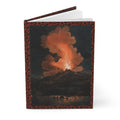
His observation of the 1779 eruption of Vesuvius — documented in the supplement to Campi Phlegraei and illustrated by Fabris in the plates that appear on the cover of this journal — was particularly significant. The eruption produced a spectacular lava fountain and extensive lava flows that Hamilton documented with exceptional precision, recording the sequence of events, the direction and velocity of the flows, and the atmospheric effects of the eruptive column with a completeness that made his account the standard reference for the 1779 eruption for more than a century.
The Collector and the Connoisseur
Hamilton was not only a volcanologist. He was also one of the greatest collectors of his age — his collection of Greek and Roman antiquities, assembled during his years in Naples, was purchased by the British Museum in 1772 and formed the nucleus of what is now one of the world's great collections of classical art. His collection of ancient vases — published in four magnificent volumes between 1766 and 1776 — was a primary source for the neoclassical designs of Josiah Wedgwood, whose Etruscan ware brought the aesthetic of ancient Greece to the tables of Georgian England.
This combination of scientific rigor and aesthetic sensibility was characteristic of the Enlightenment at its best — and it was what made Campi Phlegraei something more than a scientific report. Hamilton understood that the volcanic landscape of Campania was simultaneously a subject of scientific investigation and an object of aesthetic experience, and he commissioned from Fabris a work that honored both dimensions: a book that was as beautiful as it was accurate, and as accurate as it was beautiful.

If the Enlightenment wonder of Hamilton and Fabris inspires you, our Vesuvius Journal — Hamilton 1779 Campi Phlegraei Volcanology brings two of Fabris's most celebrated aquatints to the cover of a hardcover journal.
References
- Jenkins, I. & Sloan, K. Vases and Volcanoes: Sir William Hamilton and His Collection. British Museum Press, 1996.
- Hamilton, W. Campi Phlegraei: Observations on the Volcanoes of the Two Sicilies. Naples, 1776–1779.
- Fothergill, B. Sir William Hamilton: Envoy Extraordinary. Faber & Faber, 1969.
- Sigurdsson, H. Melting the Earth: The History of Ideas on Volcanic Eruptions. Oxford University Press, 1999.
- Burke, E. A Philosophical Enquiry into the Origin of Our Ideas of the Sublime and Beautiful. London, 1757.