Botanical Iris Hardcover Journal — Weinmann & Valentini 18th Century Iris latifolia English Iris Phytanthoza Iconographia
Botanical Iris Hardcover Journal — Weinmann & Valentini 18th Century Iris latifolia English Iris Phytanthoza Iconographia
Couldn't load pickup availability
Shipping & Returns
Shipping & Returns
• Production Time: All journals are printed on demand and shipped from Maryland, USA, within 1–3 business days.
• Estimated Delivery: 3–5 business days for the US, 7–12 business days for Europe, and 10–20 business days for the rest of the world.
• Free Shipping: Enjoy free shipping on orders over $75 to the US, and over $120 worldwide! (Standard shipping starts at $5.29 for the US and $13.99 worldwide).
• Damages & Returns: As each item is made to order, we do not accept returns for change of mind. However, if your order arrives damaged or incorrect, please contact us within 14 days at hello@lebonjournal.com and we will resolve it immediately.
Johann Wilhelm Weinmann’s Phytanthoza Iconographia (1737–1745) was one of the most ambitious botanical publications of the 18th century — eight folio volumes documenting over 1,000 plant species with hand-coloured copperplate engravings of extraordinary precision and beauty. The front cover presents Weinmann’s TAB CCV engraving of Iris latifolia — the English Iris, native to the Pyrenees and widely cultivated across 18th-century European gardens — with the violet-blue petals, yellow falls, and archaic Latin botanical nomenclature that characterise Weinmann’s meticulous documentation style; the back cover presents Michael Bernhard Valentini’s hand-coloured iris engraving from Viridarium Reformatum (1719), documenting Iris angustifolia and Iris latifolia varieties in the traditional Florilegium style inherited from the great 17th-century florilegia of Besler and de Bry — two of the 18th century’s most distinguished botanical publications, separated by 18 years and united by a shared commitment to scientific precision and artistic beauty.
Product Details
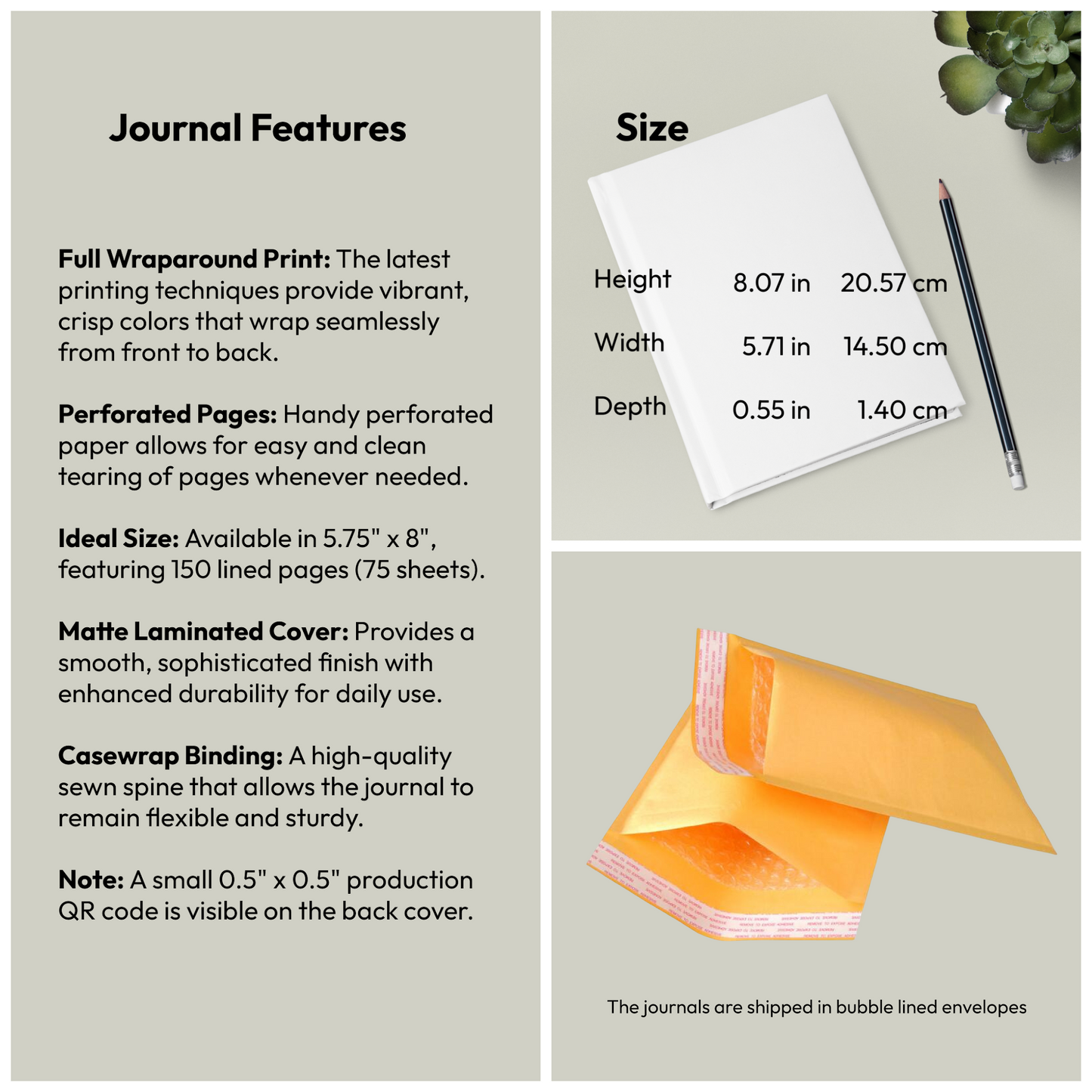
- Format: Hardcover journal
- Pages: 150 lined pages (75 sheets) with perforations for easy removal
- Binding: Casewrap sewn binding — flexible and lay-flat
- Dimensions: 5.75 × 8 inches
- Weight: 250 g
- Cover: Matte laminated full-wrap print
Perfect For
- Botanists, iris enthusiasts, and perennial gardeners
- Collectors of 18th-century botanical art and copperplate engraving
- Students and researchers of the history of botanical illustration
- Gift for anyone captivated by the beauty and precision of the golden age of natural history
- Nature journalers and garden planners drawn to the Florilegium tradition
- Admirers of Weinmann, Valentini, and the great botanical publications of the Enlightenment era
EU Compliance
EU Compliance
Representative: HONSON VENTURES LIMITED, gpsr@honsonventures.com, 3 Gnaftis House flat 102, Limassol, Mesa Geitonia, 4003, CY.
Product information: Generic brand, 2-year warranty in EU and Northern Ireland as per Directive 1999/44/EC.
Care instructions: Use a soft, clean and dry cloth to gently brush any dust or dirt off from the center of book outwards.
Share