Victorian Earth Science: Geology, Palaeontology, and the Mapping of Deep Time
In the first decades of the 19th century, the Earth acquired a history. Before 1800, the age of the planet was a matter of theological calculation rather than scientific investigation: Archbishop Ussher's famous chronology of 1650, which dated the creation to 4004 BC, remained the reference point for educated Europeans who had not yet encountered the evidence that the rocks themselves were beginning to provide. By 1900, that evidence had accumulated into one of the most dramatic intellectual revolutions in the history of science: the discovery of deep time — the recognition that the Earth was not thousands but hundreds of millions of years old, and that its surface had been shaped by processes operating over timescales that dwarfed the entire span of human history.

The Founding of Geology
The intellectual foundations of modern geology were laid in the late 18th century by James Hutton (1726–1797), the Edinburgh physician and farmer whose Theory of the Earth (1788) proposed that the geological features of the Earth's surface — its mountains, valleys, river systems, and rock formations — were the product of processes still operating in the present: erosion, deposition, volcanic activity, and the slow uplift of the land. Hutton's principle of uniformitarianism — the idea that the present is the key to the past, that the same forces that shape the Earth today have always shaped it — was the conceptual foundation on which all subsequent geology was built.
The implications of uniformitarianism for the age of the Earth were staggering. If the valleys of Scotland had been carved by rivers operating at their present rate, and if the sedimentary rocks of the cliffs had been deposited by seas advancing and retreating at their present pace, then the time required to produce the observed features was not thousands but millions of years. Hutton himself, contemplating the unconformity at Siccar Point on the Scottish coast — where ancient tilted rocks were overlain by younger horizontal strata, separated by an erosional surface that represented an unimaginable span of time — wrote that he could find "no vestige of a beginning, no prospect of an end."
The Naming of the Eras
The great achievement of Victorian geology was the systematic mapping and naming of the geological record — the identification and correlation of rock formations across continents, and the establishment of the stratigraphic column that organized Earth's history into named periods and eras. The work was done by a generation of geologists whose names are now attached to the periods they defined: Adam Sedgwick and Roderick Murchison, who named the Cambrian and Silurian; Murchison again, with the Devonian and Permian; Friedrich August von Alberti, who named the Triassic; and John Phillips, who in 1841 proposed the three great eras — Palaeozoic, Mesozoic, and Cainozoic — that organized the entire fossil record into a coherent narrative of life's development on Earth.
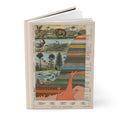
These are precisely the divisions that appear in the Vincent Brooks, Day & Son geology and palaeontology chart of c. 1880: the Palaeozoic or Primary, the age of arthropods, amphibians, and fishes; the Mesozoic or Secondary, the age of reptiles; and the Cainozoic or Tertiary, the age of mammals. The chart is a document of Victorian geology at the height of its achievement — a moment when the broad outlines of Earth's history had been established, the major fossil groups identified and named, and the story of life on Earth could be told, for the first time, as a coherent narrative from the first marine invertebrates to the mammals of the present day.
The Discovery of the Dinosaurs
No aspect of Victorian palaeontology captured the public imagination more powerfully than the discovery of the dinosaurs. The first scientific descriptions of dinosaur remains were published in the 1820s — William Buckland's account of Megalosaurus in 1824, Gideon Mantell's description of Iguanodon in 1825 — and the recognition that these were the remains of a distinct group of giant reptiles, unlike anything living today, transformed the public understanding of the prehistoric world. Richard Owen, who coined the term "Dinosauria" in 1842, commissioned the life-size reconstructions of dinosaurs that were installed in the grounds of the Crystal Palace after the Great Exhibition of 1851 — the first attempt to give the public a visual experience of the prehistoric world, and a landmark in the history of science communication.
The pterosaurs and plesiosaurs that appear in the Mesozoic section of the Vincent Brooks chart — the flying reptiles and the long-necked marine predators that shared the world of the dinosaurs — were among the most dramatic discoveries of Victorian palaeontology, and their inclusion in educational charts of this kind reflects the extraordinary public interest in prehistoric life that characterized the Victorian period. The chart was not merely a scientific reference: it was a window onto a world that had existed before human memory, a world stranger and more various than any mythology had imagined.
Mount Etna and the Science of Volcanoes
Alongside the mapping of geological time, Victorian earth science made equally dramatic advances in the understanding of volcanic processes. Mount Etna — the great stratovolcano of Sicily, one of the most active volcanoes in the world and a UNESCO World Heritage site — had been a subject of scientific investigation since the 18th century, when the Irish-born geologist William Hamilton (1730–1803) made his celebrated observations of Vesuvius and published his Campi Phlegraei (1776–1779), one of the most beautiful scientific books of the Enlightenment.
By the late 19th century, the internal structure of volcanoes like Etna was being mapped with increasing precision. The imaginary cross-section that appears on the back cover of the geology journal — showing the central magma conduit and secondary fissures penetrating layers of trachytic rock and tertiary stratum, the igneous rocks, granites, porphyries, and basalts at the base, the underground cavities filled with vapor, and the town of Nicolosi on the flank at sea level — represents the state of volcanological knowledge in the early 20th century: a synthesis of field observation, chemical analysis, and geological reasoning that transformed the volcano from a mythological phenomenon into a comprehensible geological structure.
The Art of Scientific Illustration
The Vincent Brooks, Day & Son geology chart of c. 1880 belongs to a tradition of Victorian scientific illustration that combined rigorous accuracy with genuine artistic ambition. The great publishing houses of Victorian London — among them Vincent Brooks, Day & Son, who specialized in chromolithographic printing of the highest quality — produced educational charts, natural history illustrations, and scientific diagrams that were designed to be displayed in schools, lecture halls, and private studies, and that were valued as much for their visual quality as for their scientific content.
The geology chart achieves something remarkable: it makes visible the invisible. Deep time — the hundreds of millions of years of Earth's history that no human eye has witnessed — is compressed into a single image, organized from bottom to top in the order in which the rocks were laid down, populated with the creatures that lived in each era, and annotated with the names that Victorian science had given to the formations and the fossils. It is simultaneously a scientific reference, an educational tool, and a work of art — a document of a moment when science and visual culture were in productive dialogue, and when the mapping of deep time was one of the great intellectual adventures of the age.

If Victorian earth science inspires you, our Geology Journal — Victorian 1880 Palaeontology Mount Etna brings the geology and palaeontology chart and the Mount Etna cross-section to the cover of a hardcover journal.
References
- Rudwick, M. J. S. Bursting the Limits of Time: The Reconstruction of Geohistory in the Age of Revolution. University of Chicago Press, 2005.
- Secord, J. A. Victorian Sensation: The Extraordinary Publication, Reception, and Secret Authorship of Vestiges of the Natural History of Creation. University of Chicago Press, 2000.
- Desmond, A. The Hot-Blooded Dinosaurs: A Revolution in Palaeontology. Blond & Briggs, 1975.
- Winchester, S. The Map That Changed the World: William Smith and the Birth of Modern Geology. HarperCollins, 2001.
- Chester, D. K. et al. Mount Etna: The Anatomy of a Volcano. Chapman and Hall, 1985.