Vermeer and the View of Delft: The Most Beautiful Painting in the World
In the summer of 1902, the French novelist Marcel Proust travelled to The Hague to see a single painting. He had seen a reproduction of it years before and had never forgotten it; now, standing before the original in the Mauritshuis museum, he experienced what he would later describe as one of the most overwhelming aesthetic encounters of his life. The painting was Johannes Vermeer's View of Delft, painted around 1660–1661, and Proust's response to it — which he would immortalize in In Search of Lost Time, in the famous episode of the "little patch of yellow wall" — is one of the most celebrated accounts of the experience of looking at a painting ever written. "I realized," Proust wrote, "that I had seen, in the View of Delft, the most beautiful painting in the world."

Vermeer and Delft
Johannes Vermeer was born in Delft in 1632 and died there in 1675, never leaving the city for any extended period in the forty-three years of his life. Delft was, in the mid-17th century, one of the most prosperous cities in the Dutch Republic — a center of the delftware pottery industry, a garrison town, the seat of the House of Orange, and a city of considerable cultural ambition. It was also, by the standards of the Dutch Golden Age, a city of moderate size: large enough to sustain a community of painters, small enough for those painters to know each other and to share a common visual culture shaped by the particular quality of its light, its canals, and its architecture.
Vermeer spent his entire career in Delft, working slowly and with extraordinary care, producing perhaps thirty-four to thirty-six paintings in total — a tiny output by the standards of his contemporaries, but one of such consistent quality that it has secured his reputation as one of the supreme masters of European painting. He was a member of the Guild of Saint Luke, the painters' guild of Delft, and served twice as its headman; he was also an art dealer, a profession that gave him access to the work of other painters and that may have influenced his own practice. He died in debt, leaving his wife and eleven children in financial difficulty — a reminder that the serene domestic interiors for which he is most celebrated were painted against a background of considerable personal and economic pressure.
The Only Cityscape
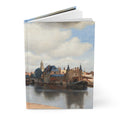
The View of Delft is unique in Vermeer's surviving oeuvre: it is the only cityscape he is known to have painted, and one of only two outdoor scenes (the other being The Little Street, also in the Mauritshuis). The painting shows the city from the south, seen from across the harbor known as the Kolk, with the River Schie in the foreground and the walled city rising behind it. The composition is organized in three horizontal bands: the water, which occupies the lower third of the canvas; the city, with its gates, towers, and rooflines; and the sky, which fills the upper half of the painting with a complex arrangement of clouds that is one of the most admired passages in the entire work.
The identifiable landmarks are precisely rendered: the Rotterdam Gate with its twin towers on the right, the Schiedam Gate to the left, and — most prominently — the tower of the Nieuwe Kerk, the New Church, which contains the tomb of William of Orange, the founder of the Dutch Republic. The Nieuwe Kerk tower is illuminated by a shaft of sunlight that breaks through the clouds, creating a dramatic contrast with the shadowed foreground and giving the composition its characteristic sense of suspended, luminous stillness. In the foreground, small figures — women in dark clothing, a man in a hat — wait on the quayside, perhaps for the horse-drawn passenger barge that connected Delft to the other cities of Holland.
The Mystery of the Light
The View of Delft has fascinated art historians and scientists for generations, not only for its beauty but for the technical means by which that beauty is achieved. The painting's surface is extraordinarily complex: Vermeer mixed sand and other granular materials into his pigments to create the sparkling, textured appearance of the water and the brickwork of the city walls; he applied paint in small, precise dabs that, at close range, resolve into an almost pointillist texture, but that at the proper viewing distance coalesce into a seamless, atmospheric whole. The sky is painted with a subtlety of gradation — from the warm light at the horizon to the cooler tones of the upper clouds — that has led some scholars to suggest that Vermeer used a camera obscura as an aid to composition, projecting the scene onto a surface and tracing its outlines before painting.
The question of the camera obscura — a device that projects an image of the external world through a lens onto a screen or surface — has been one of the most debated topics in Vermeer scholarship for decades. The art historian Philip Steadman argued in his 2001 book Vermeer's Camera that the internal evidence of Vermeer's paintings — the precise perspective, the optical distortions, the characteristic "circles of confusion" that appear in the highlights of his surfaces — is consistent with the use of a camera obscura. Others have disputed this interpretation, arguing that Vermeer's effects can be explained by his extraordinary skill as a painter without recourse to optical aids. The debate remains unresolved, and perhaps unresolvable — but it is a measure of the painting's uncanny quality that it continues to prompt such questions.
Proust and the Little Patch of Yellow Wall
The most famous response to the View of Delft in the history of literature is the episode in Marcel Proust's In Search of Lost Time in which the novelist Bergotte — a character widely understood to be a self-portrait of Proust — visits an exhibition where the painting is on display and is struck, with sudden and overwhelming force, by "a little patch of yellow wall" that he had not noticed before: a passage of paint so perfectly realized, so luminous and precise, that it seems to him to contain the secret of all great art. Bergotte dies in front of the painting, his last thought a recognition that he should have written with the same care and precision that Vermeer brought to that small patch of yellow.
Proust's episode has made the "little patch of yellow wall" one of the most discussed passages in the View of Delft — though art historians have debated which part of the painting Proust was referring to, with candidates including the sunlit wall of the Rotterdam Gate and various other passages of warm, luminous paint. Whatever its precise location, the episode captures something essential about the painting's effect: the way it rewards close attention, the way its surface reveals more the longer one looks, and the way its combination of topographical precision and atmospheric poetry creates an experience that is simultaneously documentary and transcendent.
The Mauritshuis and the Painting's Legacy
The View of Delft has been in the collection of the Mauritshuis in The Hague since 1822, when it was acquired at auction for the Royal Cabinet of Paintings. The Mauritshuis — a 17th-century palace built for Johan Maurits van Nassau-Siegen, the governor of Dutch Brazil — is one of the finest small museums in the world, housing a collection of Dutch and Flemish Golden Age paintings that includes, alongside the View of Delft, Vermeer's Girl with a Pearl Earring, Rembrandt's The Anatomy Lesson of Dr. Nicolaes Tulp, and dozens of other masterpieces. The painting has left the Mauritshuis only rarely — most notably for the great Vermeer retrospective at the Rijksmuseum in Amsterdam in 2023, the largest exhibition of Vermeer's work ever assembled — and its presence in The Hague has made the city a place of pilgrimage for lovers of Dutch painting from around the world.
If Vermeer's vision of Delft inspires you, our View of Delft Journal — Vermeer 1660 Dutch Golden Age brings the painting to the cover of a hardcover journal.
References
- Steadman, P. Vermeer's Camera: Uncovering the Truth Behind the Masterpieces. Oxford University Press, 2001.
- Wheelock, A. K. Vermeer and the Art of Painting. Yale University Press, 1995.
- Proust, M. In Search of Lost Time, Vol. 5: The Captive. Trans. C. K. Scott Moncrieff & Terence Kilmartin. Vintage, 1996.
- Liedtke, W. Vermeer: The Complete Paintings. Ludion, 2008.
- Montias, J. M. Vermeer and His Milieu: A Web of Social History. Princeton University Press, 1989.