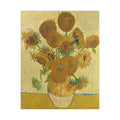
The Sunflowers of Arlés: Van Gogh, the Yellow House, and the Four Canvases of Summer 1888
In the summer of 1888, Vincent van Gogh was alone in Arlés, in a rented house he had painted yellow, waiting for Paul Gauguin. He had invited his friend to come and live with him in Provence, to found together the artists' community he had been dreaming of since his time in Paris — a studio of the south, where painters could work in the clear Mediterranean light, away from the grey skies and commercial pressures of the north. Gauguin had agreed, reluctantly, and Van Gogh was preparing the Yellow House for his arrival with the energy and anxiety of a man who understood that everything depended on this. To decorate the room he had prepared for his friend, he painted sunflowers — a series of still lifes in the yellows and golds and turquoise blues that the Provençal summer had given him, conceived as a symphony of colour and a gesture of welcome. Four of those canvases survive as the most celebrated flower paintings in the history of art.

The Yellow House and the Dream of the South
Van Gogh had arrived in Arlés in February 1888, fleeing the exhaustion of Paris and the influence of Impressionism, which he felt had taken him as far as it could. He was thirty-four years old, in poor health, and possessed by a vision of painting that he could not yet fully realise — a painting of pure colour, of emotional intensity, of the kind of expressive force that he associated with the Japanese woodblock prints he had been collecting and studying for years. Provence, with its extraordinary light and its vivid landscape, seemed to offer the conditions he needed.
He rented four rooms in a building on the Place Lamartine — the Yellow House, as he called it, after the colour he painted its exterior — and set about furnishing and decorating it with the care of a man creating not merely a home but a manifesto. He wrote to his brother Theo in Paris almost daily, describing his plans, his paintings, his hopes for the community of artists he wanted to establish. And he painted with extraordinary productivity: in the nine months he spent in Arlés before his breakdown in December 1888, he produced more than two hundred paintings and one hundred drawings.
The Sunflower Series: A Symphony of Yellow
The sunflower paintings were conceived specifically for the Yellow House — to hang in the room Van Gogh had prepared for Gauguin, as a decoration that would express, through colour alone, the warmth of his welcome and the intensity of his friendship. He wrote to Theo in August 1888: "I am now on the fourth picture of sunflowers. This fourth one is a bunch of 14 flowers against a yellow background, like a still life of quinces and lemons that I did some time ago. Only as it's much bigger, it gives a rather singular effect."
The series he produced that summer — working fast, in the heat of the Provençal August, with the urgency of a man who knew that Gauguin's arrival was imminent — represents one of the most concentrated and deliberate artistic achievements of his career. Each canvas was a study in the expressive possibilities of yellow: the warm yellow of the background in the National Gallery canvas, the cooler turquoise that sets off the flowers in the Munich and Philadelphia versions, the light ground of the private collection canvas that gives the three sunflowers their particular luminosity. Van Gogh was not painting sunflowers as they appeared; he was painting yellow as it felt.
The Four Canvases
Fifteen Sunflowers (National Gallery, London, August 1888) is the most iconic of the series — the canvas that Van Gogh himself considered his finest floral work, and that has become, in the century and more since his death, the most reproduced flower painting in the history of art. Fifteen sunflowers in various stages of bloom — from tight buds to full open faces to the drooping heads of flowers past their peak — are arranged in a terracotta vase against a warm yellow background. The composition is at once simple and extraordinarily complex: the flowers are not arranged symmetrically, but with the kind of natural asymmetry that suggests they have been gathered from a garden rather than composed in a studio. Van Gogh painted it on linen, at 92.1 × 73 cm, in oil — and signed it, unusually, on the body of the vase.
Three Sunflowers in a Vase (Private Collection, USA, August 1888) is the first canvas of the series — the one Van Gogh described to Theo as "3 large flowers in a green vase, light background." It is the most intimate of the four: three sunflowers, two fully open and one in bud, in a green vase against a light ground that gives the composition a freshness and simplicity that the later, more elaborate canvases do not quite replicate. It is rarely seen in public — held in a private collection in the United States — which gives it a particular quality of rarity and mystery among the works of the series.
Twelve Sunflowers (Neue Pinakothek, Munich, August 1888) is the third version of the series, and the one in which Van Gogh's handling of the turquoise background is most assured. Twelve sunflowers in different stages of their life cycle — from closed buds to full bloom to the brown, seed-heavy heads of flowers at the end of their season — are arranged in a yellow vase against the vibrant turquoise that Van Gogh had been exploring as a complement to yellow since his arrival in Provence. He signed this canvas simply "Vincent" on the body of the vase — the signature he used when he felt a work was complete and successful. Oil on canvas, 91 × 72 cm.
Twelve Sunflowers (Philadelphia Museum of Art, January 1889) is one of the rare instances in Van Gogh's career where he deliberately replicated his own work — a near-identical repetition of the Munich canvas, painted in January 1889, after his breakdown and his voluntary admission to the hospital in Arlés. The act of replication was itself significant: Van Gogh returned to the sunflowers at a moment of crisis, as if the series represented something stable and achieved in a life that had become unstable and uncertain. The Philadelphia canvas shares the turquoise background and the twelve flowers in various stages of bloom; it is, in its own way, a meditation on the original as much as a copy of it.
Gauguin's Arrival and the End of the Dream
Gauguin arrived at the Yellow House on 23 October 1888 — and the collaboration that Van Gogh had been dreaming of lasted exactly nine weeks. The two men worked together, argued about painting and about everything else, and pushed each other toward a crisis that ended, on the night of 23 December 1888, with Van Gogh cutting off part of his own ear and presenting it to a woman at a local brothel. Gauguin left the next morning and never returned. Van Gogh was admitted to the hospital in Arlés, and the dream of the Yellow House was over.
The sunflowers remained — hanging in the room that Gauguin had occupied, witnesses to the nine weeks of the most intense and productive artistic collaboration of the Post-Impressionist era. Gauguin painted Van Gogh painting sunflowers — a portrait that Van Gogh himself described as "certainly me, but me gone mad" — and the image of the painter with his sunflowers became, in the years after his death, one of the defining images of the Romantic myth of the artist: the man who burns with a flame too bright for the world to contain.
A Puzzle for Art Lovers

Our Van Gogh Sunflowers Puzzle Collection brings all four canvases together in a single product — each piece count revealing a different masterwork from the Arlés series. The 110-piece puzzle features the National Gallery's Fifteen Sunflowers; the 252-piece, the private collection's Three Sunflowers in a Vase; the 520-piece, the Neue Pinakothek's Twelve Sunflowers; and the 1014-piece, the Philadelphia Museum of Art's turquoise version. Printed on 100% chipboard with a glossy laminate finish, each completed puzzle is a display piece worthy of the walls of a museum-inspired home.
In August 1888, Van Gogh wrote to Theo: "I am working with the enthusiasm of a Marseillais eating bouillabaisse, which won't surprise you when it's a question of painting sunflowers." Some enthusiasms are worth assembling, piece by piece.
References & Further Reading
- Van Gogh, Vincent. The Letters of Vincent van Gogh. Ed. Ronald de Leeuw. Penguin, 1997. [The primary source: Van Gogh's own account of the sunflower series, the Yellow House, and the Gauguin collaboration, in his letters to Theo.]
- Naifeh, Steven & Smith, Gregory White. Van Gogh: The Life. Random House, 2011. [The most comprehensive modern biography, covering the Arlés period in exceptional detail.]
- Gayford, Martin. The Yellow House: Van Gogh, Gauguin, and Nine Turbulent Weeks in Arles. Fig Tree, 2006. [The definitive account of the nine weeks of the Van Gogh-Gauguin collaboration, and the context in which the sunflower series was created.]
- Dorn, Roland et al. Van Gogh: Fields. Hatje Cantz, 2002. [On Van Gogh's relationship with the Provençal landscape and the natural world, the context of the sunflower series.]
- Homburg, Cornelia. Vincent van Gogh and the Painters of the Petit Boulevard. Rizzoli, 2001. [On Van Gogh's relationship with Post-Impressionism and his contemporaries, the artistic context of the Arlés period.]
- National Gallery, London. Van Gogh: Sunflowers. National Gallery Publications, 2019. [The catalogue of the National Gallery's exhibition on the sunflower series, with technical analysis of the London canvas.]
- Pickvance, Ronald. Van Gogh in Arles. Metropolitan Museum of Art, 1984. [The catalogue of the Metropolitan Museum's landmark exhibition, the most detailed scholarly account of the Arlés period.]