The Useful Plants of the New World: William Jowit Titford and the Hortus Botanicus Americanus
I. The Garden as Encyclopedia
In the history of botany, the hortus botanicus — the botanical garden, and by extension the illustrated catalogue that documented its contents — was never merely a place of beauty. It was an instrument of knowledge, a technology of empire, and a record of the global exchange of plants that transformed European medicine, agriculture, and commerce from the sixteenth century onward.

The great botanical gardens of Europe — Padua (1545), Leiden (1590), Oxford (1621), Kew (1759) — were not ornamental parks. They were living libraries, organized according to the classificatory systems of the day, in which plants from every corner of the known world were grown, studied, described, and illustrated. The illustrated botanical catalogue that accompanied these gardens — the hortus in its printed form — was the means by which botanical knowledge was fixed, communicated, and accumulated across generations and across continents.
By the early nineteenth century, this tradition had produced some of the most beautiful books ever printed. The combination of Linnaean classification with the chromolithographic and hand-colored engraving techniques of the period created illustrated botanical works of extraordinary precision and visual splendor. It was into this tradition that William Jowit Titford entered when he published, in 1811, his Sketches towards a Hortus Botanicus Americanus.
II. William Jowit Titford and the View from Jamaica
William Jowit Titford (1784–1839) was a British physician and naturalist who spent a significant part of his career in Jamaica, where he practiced medicine and pursued the botanical interests that would produce his most lasting contribution to natural history. Jamaica in the early nineteenth century was, from a botanical perspective, an extraordinarily rich environment: an island at the intersection of the Caribbean, North American, and South American floras, with a long history of contact with Africa and Asia through the slave trade and the spice trade, and a medical tradition that drew on the healing plants of multiple continents.
Titford’s position as a physician gave him a particular perspective on the plants he documented. His interest was not purely taxonomic but practical. He was interested in plants that were useful: medicinally, economically, agriculturally. The full title of his 1811 work announces this orientation: Sketches towards a Hortus Botanicus Americanus; or, Coloured Plates (with a Catalogue and Concise and Familiar Descriptions of Many New, Singular, Beautiful, or Valuable Plants, Growing Naturally in the Western Hemisphere and Elsewhere).
The phrase “or Valuable Plants” is the key. Titford was documenting the botanical wealth of the Americas not as an abstract scientific exercise but as a contribution to the practical knowledge of plants that could heal, feed, clothe, and enrich the people who knew how to use them.
III. The Plates: A Global Botanical Exchange
The fifteen colored plates of the Hortus Botanicus Americanus are a record of the extraordinary botanical exchange that had been underway since the first European contact with the Americas. By 1811, plants from the New World had transformed European and global agriculture, medicine, and cuisine — and plants from the Old World had been introduced to the Americas, where they had naturalized and been adopted into local traditions.
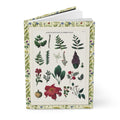
Plate 15 — the front cover of this journal — is a composition of nineteen species. Arum triphyllum, the jack-in-the-pulpit, is a North American woodland plant whose corm was used medicinally by Indigenous peoples of the eastern woodlands. Ipomoea quamoclit, the cypress vine, is a tropical American plant whose feathery foliage and scarlet flowers made it a favorite of European gardeners. Vinca, the periwinkle, had traveled in the opposite direction — a European plant naturalized in the Americas, used in folk medicine on both sides of the Atlantic. Hibiscus, represented here in one of its many species, was a genus of global distribution, with species from Africa, Asia, and the Americas all finding their way into the botanical gardens and medical traditions of the early nineteenth century.
Plate 7 — the back cover — is even richer in botanical and historical significance. Asclepias curassavica, the tropical milkweed, is a Caribbean plant whose brilliant orange-and-red flowers and medicinal properties made it one of the most documented plants of the region. Amaryllis coccinea, the scarlet amaryllis, is a South American bulb whose spectacular flowers had made it a prized ornamental in European gardens since the seventeenth century. Laurus cinnamomum — cinnamon — is one of the most historically significant plants in the world: a Sri Lankan tree whose bark had been one of the most valuable commodities in the global spice trade for centuries. Guilandina moringa — moringa — is a tree of Indian origin whose leaves, seeds, and pods have been used in Ayurvedic medicine for thousands of years.
IV. The Linnaean System and the Order of Nature
The organizational principle of Titford’s work — and of virtually all serious botanical work of the early nineteenth century — was the Linnaean system of classification, introduced by the Swedish naturalist Carl Linnaeus in his Species Plantarum of 1753. By classifying all known plants according to a hierarchical system and assigning each species a unique two-part Latin name, Linnaeus created a common language for botany that transcended national and linguistic boundaries. A plant described by a botanist in Jamaica could be identified by a botanist in London, Paris, or Leiden, because they shared the same system of names and the same criteria for classification.
For Titford, working in Jamaica in the early nineteenth century, the Linnaean system was the framework within which botanical knowledge became communicable and cumulative. By placing each of his documented plants within this system, he was connecting his observations in the Caribbean to the global network of botanical knowledge that had been accumulating since the mid-eighteenth century.
V. Botanical Illustration and the Art of Accuracy
The colored plates of the Hortus Botanicus Americanus belong to a tradition of botanical illustration that had been developing since the sixteenth century and that reached its technical and artistic peak in the late eighteenth and early nineteenth centuries. The great botanical illustrators of this period — Georg Dionysius Ehret, Pierre-Joseph Redoné, Franz Bauer — had established standards of accuracy and beauty that made botanical illustration one of the most demanding and prestigious forms of scientific art.
The challenge was to be simultaneously accurate and beautiful — to represent the plant with sufficient precision that a botanist could identify it from the illustration alone, while also conveying the visual qualities that made the plant worth looking at. Titford’s plates, produced in the hand-colored engraving technique standard for botanical publications of the period, meet this challenge with considerable success. The compositions are dense — Plate 15 contains nineteen species, Plate 7 contains nine — but each plant is rendered with sufficient detail to be recognizable, and the arrangement has an aesthetic logic that goes beyond mere taxonomic organization.
VI. The Legacy of the Useful Plants
The plants that Titford documented in 1811 have not diminished in significance in the two centuries since. Moringa — Guilandina moringa in Titford’s nomenclature — is now recognized as one of the most nutritionally dense plants known to science, being studied as a potential solution to nutritional deficiency in food-insecure regions. Cinnamon remains one of the most widely used spices in the world, and its medicinal properties are the subject of active scientific research. Asclepias curassavica has acquired new significance as one of the primary host plants of the monarch butterfly, whose global decline has made its cultivation a subject of debate among conservationists.
The jack-in-the-pulpit, the cypress vine, the periwinkle, the hibiscus, the scarlet amaryllis — all of the plants in Titford’s plates have their own contemporary stories, their own ongoing relationships with human culture, medicine, and ecology. The 1811 illustrations are not historical curiosities. They are documents of a living world.
VII. A Note on This Journal

The cover of this journal carries two plates from William Jowit Titford’s 1811 Sketches towards a Hortus Botanicus Americanus — Plate 15 with nineteen species from the Americas and beyond, and Plate 7 with nine plants of medicinal and economic significance, including cinnamon, moringa, and scarlet amaryllis. For herbalists, botanists, natural history collectors, and anyone who has ever held a plant and wondered at its history.
👉 Botanical Journal — Titford 1811 Medicinal Plants
References
- Titford, W.J. (1811). Sketches towards a Hortus Botanicus Americanus. C. and R. Baldwin, London.
- Stafleu, F.A. & Cowan, R.S. (1986). Taxonomic Literature, Vol. VI. Bohn, Scheltema & Holkema.
- Schiebinger, L. & Swan, C. (Eds.) (2005). Colonial Botany: Science, Commerce, and Politics in the Early Modern World. University of Pennsylvania Press.
- Drayton, R. (2000). Nature’s Government: Science, Imperial Britain, and the ‘Improvement’ of the World. Yale University Press.
- Blunt, W. & Stearn, W.T. (1994). The Art of Botanical Illustration. Antique Collectors’ Club.
- Biodiversity Heritage Library. Sketches towards a Hortus Botanicus Americanus, 1811. biodiversitylibrary.org.