Ulisse Aldrovandi and the Renaissance Invention of Botanical Science
In the sixteenth century, a group of Italian and Northern European naturalists did something that had never been done before: they looked at plants with the combined eyes of a scientist and an artist, and they wrote down — and drew — what they saw. Not the plants of ancient authority, not the simplified diagrams of the medieval herbals, but the actual plants growing in their gardens and in the fields around their cities, observed with a precision and a curiosity that was entirely new. Ulisse Aldrovandi of Bologna was the greatest of them, and his illustrated manuscripts of plants, flowers, and fruits — the Piante Fiori Frutti — remain among the most extraordinary documents in the history of natural history.

The Medieval Herbal and Its Limits
To understand what Aldrovandi and his contemporaries achieved, it helps to understand what came before them. The medieval herbal — the illustrated guide to medicinal plants that was the standard reference work of European botany from late antiquity through the fifteenth century — was a work of transmission rather than observation. Its illustrations were copies of copies of copies, each generation of scribes reproducing the drawings of the previous generation with varying degrees of fidelity, until the images had often drifted so far from the original plants that they were barely recognisable. Its text was similarly derivative: the great authorities were Dioscorides, whose De materia medica of the first century CE remained the standard pharmacological reference for fifteen hundred years, and Pliny the Elder, whose Naturalis Historia compiled the botanical knowledge of the ancient world in a form that was authoritative but not always accurate.
The problem was not that medieval botanists were incurious or incompetent. It was that the tradition they had inherited placed authority above observation — if Dioscorides said a plant had certain properties, those properties were true, regardless of what direct examination of the plant might suggest. The illustrations existed to help readers identify the plants described in the text, not to document what the plants actually looked like. When the illustrations became too degraded to serve even that purpose, they continued to be reproduced because they were part of the authoritative tradition.
The Renaissance Turn to Observation
The change came in the early sixteenth century, and it came from several directions at once. The recovery of Greek texts in more accurate translations — one of the great projects of Renaissance humanism — revealed that the medieval versions of Dioscorides and Pliny were often corrupt or mistranslated, and that the ancient authors themselves had sometimes disagreed with each other. The development of printing, and above all of woodcut illustration, made it possible to reproduce images with a consistency that manuscript copying could never achieve. And the voyages of exploration were bringing back plants from the Americas, Africa, and Asia that no ancient authority had ever described, forcing naturalists to develop new methods of observation and classification to deal with organisms that had no place in the inherited tradition.
The result was a generation of naturalists — Leonhart Fuchs in Germany, Rembert Dodoens in the Low Countries, Pietro Andrea Mattioli in Italy, and above all Aldrovandi in Bologna — who made direct observation of plants the foundation of their work. They grew plants in botanical gardens — the first in Europe were established at Pisa and Padua in 1545, and Aldrovandi founded the Bologna garden in 1568 — they collected dried specimens in herbaria, they commissioned artists to draw plants from life, and they compared what they saw with what the ancient authorities had written, correcting the authorities where observation contradicted them.
Ulisse Aldrovandi: The Encyclopaedist of Nature
Ulisse Aldrovandi (1522–1605) was born in Bologna into a family of lawyers and administrators, and he spent almost his entire life in the city where he was born, as professor of natural history at the university, as director of the botanical garden, and as the compiler of one of the most ambitious encyclopaedias of the natural world ever attempted. His published works — thirteen folio volumes on birds, insects, fish, serpents, quadrupeds, and monsters, most of them published posthumously — represent only a fraction of what he wrote and collected. His manuscripts, preserved in the Biblioteca Universitaria di Bologna, fill hundreds of volumes and include thousands of illustrations of plants, animals, minerals, and fossils.
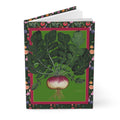
The Piante Fiori Frutti — Plants, Flowers, Fruits — is among the most visually remarkable of these manuscripts. Aldrovandi employed a team of artists to draw the plants in his collection from life, and the resulting illustrations combine scientific accuracy with a quality of observation that is genuinely artistic. The turnip and the radish that appear on the covers of this journal are characteristic examples: each plant is shown complete, with its leaves, its root, and the characteristic form and colouring that distinguish it from related species. They are documents of observation, made by someone who had looked at these plants carefully and wanted to record exactly what he saw.
The Turnip and the Radish as Scientific Subjects
It is worth pausing on the choice of subjects. The turnip (Brassica rapa) and the radish (Raphanus sativus) are among the most ancient of cultivated vegetables — both were grown in ancient Egypt and Greece, both appear in the earliest European herbals, both were staple foods of the medieval peasantry. They are not glamorous subjects. But for Aldrovandi, the humbleness of the subject was irrelevant: what mattered was the accuracy of the observation and the completeness of the documentation. Every plant in the garden deserved to be drawn with the same care as the rarest exotic specimen, because every plant was part of the natural order that the naturalist’s task was to understand and record.
This democratic impulse — the conviction that the common turnip was as worthy of scientific attention as the most exotic tropical plant — is one of the most distinctive features of Renaissance natural history, and one of its most enduring legacies. It is the impulse that underlies the modern discipline of botany, and it is visible in every careful line of Aldrovandi’s illustrations.

If Aldrovandi and the Renaissance tradition of botanical observation resonate with you, the Aldrovandi Turnips & Radish Journal brings his Piante Fiori Frutti illustrations to a hardcover journal — 150 lined pages, ready for garden notes, botanical sketches, or whatever the vegetable garden inspires.
References
- Aldrovandi, U. Piante Fiori Frutti. Manuscript, Biblioteca Universitaria di Bologna, 16th century.
- Findlen, P. Possessing Nature: Museums, Collecting, and Scientific Culture in Early Modern Italy. University of California Press, Berkeley, 1994.
- Ogilvie, B.W. The Science of Describing: Natural History in Renaissance Europe. University of Chicago Press, 2006.
- Arber, A. Herbals: Their Origin and Evolution. Cambridge University Press, 1912 (3rd ed. 1986).
- Blunt, W. and Stearn, W.T. The Art of Botanical Illustration. Antique Collectors’ Club, Woodbridge, 1994.