Twenty-Three Dogs: Thomas E. Hill’s 1915 Guide to the Breeds of Europe and America
In 1915, a practical guide to self-sufficiency quietly documented something extraordinary: a portrait of the dog world as it existed at the dawn of the twentieth century, before modern breed standards, before kennel clubs had fully standardised the shapes and temperaments we now take for granted, and before one of the breeds on its pages disappeared from the earth entirely.

The Open Door to Independence was not a book about dogs. It was a guide to making a living from the land — a compendium of practical advice for farmers, smallholders, and entrepreneurs written by Thomas E. Hill, a Chicago-based author and publisher who had spent decades producing almanacs, manuals, and illustrated guides for the American middle class. The dog breed plates were included because dogs were tools of the trade: working animals whose value to a farmer, a hunter, or a household depended on knowing which breed did what, and what each one looked like.
Thomas E. Hill and the Art of the Practical Guide
Thomas E. Hill (1832–1915) was one of the most prolific popular publishers of late nineteenth and early twentieth-century America. His Hill’s Manual of Social and Business Forms (1873) sold over a million copies. His almanacs, etiquette guides, and illustrated encyclopedias reached readers across the United States and beyond — practical, accessible, and always illustrated with the precision that made his books useful rather than merely decorative.
The Open Door to Independence appeared in the final year of his life, a summation of the practical wisdom he had spent a career assembling. Its dog breed plates were drawn in precise black-and-white line illustration — the standard of the period, designed for clarity and reproduction rather than beauty.
The Front Cover: Eleven Breeds of Europe and America
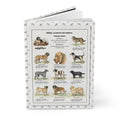
The first plate presents eleven of the most valued working, sporting, and companion breeds of the early twentieth century:
The Collie — described by Hill as “the English sheep dog of remarkable intelligence” — appears here in its classic rough-coated form, decades before the breed became a Hollywood icon. The English Mastiff, one of the oldest breeds in Britain, is shown with the massive, dignified bearing that had made it a symbol of power since antiquity. The Bloodhound, famed for its ability to follow a scent trail across days and miles, appears alongside the swift English Fox-Hound, bred for the hunt across the English countryside.
The Scottish Deer Hound — large, graceful, and ancient — shares the plate with both the Smooth and Rough St. Bernard, the legendary Alpine rescue dog whose image had become one of the most recognisable in the world by 1915. The Newfoundland Dog, black and docile, bred for water rescue on the Canadian coast, appears beside the compact Pug and the Pomeranian — also called the Spitz Dog — imported from the Baltic coast and bred across America as a fashionable companion.
The Back Cover: Twelve Terrier Breeds
The second plate is a remarkable survey of the terrier family as it existed in 1915 — a family of dogs bred for earth work, vermin control, and, increasingly, companionship, whose diversity of form and temperament had made them among the most popular breeds on both sides of the Atlantic.
The Prick-Ear and Drop-Ear Skye Terriers from the Isle of Skye appear alongside the Bull Terrier — shown here before the egg-shaped head that modern breeding would later impose. Most poignant is the White English Terrier: a breed now extinct, once common in Victorian England, ancestor of both the Bull Terrier and the Boston Terrier, and gone from the earth within a generation of this illustration.
The Black and Tan Terrier — predecessor of the Manchester Terrier — appears beside the Airedale Terrier, King of Terriers, bred in the Valley of Aire in Yorkshire and by 1915 already celebrated as a working dog, a war dog, and a companion. The courageous red Irish Terrier, the lamb-like Bedlington Terrier, and the Victorian parlor-pet Yorkshire Terrier complete the companion breeds. The Smooth and Rough Fox Terriers and the long-bodied Dandie Dinmont Terrier — with its distinctive top-knot and its name taken from a character in a Walter Scott novel — round out a plate that reads today as both a historical document and a celebration of canine diversity.
A World Before Standardisation
What makes Hill’s plates historically significant is precisely their moment. The late nineteenth and early twentieth centuries were the great age of breed standardisation — the period when kennel clubs in Britain, America, and Europe were codifying the physical characteristics of each breed into written standards that would shape their development for the next century. Hill’s illustrations capture breeds at a transitional moment: recognisable to modern eyes, but not yet fully fixed into the forms we know today.
The White English Terrier is the most dramatic example. By the early 1900s it had effectively disappeared, unable to compete with the Bull Terrier and the Boston Terrier that had partly descended from it. Hill’s plate preserves its image at almost the last moment it was considered a distinct and living breed.
The St. Bernard shown here — both Smooth and Rough — is the pre-modern St. Bernard, before the breed’s head became heavier and its body more massive. The Bull Terrier lacks the distinctive egg-shaped skull that would become its defining characteristic in the decades after 1915. These are dogs in transition, documented at the moment before the standards that would define them were fully imposed.
The Watercolor Reimagining
Hill’s original illustrations were black-and-white line drawings — precise, functional, and designed for the printing technology of their time. For this journal, LeBonJournal has preserved the original composition and arrangement of each breed exactly as Hill documented them, adding warm watercolor to bring each coat, color, and character to life in the way the original medium never could.
The result is faithful to Hill’s vision while giving these dogs the warmth that a century of black-and-white printing had withheld from them.
Twenty-Three Dogs, One Journal
The Dog Breeds Journal carries all twenty-three breeds across its front and back covers: eleven on the front, twelve on the back, together forming a portrait of the canine world as Thomas E. Hill saw it in 1915 — diverse, purposeful, and deeply intertwined with human life across two continents.
One of those breeds is gone. The rest have changed. But the relationship they represent — between humans and dogs, across centuries of work and companionship — remains as alive as it has ever been.