The Victorian Obsession with Hummingbirds
In the summer of 1851, John Gould opened a display of stuffed hummingbirds at the Zoological Society of London that stopped Victorian London in its tracks. Over 75,000 people came to see it — including a young Queen Victoria. The birds, arranged in cases by species and habitat, shimmered under the gaslight with an iridescence that seemed almost supernatural: feathers that shifted from deep black to blazing emerald, ruby, and sapphire depending on the angle of light. For most visitors, it was the first time they had ever seen a hummingbird. For many, it would prove an obsession that lasted a lifetime.

The Bird That Seemed Impossible
The hummingbird had been known to European naturalists since the first Spanish accounts of the Americas in the 16th century, but it remained, for most Europeans, a creature of legend rather than experience. The reports seemed barely credible: a bird so small it could be mistaken for an insect, capable of hovering in mid-air by beating its wings up to 80 times per second, feeding on flower nectar like a bee, its plumage shifting color like a living jewel.
The first live hummingbirds to reach Britain arrived in the 1840s, but they rarely survived the voyage. What Victorians knew of the Trochilidae — the hummingbird family, comprising over 300 species — they knew primarily through illustrations and taxidermy. And it was precisely this combination of inaccessibility and visual splendor that made the hummingbird the supreme object of Victorian natural history desire.
John Gould and the Gold Leaf Revolution
No one did more to shape the Victorian image of the hummingbird than John Gould (1804–1881), the self-taught taxidermist turned ornithologist who became the greatest bird illustrator of his age. Gould had never seen a live hummingbird when he began his monumental A Monograph of the Trochilidae, or Family of Humming-Birds (1849–1861) — a five-volume, 360-plate work that remains one of the most spectacular achievements in the history of natural history illustration.
Working with artist Henry Constantine Richter, Gould developed a revolutionary technique: applying gold leaf to the lithographic plates before hand-coloring, to capture the metallic iridescence of hummingbird plumage that conventional pigments could not reproduce. The result was a series of plates that seemed to glow from within — birds that shimmered on the page as they would in life, their gorgets and crowns blazing with the structural color that makes hummingbird plumage one of nature's most extraordinary optical phenomena.
The Monograph of the Trochilidae was published in parts at £115 for the complete set — an enormous sum equivalent to several years' wages for a working-class family — and was subscribed to by the great natural history libraries, wealthy collectors, and learned societies across Britain and Europe. It established Gould as the supreme authority on hummingbirds and made the Trochilidae the most glamorous family in Victorian ornithology.
The Taxidermy Trade: Hummingbirds by the Million
Gould's display and monograph ignited a collecting frenzy that had devastating consequences for hummingbird populations across the Americas. Victorian taxidermy had already created a substantial trade in exotic bird skins, but the hummingbird craze of the 1850s and 1860s transformed it into an industrial operation.
London's Mincing Lane — the centre of the exotic feather and skin trade — handled millions of hummingbird skins annually at the height of the craze. A single auction in 1888 sold 400,000 hummingbird skins in a single day. The birds were collected across Central and South America, dried, and shipped to London, where they were purchased by natural history collectors, taxidermists, milliners, and decorators.
The uses were extraordinary in their variety. Stuffed hummingbirds were displayed in glass domes as drawing-room ornaments — a fashion that swept through middle-class Victorian homes in the 1860s and 1870s. Hummingbird feathers were incorporated into ladies' hats, fans, and evening gowns. Entire hummingbirds — wings spread, bills extended — were mounted on hat brims as living jewels of millinery. The Empress Eugénie of France was said to have owned a fan made entirely of hummingbird feathers; Queen Alexandra wore hummingbird ornaments at court.
The Scientific Counterpoint
Not all Victorian engagement with hummingbirds was decorative. The Trochilidae were also the subject of serious scientific inquiry, driven by the extraordinary biological puzzles they presented. How did a bird weighing less than a penny coin sustain the metabolic demands of hovering flight? How did hummingbird feathers produce their iridescent colors without pigment, through the structural interference of light alone? How had 300-plus species evolved across the Americas, each adapted to specific flower shapes and altitudinal ranges?
These questions attracted some of the finest minds of Victorian natural history. Charles Darwin noted the hummingbird's relationship with flowers as a key example of co-evolution in On the Origin of Species (1859). The physicist John Tyndall used hummingbird feathers to demonstrate the principles of structural color — the same optical phenomenon that produces the blue of the sky — in his popular science lectures of the 1860s.
William Davis's 1835 copper engravings in the Edinburgh Journal of Natural History, produced fourteen years before Gould's gold-leaf revolution, represent this earlier, more austere tradition of scientific hummingbird illustration: precise, unadorned, focused on anatomical accuracy rather than visual splendor. Together, Davis and Gould bracket the arc of Victorian hummingbird science — from the copper needle of empirical documentation to the gold leaf of aesthetic celebration.
The Backlash: The Birth of Bird Protection
By the 1880s, the scale of the slaughter had begun to provoke a reaction. The Plumage League, founded in 1885, and the Society for the Protection of Birds (later the Royal Society for the Protection of Birds, RSPB), founded in 1889, were both driven in significant part by outrage at the feather trade — and hummingbirds were among its most visible victims.
The campaign against feathered hats became one of the first mass conservation movements in British history, drawing in aristocratic women, naturalists, and clergymen in a coalition that eventually secured the Importation of Plumage (Prohibition) Act of 1921, which banned the import of exotic bird feathers into Britain. The Victorian obsession with hummingbirds had, in its excess, helped to create the modern conservation movement.
A Legacy in Gold and Copper
Today, the hummingbird retains its hold on the imagination — not as a trophy or a fashion accessory, but as a symbol of the extraordinary diversity and fragility of the natural world. Gould's gold-leaf lithographs and Davis's copper engravings survive as documents of a Victorian fascination that was by turns scientific, aesthetic, and destructive — and that ultimately, in its excesses, helped to birth the idea that the natural world was worth protecting.

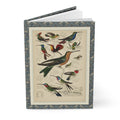
If the iridescent wonder of the hummingbird inspires you, our Hummingbird Journal — Gould 1849 & Davis 1835 Trochilidae Art brings Gould's gold-leaf lithographs and Davis's copper engravings to the cover of a hardcover journal, ready to accompany your own observations of the natural world.
References
- Gould, J. A Monograph of the Trochilidae, or Family of Humming-Birds. Taylor and Francis, 1849–1861.
- Chansigaud, V. The History of Ornithology. New Holland Publishers, 2009.
- Doughty, R. W. Feather Fashions and Bird Preservation: A Study in Nature Protection. University of California Press, 1975.
- Tyndall, J. On the Blue Colour of the Sky, the Polarization of Skylight, and the Polarization of Light by Cloudy Matter Generally. Philosophical Magazine, 1869.
- Sclater, P. L. & Salvin, O. Nomenclator Avium Neotropicalium. London, 1873.