The Ostrich Mimic and the Cocoa Cards: Heinrich Harder and the Birth of Paleoart
How a German landscape painter helped a generation imagine the prehistoric world — and why his dinosaurs still captivate us
In 1906, the German weekly magazine Die Gartenlaube published a series of articles on Earth’s deep history, written by the naturalist and popular science writer Wilhelm Bölsche. To illustrate them, the editors commissioned a Berlin-based art professor and landscape painter named Heinrich Harder. The result was a series of watercolor illustrations that would become, over the following decade, among the most widely seen images of prehistoric life ever produced — distributed as collectible cards tucked into packets of Reichardt Cocoa, collected by children across the German-speaking world, and reproduced in natural history publications for years afterward.
Harder had no formal training in paleontology. What he had was something rarer and, for the purposes of paleoart, more valuable: an extraordinary ability to place a creature in a landscape and make it feel at home. His dinosaurs did not float against white backgrounds or pose stiffly for the viewer. They waded through wetlands, sheltered under ferns, and moved through richly detailed environments that felt, to the viewer of 1906, genuinely prehistoric — ancient, lush, and alive.

Heinrich Harder and the Landscape Tradition
Heinrich Harder (1858–1935) was, by training and temperament, a landscape painter. He studied at the Berlin Academy of Arts and built a career painting the natural world — forests, rivers, coastlines, the quiet drama of light on water and stone. When he turned to prehistoric subjects, he brought with him all the habits of observation and composition that landscape painting demands: the sense of atmosphere, the attention to light, the understanding of how living things occupy space.
This background gave his paleoart a quality that distinguished it from much of what came before. Earlier reconstructions of prehistoric life had tended toward the monumental and the static — great beasts frozen in dramatic poses, more symbol than animal. Harder’s creatures were different. They were embedded in their environments, subject to the same light and weather as the plants around them, behaving in ways that suggested ongoing lives rather than posed exhibitions.
For the Tiere der Urwelt series — “Animals of the Prehistoric World” — Harder produced dozens of illustrations covering the full sweep of prehistoric life, from the Cambrian seas to the Pleistocene megafauna. Each image was a small act of imagination: a synthesis of the best available science, filtered through the sensibility of a trained artist, and rendered in watercolor with a warmth and specificity that made the ancient world feel, for the first time for many viewers, genuinely real.
The Struthiomimus: Science in Motion
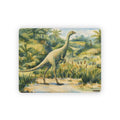
Among the creatures Harder depicted was a long-necked, long-legged dinosaur of the Late Cretaceous — a member of the ornithomimid family, the “bird mimics,” known today as Struthiomimus or its close relative Ornithomimus. In 1906, these animals were understood primarily through their skeletal structure: long hindlimbs built for running, a small toothless head on an elongated neck, forelimbs with grasping hands. They were, in the parlance of the time, “ostrich mimics” — dinosaurs that seemed to have converged, across the vast gulf of evolutionary time, on the body plan of the modern ratite.
Harder depicted the Struthiomimus in a lush wetland setting, surrounded by ferns and aquatic plants, in a pose that suggested alertness and movement. It was a plausible reconstruction for its era — grounded in the skeletal evidence available, animated by Harder’s instinct for naturalistic behavior, and set in an environment that reflected the best understanding of Late Cretaceous ecology.
What Harder could not have known — what no one in 1906 could have known — was that the Struthiomimus almost certainly had feathers. The evidence for feathered ornithomimids would not emerge until the discovery of exceptionally preserved specimens in the twenty-first century, specimens that showed clear evidence of wing-like structures on the forelimbs and a body covering of filamentous proto-feathers. The sleek, scaled creature of Harder’s imagination was, in reality, something closer to a very large, very fast, flightless bird.
This is not a failure of Harder’s art. It is, rather, a testament to how science works: each generation reconstructs the past with the best tools available, and each generation is revised by the next. The Struthiomimus of 1906 tells us as much about the science of 1906 as it does about the Cretaceous — and that, for the curious mind, is part of its fascination.
The Cocoa Cards and the Democratization of Natural History
Between 1910 and 1916, the Reichardt Cocoa Company distributed Harder’s Tiere der Urwelt illustrations as collectible cards — small, printed reproductions tucked into packets of cocoa, designed to be collected, traded, and assembled into complete sets. It was a marketing strategy common to the era, applied to everything from cigarettes to chocolate, and it had a remarkable cultural effect: it put images of prehistoric life into the hands of ordinary families, into the pockets of children who might never visit a natural history museum or read a scientific monograph.
The cocoa cards were, in their way, a form of popular science education — informal, incidental, and enormously effective. A child who collected the full set of Tiere der Urwelt cards would have encountered, in miniature, the full sweep of prehistoric life as understood by early twentieth-century science: the Cambrian seas, the coal forests of the Carboniferous, the great reptiles of the Mesozoic, the mammals of the Cenozoic. They would have learned, without quite realizing they were learning, that the Earth had a deep history, that life had changed profoundly over time, and that the world they inhabited was the latest chapter in a story of almost incomprehensible length.
This is the tradition that Harder’s Struthiomimus belongs to: not the tradition of the museum diorama or the scientific monograph, but the tradition of the kitchen table, the schoolroom, the collector’s album — the tradition of making the ancient world accessible, vivid, and genuinely exciting to ordinary people.
Paleoart as a Living Tradition
Harder’s work did not end with the cocoa cards. His illustrations were reproduced in natural history books, educational materials, and popular publications throughout the early twentieth century, and they influenced a generation of artists and illustrators who came after him. The tradition of paleoart — of reconstructing prehistoric life in visual form, for a general audience — owes a significant debt to the work he did for Die Gartenlaube in 1906.
That tradition is very much alive today. Each new fossil discovery, each new analysis of bone structure or isotope chemistry or preserved soft tissue, prompts a new round of reconstruction — new images of creatures that no human eye has ever seen, built from evidence and imagination in equal measure. The feathered Struthiomimus of contemporary paleoart is as much an act of informed imagination as Harder’s scaled version was. The tools are different; the fundamental challenge is the same.
What connects Harder’s 1906 watercolors to the paleoart of today is not accuracy — science has moved on, and will move on again — but the underlying impulse: the desire to make the deep past visible, to give form and life to creatures that existed millions of years before the first human being looked up at the sky. It is an impulse that belongs, at its heart, to the same family as all storytelling: the refusal to let the past remain merely abstract.

If the world of early paleoart and prehistoric wonder resonates with you, the Struthiomimus Kids’ Puzzle brings Heinrich Harder’s 1906 illustration to a 30-piece puzzle for young explorers — carefully hand-colorized, with large rounded pieces designed for curious hands aged 3 and up.
References
- Bölsche, W. Tiere der Urwelt. Articles in Die Gartenlaube. Leipzig, 1906.
- Lescaze, Z. Paleoart: Visions of the Prehistoric Past. Taschen, 2017.
- Naish, D. Tetrapod Zoology. Various publications, 2000s–2020s.
- Paul, G.S. The Princeton Field Guide to Dinosaurs. Princeton University Press, 2010.
- Hartman, S. The History of Dinosaur Illustration. Various publications.