The Last Golden Summer: Ghent’s Exposition Universelle of 1913
In the spring of 1913, the city of Ghent opened the gates of the most ambitious world’s fair Belgium had ever staged. The Exposition Universelle et Internationale de Gand ran from 26 April to 3 November, spanning 130 hectares and drawing between four and nine and a half million visitors. It was a celebration of a century of progress in science, industry, and art — and, though no one knew it yet, the last great international exposition of the Belle Époque. Fourteen months later, the First World War would begin.
That luminous summer of 1913 has never quite left Ghent’s memory. The exposition left behind a railway station, a transformed Citadelpark, and a set of official posters that rank among the finest graphic art produced in Belgium before the war.
Ghent in 1913: A City at Its Apex
By 1913, Ghent was one of the great industrial cities of Europe — the “Manchester of the Continent,” its textile mills and chemical industries driving a prosperity that had transformed the city over the previous century. It was also a city of extraordinary medieval heritage: the Church of Saint Nicholas, the Belfry, and Saint Bavo’s Cathedral rose above the Leie and Scheldt rivers as they had for centuries, a skyline that seemed to belong simultaneously to the Middle Ages and the modern world.
The exposition was organised under the direction of Commissioner General Jean de Hemptinne, and it occupied a vast site stretching from the Citadelpark to the southern edge of the city. Twenty-four nations participated. The official posters were commissioned from the leading graphic artists of the day.
Oud Vlaendren: A Village Built for One Season
The most celebrated attraction of the exposition was not a pavilion of industry or a hall of science. It was Oud Vlaendren — Old Flanders — a temporary reconstruction of iconic Flemish medieval buildings created expressly for the fair in the Citadelpark.
Visitors who entered Oud Vlaendren stepped into an idealised version of medieval Flanders: guild houses, belfries, market squares, and cobbled streets, all built from scratch for a single season. It was part historical recreation, part theatrical spectacle, and entirely extraordinary. When the exposition closed in November 1913, Oud Vlaendren was dismantled. It existed for one luminous season alone.
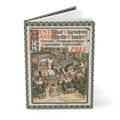
The official poster for Oud Vlaendren was designed by René De Cramer and printed in lithography by Franz Poelvoorde. It presents an aerial view of the reconstructed Flemish streetscape in warm earth tones — a collector’s piece of the highest order, regularly appearing at auction houses for its historical and artistic significance.
The Three Towers: Jos Cornelis and the Art of the Exposition Poster
The second great poster of the exposition was attributed to artist Jos Cornelis. It presents the three iconic towers of Ghent — the Church of Saint Nicholas, the Belfry (Belfort), and Saint Bavo’s Cathedral — adorned with festive garlands against a luminous sky.
The visual style is a precise document of its moment: the decorative sensibility of Art Nouveau combined with a geometric clarity that anticipates early modernism. It is a poster that belongs to the last years of a visual culture that the war would sweep away entirely — the confident, ornamental, optimistic graphic language of the Belle Époque at its peak.
Together, the De Cramer and Cornelis posters frame the exposition’s two great themes: the pride in Flemish medieval heritage, and the confidence in a modern, progressive Belgium that could stage a world’s fair to rival Paris or London.
The Legacy: What the Exposition Left Behind
Most of what was built for the exposition was temporary. Oud Vlaendren was dismantled. The pavilions were removed. But the exposition left permanent marks on the city.
The most enduring is the Gent-Sint-Pieters railway station, designed by architects Louis Cloquet and Stéphane Mortier and inaugurated for the exposition. It still stands today as a monument to the fair’s ambition — a Beaux-Arts building of extraordinary scale and confidence, its façade a statement of what Ghent believed itself to be in 1913.
The exposition also accelerated the transformation of the Citadelpark into the public green space it remains today. And it left behind its posters — printed in lithography, distributed across Europe, and now preserved in museum collections and private hands as some of the finest graphic documents of the pre-war Belle Époque.
A World on the Eve of Transformation
There is something particular about the cultural objects produced in the years immediately before the First World War — a quality of fullness, of confidence, of a world that does not yet know what is coming. The Ghent 1913 posters have that quality. They were made by artists who believed in progress, in beauty, in the capacity of a world’s fair to gather the nations of the world in peaceful competition and mutual admiration.
Fourteen months after the exposition closed, the German army marched into Belgium. The Belle Époque was over. The summer of 1913 in Ghent — with its reconstructed medieval village, its millions of visitors, its lithographed posters of towers and garlands — became, in retrospect, one of the last golden summers of a world that would not return.
—

The official posters of the Exposition Universelle et Internationale de Gand 1913 — René De Cramer’s Oud Vlaendren and Jos Cornelis’s three towers — appear on the cover of our Ghent 1913 World’s Fair Journal, a hardcover journal with 128 pages, casewrap sewn binding, and matte laminated full-wrap cover.
References
- Exposition Universelle et Internationale de Gand 1913. Official catalogue. Ghent, 1913.
- Lemmens, Geert, and Suzanne Bogman. Affiches belges / Belgische affiches 1880–1940. Pandora, 1999.
- Scholliers, Peter. Wages, Manufacturers and Workers in the Nineteenth-Century Factory: The Voortman Cotton Mill in Ghent. Berg, 1996.
- Van Acker, Wouter. Internationalism in the Olympic Movement and the Universal Expositions. Leuven University Press, 2011.