The Language of Flowers: Forget-Me-Nots, Heliotrope, and the Victorian Art of Floriography
In the summer of 1819, a young French woman named Charlotte de Latour published a small volume in Paris that would transform the way an entire civilization thought about flowers. Le Langage des fleurs — The Language of Flowers — was a dictionary of floral symbolism: a guide to the meanings that centuries of poetry, mythology, and popular tradition had attached to the plants of the garden, organized alphabetically and illustrated with hand-colored engravings. It was an immediate success, going through multiple editions in France and inspiring translations and adaptations across Europe and America. By the 1830s, the language of flowers — floriography, as it came to be called in English — had become one of the defining cultural practices of the Victorian age: a system of communication that allowed lovers, friends, and mourners to express emotions that the strict codes of polite society forbade them to articulate in words.

The Origins of Floriography
The idea that flowers carry symbolic meanings is far older than the Victorian era. In ancient Greece and Rome, specific flowers were associated with specific gods and occasions: the rose with Venus and love, the laurel with Apollo and victory, the cypress with mourning and the underworld. In the Christian tradition, flowers acquired a rich symbolic vocabulary through their association with the Virgin Mary and the saints: the lily of purity, the violet of humility, the rose of martyrdom. In the Persian and Ottoman traditions, a sophisticated system of floral symbolism — the selam, or language of objects — allowed lovers to communicate through the exchange of flowers and other natural objects, each carrying a specific meaning encoded in its name or appearance.
It was this Ottoman tradition that first captured the imagination of European writers and travellers. Lady Mary Wortley Montagu, who accompanied her husband to Constantinople in 1716–1718, described the selam in her celebrated Turkish Embassy Letters, and her account — widely read and frequently reprinted throughout the 18th century — introduced the idea of a systematic floral language to European readers. By the early 19th century, the combination of the Ottoman tradition, the Christian symbolic vocabulary, and the new Romantic sensibility that celebrated nature as a vehicle of emotion had created the conditions for the flowering of floriography as a cultural practice.
The Forget-Me-Not: Ne M'Oublie Pas
Of all the flowers in the Victorian language of flowers, none carried a more universally understood meaning than the forget-me-not. Myosotis scorpioides — the water forget-me-not, the ne m'oublie pas, the Vergissmeinnicht — is a small, delicate plant of damp meadows and stream banks, its tiny blue flowers with their yellow centers so modest in scale that they seem almost to disappear into the vegetation around them. Yet the flower's name — in English, French, German, Italian, Spanish, and virtually every other European language — is a plea for remembrance, and it is this name, more than any other quality of the plant, that gave it its extraordinary emotional resonance in the 19th century.
The origin of the name is the subject of several competing legends, the most popular of which tells of a medieval knight who, gathering flowers for his beloved on the bank of a river, fell into the water and, swept away by the current, threw the flowers to her with the cry "Forget me not!" before drowning. Whether or not the legend is true, it captures something essential about the flower's meaning: the forget-me-not is the flower of those who fear to be forgotten — lovers separated by distance or death, friends parted by circumstance, the dying who wish to leave a trace of themselves in the memory of those they leave behind.
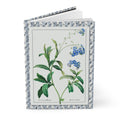
Pierre-Joseph Redouté's plate of Myosotis scorpioides from Choix des plus belles fleurs (1827) is one of the most beloved images in the history of botanical illustration: the curling scorpioid cyme of the stem — the characteristic coiled flower cluster that gives the plant its species name — rendered with the stipple engraving technique at its most delicate, the blue of the petals and the yellow of the centers captured with a fidelity that no previous botanical illustrator had achieved. It is a portrait of a flower that is simultaneously a scientific document and an act of homage to one of the most emotionally resonant plants in the European garden.
The Heliotrope: Devotion and the Scent of Vanilla
Heliotropium arborescens — the garden heliotrope, the héliotrope du Pérou — is a plant of a very different character. Native to Peru, it was introduced to European gardens in the 18th century and rapidly became one of the most beloved plants of the 19th-century garden, prized above all for its fragrance: a warm, sweet, complex scent of vanilla and cherry that carries across the garden on a summer evening and that was, for generations of Victorian gardeners, one of the defining sensory experiences of the season. The Empress Joséphine grew it at Malmaison; it filled the conservatories of English country houses; it was one of the most popular plants in the cut-flower trade of Paris and London.
In the language of flowers, the heliotrope symbolized devotion — a meaning derived from its name, which comes from the Greek helios (sun) and tropos (turning): the plant that always faces the light, as the devoted heart always turns toward its beloved. The heliotrope's devotion is, in fact, a botanical myth — the mature plant does not actually track the sun, though the young seedlings do — but the myth was more powerful than the botany, and the heliotrope remained the flower of devotion throughout the Victorian era, appearing in love poetry, in the decoration of mourning jewelry, and in the bouquets that lovers exchanged as pledges of fidelity.
Redouté's plate of Heliotropium arborescens captures the plant with the same combination of scientific accuracy and aesthetic refinement that characterizes all his work: the clusters of tiny mauve-purple flowers, the dark green leaves, the branching stems — all rendered with the stipple engraving technique that he had spent decades perfecting, and that gave his botanical illustrations their characteristic quality of luminous, almost photographic precision.
Redouté and the Art of Botanical Illustration
Pierre-Joseph Redouté (1759–1840) was the greatest botanical illustrator of his age, and one of the greatest in the history of the art. Born in Saint-Hubert in what is now Belgium, he came to Paris as a young man and rapidly established himself as the leading flower painter of the French capital, working for the royal family, the Empress Joséphine, and the great botanical institutions of the age. His masterwork, Choix des plus belles fleurs (1827–1833), published in 144 hand-colored stipple engravings, represents the summit of French botanical illustration: a celebration of the most beautiful flowers of the garden, rendered with a technical mastery and an aesthetic sensibility that have never been surpassed.
The stipple engraving technique that Redouté perfected — building up tone through thousands of tiny dots rather than lines — was ideally suited to the representation of flowers: it could capture the translucency of petals, the texture of leaves, and the subtle gradations of color with a fidelity that line engraving could not achieve. Combined with the hand-coloring that gave each plate its individual character, the technique produced images of extraordinary beauty and scientific accuracy — images that were simultaneously works of art and works of natural history, and that have remained among the most admired botanical illustrations ever produced.
If the language of flowers and the art of Redouté inspire you, our Forget Me Not Journal — Redouté 1827 Choix des Fleurs brings his forget-me-not and heliotrope to the cover of a hardcover journal.
References
- De Latour, C. Le Langage des fleurs. Paris, 1819.
- Seaton, B. The Language of Flowers: A History. University Press of Virginia, 1995.
- Lack, H. W. Pierre-Joseph Redouté: The Raphael of Flowers. Prestel, 2013.
- Montagu, Lady M. W. Turkish Embassy Letters. London, 1763.
- Goody, J. The Culture of Flowers. Cambridge University Press, 1993.