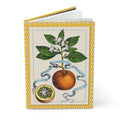
The Golden Apple and the Baroque Garden: Ferrari's Hesperides and the First Book of Citrus
How a Jesuit botanist, a papal family, and the myth of the golden apples of antiquity came together in Rome in 1646 to produce the most sumptuous botanical book ever devoted to a single fruit.
There is a moment in the history of botanical publishing when science and mythology become, briefly and gloriously, the same thing. That moment is the Hesperides of Giovanni Battista Ferrari, published in Rome in 1646 — a book so extraordinary in its ambition, its scholarship, and its visual splendour that it stands apart from everything that preceded it and much that followed.
The Hesperides was the first book in the history of natural history devoted entirely to a single genus of plants. Its subject was citrus — the orange, the lemon, the lime, the citron, and the extraordinary diversity of varieties that the great European orangeries of the seventeenth century had cultivated, hybridized, and collected with the obsessive enthusiasm of an age that saw the garden as a theatre of wonder. Its title was a declaration of intent: the Hesperides were the nymphs of Greek mythology who guarded the garden at the edge of the world where the golden apples grew, and Ferrari and his contemporaries understood those golden apples to be citrus fruits — the most precious, the most fragrant, the most mythologically resonant plants in the European garden.
To write about citrus in 1646 was to write about mythology, theology, science, and power all at once. Ferrari understood this, and the Hesperides is the fullest expression of that understanding.
The Jesuit and the Barberini
Giovanni Battista Ferrari was born in Siena in 1584 and entered the Society of Jesus as a young man, eventually becoming one of the most learned botanists and classical scholars in Rome. He was a man of the Baroque in the fullest sense: deeply erudite, passionately interested in the natural world, committed to the idea that the study of plants was a form of devotion, and intimately connected to the networks of patronage and power that shaped intellectual life in seventeenth-century Rome.
The most important of those networks was the Barberini family. Maffeo Barberini had become Pope Urban VIII in 1623, and under his pontificate the Barberini became the most powerful patrons of art, architecture, and learning in Rome — the family that commissioned Bernini's baldachin for St. Peter's, that built the great Palazzo Barberini, and that supported a circle of scholars, poets, and scientists that included some of the most brilliant minds of the age. Ferrari was part of this circle, and the Hesperides was, in a very real sense, a Barberini production: dedicated to the family, illustrated by artists connected to the Barberini court, and published under the auspices of a patronage network that gave Ferrari access to resources — financial, artistic, and intellectual — that no independent scholar could have commanded.
The result was a book of extraordinary ambition. The Hesperides ran to four volumes, combining rigorous botanical description with classical scholarship, mythological interpretation, and the most sumptuous copper engravings that Roman printing could produce. It documented more than sixty varieties of citrus, many of them cultivated in the great Roman orangeries and described here for the first time with scientific precision. And it did all of this within a framework of mythological meaning that transformed the orange grove into a garden of paradise and the act of botanical study into a form of sacred contemplation.
The Plates and Their Language
The copper engravings of the Hesperides are among the most celebrated images in the history of botanical illustration, and they deserve to be understood as a visual language as much as a scientific record. Each plate follows a consistent compositional logic that is, in its way, a masterpiece of Baroque design.
The citrus branch — laden with fruit, flowers, and leaves in various stages of development — occupies the centre of the image, rendered with a botanical precision that reflects Ferrari's commitment to accurate observation. The fruit is shown whole and in cross-section, the latter a pioneering scientific detail that Ferrari introduced to botanical illustration: by cutting the fruit open and depicting the internal arrangement of seeds, pulp, and pith, he made visible the anatomical structure of the citrus in a way that no previous botanical illustrator had attempted.
Around and through the branch floats the filacteria — the ribbon bearing the Latin name of the variety, rendered in the flowing, dynamic calligraphy of the Baroque. The filacteria is not merely a label; it is a compositional element, a decorative device that gives each plate its characteristic sense of movement and elegance. In some plates it curls gently around the branch; in others it takes a more serpentine, dynamic form, as if caught by a garden breeze. It is the signature of the Baroque — the insistence that even the most scientific image must be beautiful, that knowledge and art are not in tension but in productive, glorious alliance.
The plates were engraved in copper and, in the finest copies of the Hesperides, coloured by hand in watercolour — the azahar flowers rendered in white, the fruit in the warm golds and oranges of the ripe citrus, the leaves in the deep greens of the Mediterranean garden. The effect is of extraordinary richness: images that are at once scientifically precise and visually magnificent, that reward both the botanist's close attention and the art lover's aesthetic pleasure.
Aurantium Flore Duplici: The Double-Flowered Orange
Among the most celebrated of the Hesperides plates is the Aurantium Flore Duplici — the Double-Flowered Orange. This was a variety prized by the Roman aristocracy for its extraordinary blooms: where a common orange blossom has five petals, the Flore Duplici variety produces flowers with many more, creating a bloom of unusual fullness and fragrance that made it one of the most sought-after plants in the great Roman gardens.
Ferrari's plate shows the branch in full fruit, with the characteristic cross-section of the orange revealing its internal structure — the pioneering scientific detail that distinguishes the Hesperides from all previous citrus illustration. The double flowers are shown in various stages of development, from bud to full bloom, with the botanical precision that Ferrari brought to all his descriptions. The filacteria floats through the composition in its characteristic blue — a colour choice that gives the plate its distinctive visual character and that has made the Aurantium Flore Duplici one of the most recognizable images in the history of botanical art.
The double-flowered orange was, for Ferrari and his contemporaries, more than a botanical curiosity. It was a symbol of the garden's capacity for wonder, of nature's inexhaustible creativity, of the divine generosity that had filled the world with beauty beyond what mere utility required. To cultivate the Flore Duplici was to participate in that wonder — to tend a plant that seemed to exceed the ordinary laws of nature in the direction of greater beauty.
Aurantium Stellatum et Rosenum: The Starred and Rose Orange
The back cover plate — Aurantium Stellatum et Rosenum — brings together two of the greatest curiosities of the seventeenth-century Roman orangerie. The Stellatum, or starred orange, bears fruits with distinctive protuberances arranged in a star-like pattern around the apex — a morphological peculiarity that made it one of the most prized collector's items in the great gardens of the age. The Rosenum, or rose orange, was associated by Ferrari's contemporaries with a rose-like fragrance or colouration, a variety that seemed to combine the pleasures of the citrus garden with those of the rose garden in a single, improbable fruit.
The filacteria in this plate takes a more dynamic, serpentine form than in the Flore Duplici — a stronger expression of the Baroque decorative spirit, as if the strangeness of the fruits it names has infected the ribbon itself with a greater restlessness. It is a small detail, but it illustrates the sophistication of Ferrari's visual programme: the filacteria is not a fixed formula but a responsive element, its form adjusted to the character of the variety it identifies.
Together, the two plates on the covers of this journal represent the full range of the Hesperides' achievement: the scientific precision of the cross-section, the decorative splendour of the filacteria, the mythological resonance of the golden fruit, and the Baroque conviction that the study of nature is, at its best, a form of wonder.
The Garden at the Edge of the World
The title of Ferrari's book — Hesperides sive de malorum aureorum cultura et usu — places the entire enterprise within the framework of classical mythology. The Hesperides were the daughters of Atlas, the nymphs who tended the garden at the western edge of the world where the golden apples grew. Hercules, in the eleventh of his labours, was sent to steal those apples — a journey to the ends of the earth in pursuit of a fruit that was, in the mythological imagination of antiquity, the most precious thing the natural world contained.
For Ferrari and his contemporaries, the identification of those golden apples with citrus fruits was not a fanciful conceit but a serious scholarly proposition, supported by classical texts and botanical observation. The orange, the lemon, the citron — these were the fruits that the ancients had called golden, that had come to Europe from the East with the aura of paradise about them, that were cultivated in the great orangeries of the seventeenth century with a care and expense that reflected their status as objects of almost sacred value.
To write the Hesperides was, for Ferrari, to recover that ancient garden — to show that the golden apples of mythology were not lost but present, growing in the orangeries of Rome, tended by the Barberini and their peers, available to the botanist's observation and the artist's representation. It was an act of scholarly recovery and an act of devotion: the demonstration that the world of classical antiquity and the world of Baroque Rome were, in the garden at least, continuous.

If the golden wonder of the Baroque citrus garden resonates with you, the
References
- Ferrari, G.B. Hesperides sive de malorum aureorum cultura et usu libri quatuor. Rome, 1646.
- Freedberg, D. The Eye of the Lynx: Galileo, His Friends, and the Beginnings of Modern Natural History. University of Chicago Press, 2002.
- Tongiorgi Tomasi, L. & Hirschauer, G.A. The Flowering of Florence: Botanical Art for the Medici. National Gallery of Art, 2002.
- Findlen, P. Possessing Nature: Museums, Collecting, and Scientific Culture in Early Modern Italy. University of California Press, 1994.
- Lanzara, P. & Pizzetti, M. Il libro dei fiori. Mondadori, 1975.