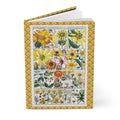
The Fused Anthers: Linnaeus, Geisler, and the Botanical Order of Syngenesia
How an eighteenth-century classification system turned the sunflower family into one of the most visually compelling chapters in the history of natural history illustration
In 1753, Carl Linnaeus published Species Plantarum — the work that would become the foundation of modern botanical nomenclature. In its pages, he organized the plant kingdom into twenty-four classes, each defined by the number, arrangement, and characteristics of the stamens. The nineteenth class he called Syngenesia: from the Greek syn (together) and genesis (origin), rendered in German as Zusammengewachsene — “fused together.” It was the class of plants whose anthers grew united into a tube around the style, a structural peculiarity that Linnaeus recognized as one of the most distinctive in the vegetable kingdom.
The plants of Syngenesia were, in the main, the composite flowers: the daisies, the sunflowers, the calendulas, the thistles, the echinacea. What appears to the casual observer as a single flower is, in fact, a dense community of dozens or hundreds of tiny individual florets, each with its own reproductive apparatus, packed together into a structure of extraordinary efficiency and beauty. Linnaeus saw in this arrangement not merely a taxonomic curiosity but a kind of botanical democracy — a multitude organized into a unity.

Christian Gottfried Geisler and the Art of Scientific Engraving
By the final decade of the eighteenth century, Linnaeus had been dead for seventeen years, but his system had conquered European botany. Universities, academies, and private collectors across the continent were commissioning illustrated charts and plates to make the Linnaean classes visible — to give students and enthusiasts a way of seeing the system, not merely reading about it.
It was in this context that Christian Gottfried Geisler (1759–1828) produced his chart of Classis XIX Syngenesia around 1795. Geisler was a Leipzig-based artist and engraver of considerable versatility — he worked across natural history, topography, and portraiture, and his botanical work combined the precision demanded by science with the compositional sensibility of a trained draughtsman. The inscription on the plate — C. G. Geisler Pinx et Sculps — tells us that he both painted and engraved it himself, a relatively rare combination that gave the work an unusual unity of vision.
The chart was designed for educational use, most likely for use in German-speaking academies and natural history collections. Its purpose was didactic: to show students what Syngenesia looked like, to make the abstract category of the fused anther concrete and visible. But Geisler understood, as the best scientific illustrators always have, that clarity and beauty are not opposites. A chart that delights the eye is a chart that is remembered.
The Plate: A Botanical Parliament
The Syngenesia chart is organized with the logic of a well-designed textbook and the visual ambition of a decorative print. At its center, dominating the composition, are the great Helianthus sunflowers — their vivid yellow ray florets radiating outward from dense brown disc centers, their stems thick and authoritative. Around them, in careful arrangement, are the supporting cast of Syngenesia: daisies with their white rays and yellow discs, calendulas in warm orange, echinacea-like forms with their distinctive cone centers, and a range of smaller composite species rendered with the same attentive precision.
What makes the plate remarkable is its layering of information. The large, decorative blooms establish the visual identity of the class; the smaller dissection panels — showing seeds, fruits, individual florets, and reproductive structures in cross-section — provide the scientific substance. The header, in both Latin and German, anchors the chart within the Linnaean system: Classis XIX Syngenesia — Polygamia Frustranea, the subdivision of Syngenesia in which the ray florets are sterile, present for attraction rather than reproduction.
This distinction — between the showy, sterile ray florets and the fertile disc florets at the center — was one of the great insights of eighteenth-century botany. The sunflower, that most apparently simple and cheerful of flowers, turned out to be a complex social organism, a colony of specialists working in concert. Geisler’s chart makes this complexity visible without sacrificing the flower’s essential beauty.
Linnaeus and the Sunflower
The sunflower — Helianthus annuus — had arrived in Europe from the Americas in the sixteenth century, carried back by Spanish explorers who found it cultivated by indigenous peoples across a vast range of the continent. By the eighteenth century, it had become one of the most familiar plants in European gardens, grown for its seeds, its oil, and its spectacular ornamental presence.
For Linnaeus, the sunflower was a perfect exemplar of Syngenesia. Its composite structure was large enough to be easily observed, its ray and disc florets clearly differentiated, its reproductive anatomy accessible to the student with a hand lens and a steady hand. When Geisler chose to place the Helianthus at the center of his chart, he was following a logic that was both scientific and aesthetic: the sunflower was the face of the class, the plant that made Syngenesia legible.
There is something fitting about this. The sunflower has always been a plant of orientation — it turns, famously, to follow the sun across the sky, a behavior known as heliotropism that gave it its Linnaean name. In Geisler’s chart, it performs a similar function: it orients the viewer, draws the eye, and holds the composition together while the smaller, more technical elements do their scientific work around it.
The Enlightenment Classroom
The botanical charts of the late eighteenth century were among the most sophisticated educational tools of their era. In an age before photography, before projected images, before digital reproduction, the hand-engraved and hand-coloured plate was the primary means by which scientific knowledge was made visual. A chart like Geisler’s Syngenesia plate would have been mounted on a wall, unrolled from a case, or bound into a portfolio — consulted, studied, and returned to over years of teaching and learning.
What strikes the modern viewer is how little the fundamental challenge has changed. The problem of making complex information beautiful — of designing a visual object that is simultaneously accurate, clear, and compelling — is as alive today as it was in Leipzig in 1795. Geisler solved it with engraving tools and watercolour; we solve it with screens and software. The sunflowers, at least, remain the same.

If the world of Enlightenment botanical science resonates with you, the Syngenesia Journal brings C.G. Geisler’s 1795 Linnaean classification chart to a hardcover journal — 150 perforated lined pages, ready for botanical notes, observations, or whatever your days require.
References
- Linnaeus, C. Species Plantarum. Stockholm: Laurentius Salvius, 1753.
- Blunt, W. & Stearn, W.T. The Art of Botanical Illustration. Antique Collectors’ Club, 1994.
- Lack, H.W. Garden Eden: Masterpieces of Botanical Illustration. Taschen, 2008.
- Stearn, W.T. Botanical Latin. David & Charles, 1983.
- Pavord, A. The Naming of Names: The Search for Order in the World of Plants. Bloomsbury, 2005.