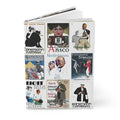
The Camera and the Poster: How Graphic Art Sold the Modern Eye
How the advertising artists of the early twentieth century turned a technological revolution into a visual one — and made photography the defining hobby of the modern age.

There is a moment, somewhere in the first decade of the twentieth century, when photography stops being a profession and becomes a passion. Before that moment, the camera belongs to the studio — to the professional portraitist with his heavy equipment, his tripod, his carefully controlled light, his clients sitting rigid against painted backdrops. After it, the camera belongs to everyone: to the tourist on the promenade, the amateur naturalist in the field, the young woman on a Sunday afternoon, the traveler on the train. The image-making impulse, which had always been present in human culture, suddenly has a new instrument — portable, accessible, democratic — and the world is never quite the same again.
The advertising artists who were commissioned to sell this new instrument understood, with the instinct of their profession, that they were not selling a machine. They were selling a way of seeing. And in doing so, they produced some of the most visually inventive commercial art of the twentieth century.
The Studio and the Street
The professional photographer of the 1880s was a craftsman of considerable technical complexity. The equipment was heavy, fragile, and demanding: large-format cameras on substantial tripods, glass plate negatives that required careful handling and immediate development, exposure times that demanded absolute stillness from the subject. Photography was an art of the studio, of the controlled environment, of the patient professional and the cooperative client.
The transformation of the camera into a portable instrument — lighter, faster, more forgiving — changed not just the technology but the culture. Photography moved from the studio to the street, from the professional to the amateur, from the formal portrait to the spontaneous moment. The folding bellows camera, compact enough to carry in a bag, became the emblem of a new kind of modernity: mobile, curious, visually alert, committed to capturing the world as it actually appeared rather than as it could be arranged to appear.
This shift was as much social as technological. The new amateur photographer was a figure of the emerging middle class — educated, leisured enough to pursue hobbies, interested in the world beyond the immediate horizon of work and family. Photography offered this figure something that no previous hobby had quite provided: a systematic way of engaging with the visual world, of selecting and preserving moments, of constructing a personal archive of experience. The photograph album became a new kind of autobiography, and the camera the instrument of a new kind of self-consciousness.
Art Nouveau and the Organic Lens
The first advertising artists to grapple with the challenge of selling photography worked within the visual language of Art Nouveau — the style that dominated European commercial and decorative art from the 1890s through the first decade of the twentieth century. Art Nouveau was a style of organic forms and flowing lines, of natural motifs translated into decorative pattern, of the boundary between art and craft deliberately dissolved. Its characteristic images — the woman with flowing hair, the flower with sinuous stem, the peacock feather with its hypnotic eye — were everywhere in the visual culture of 1900: on posters, on packaging, on the facades of buildings, on the covers of magazines.
For the advertising artist working in this tradition, the camera presented an interesting challenge. It was a mechanical object — precise, angular, made of metal and glass — and the visual language of Art Nouveau was fundamentally organic, resistant to the geometric and the industrial. The solution that the best Art Nouveau poster artists found was to embed the camera in a world of natural beauty: to surround it with flowers and flowing figures, to present it not as a machine but as an instrument of aesthetic perception, a device for capturing the beauty that Art Nouveau itself celebrated.
The result was a body of advertising imagery of considerable elegance — posters in which the camera appears almost incidentally, held by a graceful figure in a garden or on a terrace, as if photography were simply the natural extension of the cultivated appreciation of beauty that Art Nouveau promoted. The message was subtle but clear: this instrument belongs to the world of art, not the world of industry. To own it is to participate in a visual culture of refinement and sensitivity.
Plakatstil and the Bold Claim
The reaction against Art Nouveau, when it came, was swift and decisive. By the early 1910s, a new generation of German and Austrian graphic designers had developed a radically different approach to the advertising poster — one that rejected the organic complexity of Art Nouveau in favor of stark simplicity, bold color, and the direct confrontation of the viewer. This was the style that came to be known as Plakatstil — poster style — and its leading practitioners, working in Berlin, Munich, and Vienna, transformed the visual language of commercial art with a speed and confidence that still impresses.
The Plakatstil poster was built on reduction. Where Art Nouveau accumulated detail, Plakatstil eliminated it. Where Art Nouveau used the full palette of natural color, Plakatstil used three or four strong colors, flat and unmodulated, chosen for maximum visual impact. Where Art Nouveau placed its figures in elaborate decorative contexts, Plakatstil isolated them against plain backgrounds, forcing the eye to focus on the essential message. The result was a visual language of extraordinary directness — posters that communicated instantly, that could be read at a glance from across a busy street, that lodged themselves in the memory with the efficiency of a well-designed logo.
For photography advertising, Plakatstil offered a different solution to the problem of representing a mechanical object. Rather than aestheticizing the camera, the Plakatstil artist celebrated it — presented it as a bold, modern instrument for a bold, modern age. The camera in a Plakatstil poster is not embedded in a garden; it is held up to the light, displayed with pride, offered to the viewer as an emblem of contemporary life. The figure holding it — often a solid, confident, modern type, far removed from the languid beauties of Art Nouveau — is not an aesthete but an active participant in the visual world, someone who sees clearly and records what they see.
Art Déco and the Geometry of Vision
By the early 1920s, a third visual language had emerged to compete with and eventually supersede both Art Nouveau and Plakatstil. Art Déco — the style that would dominate the decorative and commercial arts of the 1920s and 1930s — drew on both its predecessors while transforming them into something distinctly new. From Art Nouveau it took the commitment to beauty and the integration of art and craft; from Plakatstil it took the bold simplification and the flat color. To these it added a new element: the geometry of the machine age, the angular precision of the skyscraper and the ocean liner, the dynamic diagonals of speed and modernity.
The great exhibitions of the early 1920s — Leipzig 1922 among them — were showcases for this new aesthetic, bringing together the commercial arts of Europe in a spirit of competitive display that drove innovation and established new standards of visual sophistication. Photography advertising at these exhibitions reflected the Art Déco sensibility perfectly: posters in which the camera was presented as a precision instrument of the modern age, its mechanical geometry celebrated rather than concealed, its association with speed and travel and the dynamic life of the contemporary city made explicit.
The figure of the “Photo Girl” — the young, independent woman with her camera, ready to capture the world on her own terms — became one of the defining images of Art Déco advertising. She was a new social type: mobile, confident, visually literate, at home in the modern city. Her camera was not a professional tool or an aesthetic instrument but a personal one — an extension of her own curiosity and independence. In her, the democratization of photography found its most compelling visual embodiment.
The Archive of the Ordinary
What the advertising artists of the early twentieth century were selling, beneath the shifting styles of Art Nouveau and Plakatstil and Art Déco, was a single fundamental proposition: that the ordinary world was worth recording. That the Sunday afternoon, the family gathering, the view from the train window, the face of a friend — that these things deserved to be preserved, that the act of preservation was itself meaningful, that the camera was the instrument of a new relationship between human beings and their own experience.
This proposition has proved, in the century since, to be one of the most consequential ideas in the history of visual culture. The impulse that the early advertising artists were cultivating — the impulse to document, to preserve, to share — has become, in the age of the digital image, the defining visual habit of modern life. We are all photographers now, in a way that the artists of 1910 could barely have imagined, and the world they were helping to create — a world saturated with personal images, committed to the visual documentation of experience — is the world we inhabit.
The posters they made to sell that world are, in their way, its founding documents: images of an image-making culture at the moment of its birth, rendered in the most beautiful commercial art of their age.

If the visual culture of early twentieth-century photography and graphic design resonates with you, the Vintage Photography Advertising Journal brings this golden age collage to a hardcover journal — a hardcover journal — 128 pages, available in lined, dotted, and blank — ready for notes, sketches, or whatever your days require..
References
- Weill, A. Graphic Design: A History. Abrams, 2004.
- Hillier, B. Art Deco of the 20s and 30s. Studio Vista, 1968.
- Ovenden, M. Art Nouveau Posters. Prestel, 2012.
- Frizot, M. (ed.) A New History of Photography. Könemann, 1998.
- Jobling, P. & Crowley, D. Graphic Design: Reproduction and Representation since 1800. Manchester University Press, 1996.