The Armoured Flower: Two Centuries of Cactus Botanical Art, from Saftleven's Golden Age to Mütrel's Encyclopedia
When the first cactus arrived in Europe, nobody quite knew what to make of it. The plant that Spanish explorers brought back from the New World in the late fifteenth and early sixteenth centuries was unlike anything in the European botanical tradition — leafless, armoured with spines, capable of flowering with improbable extravagance in conditions that would kill almost any other plant. It was, to European eyes, a botanical paradox: a living thing that seemed to have dispensed with the usual requirements of plant life and replaced them with something altogether stranger.
The response of European naturalists and artists to this paradox produced, over the following centuries, some of the most remarkable botanical illustrations in the history of science. Two of them — separated by more than two hundred years but united by the same spirit of careful observation — are the subject of this essay: Herman Saftleven's 1683 drawing of a flowering prickly pear, and G. Mütrel's 1892 scientific plate of the Cactaceae family from Brockhaus' Konversations-Lexikon.
The New World Plant and the European Imagination
The cactus entered European consciousness gradually, through the accounts of explorers, the collections of botanical gardens, and the curiosity cabinets of the wealthy. By the sixteenth century, the prickly pear — Opuntia — had been introduced to the Mediterranean basin, where it adapted with such enthusiasm that it is now considered a naturalized plant in Spain, Italy, and North Africa. Other species followed more slowly, requiring the controlled environments of heated glasshouses to survive northern European winters.
The botanical gardens of the sixteenth and seventeenth centuries — at Padua, Leiden, Oxford, and Paris — became the primary sites of cactus cultivation in Europe, and their collections attracted naturalists, artists, and curious visitors from across the continent. It was in these gardens, and in the private collections of wealthy patrons, that the first serious attempts to document the cactus in art and science were made.
The challenge for the botanical illustrator was considerable. The cactus presented forms that had no precedent in the European visual tradition — the flattened pads of the prickly pear, the columnar stems of the cereus, the globular bodies of the mammillaria, the pendant branches of the rhipsalis. Each required a new visual vocabulary, a new set of conventions for representing form, texture, and structure.
Herman Saftleven and the Dutch Golden Age
Herman Saftleven (1609–1685) was one of the most versatile Dutch artists of the seventeenth century. Born in Rotterdam and trained in the tradition of Dutch landscape painting, he spent most of his career in Utrecht, where he became celebrated for his river landscapes, his panoramic views of the Rhine, and his meticulous studies of natural history subjects.
The Dutch Golden Age was, among many other things, a golden age of natural history illustration. The same mercantile culture that funded Rembrandt and Vermeer also funded the great botanical gardens, the natural history collections, and the illustrated publications that documented the extraordinary diversity of the natural world that Dutch trade was bringing to European attention. Artists like Maria Sibylla Merian, Jan Davidsz. de Heem, and Rachel Ruysch developed a tradition of natural history illustration that combined scientific precision with artistic ambition in ways that had no parallel elsewhere in Europe.
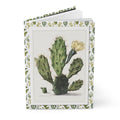
Saftleven's 1683 drawing of a flowering prickly pear belongs to this tradition. Created when the artist was in his mid-seventies — a remarkable late work — it captures the plant with the directness and precision that characterize the best Dutch natural history art of the period. The composition is simple: a single prickly pear stem, its pads rendered with careful attention to the geometry of the spines and the texture of the surface, crowned with flowers that open with an extravagance that seems almost incongruous on such an armoured plant.
What makes Saftleven's drawing remarkable is not merely its accuracy but its quality of attention. The artist has looked at this plant with genuine curiosity — not as a specimen to be catalogued but as a living thing with its own particular beauty. The flowers are rendered with the same care as the spines, the soft with the same precision as the hard. It is a drawing that bridges art and science in the way that the best Dutch natural history illustration always did.
Two Centuries Later: G. Mütrel and the Encyclopedic Tradition
By 1892, the world of botanical illustration had changed almost beyond recognition. The development of chromolithography in the 1830s and 1840s had made colour illustration affordable for mass publication. The great encyclopedias and reference works of the nineteenth century — among them Brockhaus' Konversations-Lexikon, the German-language encyclopedia that was one of the most comprehensive reference works of its age — could now include full-colour botanical plates as a matter of course.
G. Mütrel's 1892 Cactaceae plate for Brockhaus represents a different tradition from Saftleven's intimate study. Where Saftleven drew a single plant with the eye of an artist, Mütrel assembled six species on a single plate with the systematic ambition of a scientist. The plate is a survey — an attempt to represent the diversity of the Cactaceae family in a single composition that would allow the encyclopedia's readers to understand the range of forms that the family encompasses.
The six species Mütrel chose are a remarkable selection. Nopalea coccinellifera — the cochineal cactus, cultivated for centuries in Mexico as the host plant of the cochineal insect, source of the red dye that coloured the textiles of Europe. Cephalocereus senilis — the Old Man Cactus, its columnar stem covered in long white hair that gives it an appearance of great antiquity. Cereus giganteus — the Saguaro, the iconic columnar cactus of the Sonoran Desert, which can live for two hundred years and reach a height of twelve metres. Mammillaria longimamma — a globular cactus from Mexico, its surface covered in elongated tubercles that give it a distinctive warty appearance. Rhipsalis paradoxa — a pendant epiphytic cactus from the Brazilian rainforest, as different from the desert cacti as it is possible to imagine while remaining within the same family. And Echinocactus — the barrel cactus, its ribbed globular body a masterpiece of structural engineering.
Together, these six species demonstrate the extraordinary range of the Cactaceae family — from the desert to the rainforest, from the columnar to the globular, from the spined to the hairy. Mütrel's plate is not merely a scientific document but a visual argument: that the cactus family, far from being a curiosity of the New World, is one of the most diverse and remarkable plant families on earth.
The Art of Botanical Documentation
What unites Saftleven's 1683 drawing and Mütrel's 1892 plate, despite their differences of purpose and tradition, is a shared commitment to the act of looking. Both artists — and both were artists, whatever their scientific intentions — understood that the botanical illustration is, at its best, an act of sustained attention: a record not merely of what a plant looks like but of what it is like to look at a plant carefully, over time, with the intention of understanding it.
This quality of attention is what distinguishes the great botanical illustrations from the merely competent ones. It is present in Saftleven's rendering of the prickly pear flowers, in the way the petals catch the light and the stamens cluster at the centre. It is present in Mütrel's depiction of the Saguaro's fluted columns, in the precision with which the ribs and spines are rendered. In both cases, the illustration is not a substitute for the plant but an invitation to look at it more carefully — to see what the artist has seen.
Two centuries separate these two works, and the world of botanical science changed enormously in the interval. But the fundamental act — a human being looking at a plant with care and attempting to render what they see — remained constant. It is an act that connects Saftleven's Utrecht studio to Mütrel's Leipzig workshop, and both to every naturalist who has ever sat down with a notebook and tried to capture the particular beauty of an armoured flower.
Further Reading
- Blunt, W., & Stearn, W. T. (1994). The Art of Botanical Illustration. Woodbridge: Antique Collectors’ Club.
- Schulz, W. (1982). Herman Saftleven 1609–1685: Leben und Werke. Berlin: De Gruyter.
- Anderson, E. F. (2001). The Cactus Family. Portland: Timber Press.
- Brockhaus, F. A. (1892). Brockhaus’ Konversations-Lexikon. Leipzig: Brockhaus.
- Mabberley, D. J. (2008). Mabberley’s Plant-Book. Cambridge: Cambridge University Press.
- Lack, H. W. (2001). Garden Eden: Masterpieces of Botanical Illustration. Cologne: Taschen.

The Saftleven & Mütrel Cactus Botanical Journal from LeBonJournal brings together Herman Saftleven’s 1683 Dutch Golden Age prickly pear and G. Mütrel’s 1892 Cactaceae plate from Brockhaus’ Konversations-Lexikon. 150 lined pages, hardcover, 5.5 × 8.5 inches. Explore the journal →