Silence Over the Marsh: Ohara Koson and the Art of the Wild Goose
In Japanese art and poetry, the wild goose — kari — has carried a particular weight of meaning for more than a thousand years. It is the bird of autumn, of migration, of distances too great to measure. It appears in the oldest anthologies of Japanese verse as an emblem of longing and transience, its cry heard across the night sky as the seasons turn. When Ohara Koson chose the wild goose as one of his most enduring subjects, he was drawing on a tradition as deep as Japanese culture itself.
Koson’s geese are not symbols, exactly. They are geese — observed with the precision of a naturalist and rendered with the economy of a master printmaker. And yet they carry everything the tradition asks of them: the silence of the marsh at dawn, the stillness of a moonlit night, the sense of a world that exists just beyond the reach of words.

Ohara Koson: From Meiji to Shōwa
Ohara Koson (1877–1945) was born in Kanazawa and trained in the Maruyama-Shijō school of painting before moving to Tokyo, where he became one of the most prolific and celebrated designers of woodblock prints of his generation. He worked under several names — Koson, Shōson, Hoson — across a career that spanned the Meiji, Taishō, and early Shōwa periods, a time of extraordinary transformation in Japanese art and society.
His speciality was kachō-e — pictures of birds and flowers — a genre with deep roots in both Chinese and Japanese painting. Within this tradition, Koson achieved something distinctive: a combination of meticulous naturalistic observation and bold compositional simplicity that made his prints immediately recognisable and endlessly reproducible. He designed hundreds of prints over his career, many of them featuring birds — herons, kingfishers, cranes, sparrows, eagles — observed in their natural habitats with an attention to posture, plumage, and movement that no photograph of the era could match.
The Shin-hanga Movement
Koson worked at the heart of the Shin-hanga — “new prints” — movement, a early twentieth-century revival of the traditional Japanese woodblock print that sought to combine the craft traditions of the Edo period with Western influences in light, shadow, and perspective. Where the earlier ukiyo-e tradition had been a popular commercial art, Shin-hanga positioned the woodblock print as a fine art object — produced in limited editions, signed by the designer, and collected by connoisseurs in Japan, Europe, and America.
The movement was championed by publisher Watanabe Shōzaburō, who worked with Koson and other leading designers to produce prints of exceptional technical quality. The collaboration between designer, woodcarver, printer, and publisher — the traditional division of labour in Japanese printmaking — was maintained, but elevated to a new standard of refinement. The results were prints of extraordinary delicacy: subtle gradations of colour, precise rendering of texture, compositions that balanced the decorative and the naturalistic with perfect ease.
Flying Geese, c. 1926: Dawn Over the Marsh
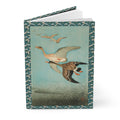
The front cover of our journal reproduces one of Koson’s most celebrated compositions: Flying Geese, created around 1926 during the Taishō-Shōwa period. A bandada of wild geese rises from a misty marsh at dawn — their wings spread, their bodies caught in the moment of lift, the pale sky behind them still holding the last of the night.
The composition is a masterclass in Shin-hanga technique. The geese are rendered with precise naturalistic detail — the curve of each wing, the angle of each neck — while the marsh and sky dissolve into soft gradations of grey and gold that owe as much to Western watercolour as to the Japanese woodblock tradition. The sense of movement is extraordinary: you can almost hear the rush of wings, the splash of water, the silence that follows.
It is a print that captures a single instant — and makes it feel eternal.
Goose at Full Moon, 1900–1936: The Stillness of Night
The back cover presents a very different mood: Goose at Full Moon, one of Koson’s most serene and widely admired compositions. A single goose stands among reeds and small wildflowers beneath a full moon — the water still, the night quiet, the world reduced to its essential elements.
Where Flying Geese is all movement and energy, Goose at Full Moon is stillness and contemplation. The full moon — a recurring motif in Japanese art and poetry, associated with beauty, impermanence, and the passage of time — illuminates the scene with a soft, even light that flattens the space and draws the eye to the goose’s simple, dignified form. The reeds and flowers frame the composition with the delicate precision that is Koson’s signature.
Together, the two prints frame the wild goose’s world: the drama of dawn departure and the peace of moonlit rest.
The Goose as Symbol
In the Japanese literary tradition, the wild goose is above all a bird of distance. It arrives in autumn from the north and departs in spring — its migrations marking the turning of the year with a regularity that poets found both consoling and melancholy. The sound of geese calling overhead on an autumn night is one of the great set pieces of Japanese poetry, from the Man’yōshū of the eighth century to the haiku of Bashō and beyond.
Koson’s prints participate in this tradition without being enslaved to it. His geese are real birds — observed, studied, rendered with care — and they carry their symbolic weight lightly, as the best art always does. To look at Flying Geese or Goose at Full Moon is to feel the pull of distance and the comfort of stillness at the same time — which is, perhaps, what the wild goose has always meant.
—
The woodblock prints of Ohara Koson — Flying Geese (c. 1926) and Goose at Full Moon — appear on the cover of our Ohara Koson Journal — Flying Geese & Moonlit Goose, a hardcover journal with 128 pages, casewrap sewn binding, and matte laminated full-wrap cover.
References
- Koson, Ohara. Flying Geese. Woodblock print, c. 1926. Shin-hanga period.
- Koson, Ohara. Goose at Full Moon. Woodblock print, 1900–1936.
- Merritt, Helen, and Nanako Yamada. Guide to Modern Japanese Woodblock Prints: 1900–1975. University of Hawaii Press, 1992.
- Newland, Amy Reigle, ed. The Hotei Encyclopedia of Japanese Woodblock Prints. Hotei Publishing, 2005.
- Keene, Donald. Seeds in the Heart: Japanese Literature from Earliest Times to the Late Sixteenth Century. Columbia University Press, 1999.