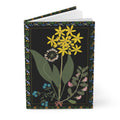
Scissors and Black Paper: The Mysterious Ellen W. and Her 1835 Album of Cut-Paper Flowers
She is known only as Ellen W. No surname, no biography, no portrait. And yet the work she left behind — an album of 26 cut-paper flower compositions created in Great Britain in 1835 — is among the most extraordinary examples of botanical art produced in the early Victorian era.
In an age when women’s contributions to natural history were routinely uncredited, Ellen W.’s initials are all we have. But her work speaks with remarkable clarity: a mastery of botanical observation, an eye for dramatic composition, and a patience with scissors and colored paper that borders on the meditative.
The Art of Cut-Paper Flowers
Cut-paper art — the practice of cutting and arranging paper to create images — has a long history in European decorative tradition, from the scherenschnitte of German-speaking countries to the silhouette portraits fashionable in Georgian England. But Ellen W.’s application of the technique to botanical illustration was something altogether different.
Rather than painting or engraving her subjects, she cut individual flower representations from colored paper — each petal, each leaf, each stem — and arranged them into composite botanical studies. The result is a technique that is simultaneously more laborious and more intimate than any other form of botanical art: every edge is a decision, every layer a choice.
The stark black backgrounds she chose for her compositions were not merely decorative. They serve a precise visual function: against black, the colors of each wildflower — the golden yellow of a buttercup, the soft pink of a hawk’s-beard, the pale blue of a chicory — appear luminous, almost backlit, with a drama that no watercolor or engraving can replicate.
Plate 04: Yellow, Blue and Pink Wildflowers with Ribbon
The fourth plate of Ellen W.’s album presents a vibrant bouquet of British wildflowers against the characteristic black background. Yellow blooms burst with golden warmth; delicate blue blossoms add cool contrast; pink buds provide soft romantic accents. The bouquet is tied at the base with a small pink ribbon — a detail that transforms the botanical study into something closer to a gift, a gesture of affection rendered in paper and scissors.
The cut-paper technique is evident in the precise edges and layered composition. Each flower was individually cut and carefully arranged to create a whole that is simultaneously a scientific record and a work of decorative art — the two impulses of Victorian natural history, the documentary and the beautiful, held in perfect tension.
Plate 14: Crepis Rubra, Scorzonera Hispanica and Lactuca Perennis
The fourteenth plate turns to the Asteraceae — the daisy family, one of the largest and most diverse plant families in the world. The prominent pink multi-petaled flowers are Crepis rubra, the pink hawk’s-beard, native to southern Europe and the eastern Mediterranean. Alongside them, Scorzonera hispanica — black salsify, cultivated since antiquity for its edible root — and Lactuca perennis, the perennial lettuce, a wildflower of rocky slopes and dry grasslands valued in traditional medicine.
Against the black background, each petal, leaf, and stem stands out as if illuminated from within. It is a drama that no other botanical art technique can match — and it is entirely the product of Ellen W.’s deliberate compositional choices, made with scissors and paper in Great Britain in 1835.
A Woman of the Early Victorian Era
Ellen W. worked at a particular moment in British cultural history. The 1830s were the decade before Victoria’s accession, a period of intense interest in natural history among the educated middle classes, and of growing — if still constrained — participation by women in scientific and artistic life. Botanical illustration was one of the few fields in which women’s contributions were acknowledged, even celebrated: the tradition of the “botanical lady” was well established by the time Ellen W. took up her scissors.
But cut-paper flowers were not the work of a dilettante. The 26 plates of her album represent a sustained, systematic engagement with British flora — a project of documentation as much as decoration. That she chose to sign only with her initials may reflect the conventions of the time, or a personal preference for anonymity. Either way, the work survives, and it is enough.
—
The cut-paper compositions of Ellen W. appear on the cover of our Wildflower Journal — Ellen W. 1835, a hardcover lined journal with 150 perforated pages, casewrap sewn binding, and matte laminated full-wrap cover.
References
- Ellen W. Album of Cut-Paper Flowers. Great Britain, 1835. Collection of 26 plates.
- Shteir, Ann B. Cultivating Women, Cultivating Science: Flora’s Daughters and Botany in England, 1760–1860. Johns Hopkins University Press, 1996.
- Blunt, Wilfrid, and William T. Stearn. The Art of Botanical Illustration. Antique Collectors’ Club, 1994.
- Allen, David Elliston. The Naturalist in Britain: A Social History. Princeton University Press, 1994.