The Jungle in the Playroom: Henri Rousseau and the Naïve Art of Childhood Wonder
There is a quality in Henri Rousseau's jungle paintings that children recognise immediately and adults spend years trying to describe. It is not realism — the plants are too large, the animals too still, the light too even and sourceless. It is not fantasy in the conventional sense — the details are too precise, too carefully observed, too insistent on the particularity of each leaf and each eye. It is something else: a way of seeing that treats every element of the visible world as equally important, equally worthy of attention, equally strange.

Children see this way naturally. Adults, for the most part, have learned not to. The history of Rousseau's critical reception is, in part, the history of adults slowly relearning what children never forgot.
The Painter Who Never Left France
Henri Rousseau was born in Laval, in the Loire valley, in 1844. He worked for most of his adult life as a customs officer — a douanier — at the gates of Paris, collecting tolls on goods entering the city. He began painting seriously in his forties, entirely self-taught, and exhibited at the Salon des Indépendants from 1886 onward. He was, by the standards of the Parisian art world, an outsider: no formal training, no academic credentials, no wealthy patrons. He was also, by any measure, one of the most original painters of his generation.
He never visited a jungle. The tropical landscapes that made him famous — the dense, layered, luminous forests populated by lions and monkeys and exotic birds — were constructed entirely from sources available in Paris. He spent hours in the greenhouses of the Jardin des Plantes, studying the tropical plants that the French colonial enterprise had brought to the capital. He sketched animals at the zoo. He consulted illustrated books and botanical atlases. From these materials, he built a jungle that no one had ever seen — because it had never existed anywhere except in his imagination.
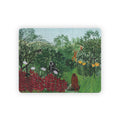
Tropical Forest with Monkeys, 1910
Tropical Forest with Monkeys was painted in 1910, the last year of Rousseau's life. He was sixty-five years old, and he had been painting jungles for more than two decades. The composition is characteristic: a dense wall of vegetation fills the canvas from edge to edge, the individual plants rendered with the same flat, precise attention regardless of whether they are in the foreground or the background. Five monkeys inhabit the scene — perched on rocks, clinging to vines, looking out at the viewer with the calm, curious gaze that Rousseau gave to all his animals.
The palette is deep and various: dozens of greens, from the almost-black of the shadowed undergrowth to the bright, almost acid green of the sunlit leaves. Against this, the reds and oranges of fruit and flower create a rhythm of colour that is both decorative and naturalistic. The light is sourceless — everything is equally illuminated, nothing casts a shadow in the conventional sense — and this gives the scene its characteristic quality of suspension, as if time has stopped and the jungle is holding its breath.
The painting is now in the collection of the National Gallery of Art in Washington. It is one of the finest examples of Rousseau's mature style — a style that, by 1910, had attracted the admiration of Picasso, Apollinaire, and the Parisian avant-garde, who recognised in Rousseau's apparent naivety something more sophisticated than it appeared.
What Naïve Art Knows
The term “naïve art” is sometimes used dismissively, as if the absence of formal training were a deficiency rather than a condition. But the naïve painter's relationship to the visible world is not simpler than the trained painter's — it is different. The trained painter has learned a set of conventions for representing space, light, and form that are so deeply internalised they feel like perception itself. The naïve painter has not learned these conventions, and so approaches the visible world without them — seeing each element as it presents itself, without the hierarchy of importance that academic training imposes.
This is why Rousseau's jungles feel the way they do. Every leaf is as important as every other leaf. The monkey in the foreground receives no more visual emphasis than the plant behind it. The eye moves across the surface of the painting without being directed — it discovers, rather than follows. This is precisely how a child looks at a picture: without the trained adult's tendency to identify the main subject and subordinate everything else to it.
Picasso understood this. When he organised a famous dinner in Rousseau's honour in 1908, he was not being ironic. He genuinely admired what Rousseau had achieved — a way of seeing that the academic tradition had trained out of most painters, and that Rousseau had retained, or recovered, or perhaps never lost.
The Jungle as a Child's World
There is another reason why Rousseau's jungles connect so naturally with children. They are, in a fundamental sense, worlds of equal wonder — places where everything is interesting, where the small and the large, the familiar and the exotic, the plant and the animal, all coexist without hierarchy. This is how children experience the natural world before adults teach them which things are worth noticing and which are not.
A child assembling a puzzle of Tropical Forest with Monkeys will not necessarily go straight to the monkeys. They may be equally drawn to a particular leaf, a patch of colour, a fruit half-hidden in the undergrowth. They are doing what Rousseau did: looking at everything, finding everything equally worthy of attention. The puzzle, in this sense, is not just a reproduction of a painting. It is an invitation to see the way Rousseau saw — and the way children, before they are taught otherwise, naturally do.
A Legacy of Wonder
Rousseau died in September 1910, a few months after completing Tropical Forest with Monkeys. He died in poverty, largely unrecognised by the official art world, though celebrated by the avant-garde. Within a decade of his death, his reputation had been transformed: he was recognised as a precursor of surrealism, an influence on Picasso and the cubists, a painter whose apparent simplicity concealed a profound and original vision.
His jungles have never gone out of fashion. They appear on posters and postcards, in children's books and museum gift shops, in the backgrounds of films and the covers of novels. They have become part of the visual furniture of the modern world — images so familiar that it is easy to forget how strange they are, how unlike anything that existed before Rousseau painted them.
The strangeness is still there, if you look. The monkeys are still watching. The leaves are still equally important. The light is still sourceless and even. It is still a jungle that no one has ever visited — except in the imagination of a customs officer from Laval who spent his afternoons in the greenhouses of the Jardin des Plantes, looking carefully at plants he had never seen before, and finding them extraordinary.

Our Rousseau Jungle Monkeys Puzzle reproduces Tropical Forest with Monkeys (1910) from the National Gallery of Art in 30 large pieces for children ages 3–7.
References
Shattuck, R. (1968). The Banquet Years: The Origins of the Avant-Garde in France, 1885 to World War I. Vintage Books.
Bihalji-Merin, O. (1971). Modern Primitives: Naïve Painting from the Renaissance to the Present Day. Thames and Hudson.
LeRoy, C. (2006). Henri Rousseau. Taschen.
National Gallery of Art. (2024). Tropical Forest with Monkeys, Henri Rousseau, 1910. nga.gov.