The Secret Language of Bouquets: Robert Tyas and the Floral Emblems of 1896
In the drawing rooms and gardens of Victorian England, a bouquet was never merely a bouquet. The roses a young man sent to a woman he admired, the violets she returned, the forget-me-nots tucked into a corsage, the lily of the valley arranged beside carnations on a dinner table — each flower carried a meaning, each combination composed a message, and the recipient who knew the language could read it as clearly as any written note. This was floriography — the language of flowers — and it flourished in the Victorian era with an elaborateness and a seriousness that reflected the particular social conditions of the age: a world in which direct emotional expression was constrained by etiquette, in which the distance between what could be said and what could be felt was vast, and in which flowers offered a medium of communication that was at once public and private, visible to all and legible only to those who knew the code.

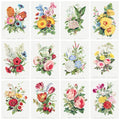
Robert Tyas's The Language of Flowers, or, Floral Emblems of Thoughts, Feelings, and Sentiments, published in London in 1896, was one of the most beautiful documents of this tradition. Its twelve hand-coloured plates — showing bouquets that mixed garden classics with wilder species, each combination a deliberate composition of meaning — were not merely illustrations of flowers. They were illustrations of messages: visual transcriptions of the emotional vocabulary that the Victorians had developed over decades of floral exchange, preserved in the kind of chromolithographic colour that could capture the luminous pink of a moss rose, the deep purple of a sweet violet, the clear blue of a forget-me-not, with a fidelity that no earlier printing technology could have achieved.
The Victorian Art of Floriography
The language of flowers was not a Victorian invention — it had roots in the Ottoman tradition of selam, the practice of sending messages through objects including flowers, which had been introduced to Western Europe by Lady Mary Wortley Montagu in the early eighteenth century. But it was in the Victorian era that floriography reached its fullest elaboration, supported by a publishing industry that produced dozens of flower dictionaries, each assigning symbolic meanings to hundreds of species, and by a social culture in which the giving and receiving of flowers was a central ritual of courtship, friendship, and mourning.
The meanings assigned to flowers were not always consistent between different dictionaries — the red rose meant passionate love in almost every version, but the meanings of less prominent flowers varied considerably from author to author. What was consistent was the underlying principle: that flowers could carry emotional weight, that a bouquet could be composed as deliberately as a poem, and that the recipient who understood the language was receiving not merely a gift but a communication. The moss rose meant voluptuous love; the sweet violet meant modesty; the forget-me-not meant true love and remembrance; the lily of the valley meant the return of happiness. To mix roses with forget-me-nots was to say, in the most direct terms the etiquette of the era permitted: I love you, and I will not forget you.
Robert Tyas and the 1896 Publication
Robert Tyas was a Victorian author and publisher who produced several works on flowers and their symbolism, of which the Language of Flowers was the most celebrated and most enduring. The 1896 edition — published in London at a moment when the Victorian era was approaching its close and the elaborate social rituals of the mid-century were beginning to give way to the more relaxed conventions of the Edwardian period — was a summation of the floriographic tradition at its fullest development: a work that combined botanical accuracy with symbolic richness, and that presented the language of flowers in a visual form of exceptional beauty.
The twelve hand-coloured plates that illustrate the volume are among the finest examples of Victorian botanical chromolithography: images in which the technical demands of accurate botanical representation — the precise rendering of petal shape, leaf texture, and stem structure — are combined with the decorative ambition of the gift book tradition, producing illustrations that are at once scientifically informative and aesthetically ravishing. Each plate shows a bouquet composed of multiple species, and each bouquet is a deliberate composition: not merely a pleasing arrangement of flowers, but a message written in the language that Tyas's text decodes.
The Twelve Bouquets: A Reading
The twelve plates of the Language of Flowers can be read as a sequence of messages, each bouquet a different emotional register within the vocabulary of Victorian floriography.
The first plate opens with dog roses (Rosa canina) in pink and orange — pleasure and pain, the ambivalence of love — accompanied by blue cornflowers (Centaurea cyanus), which carried the meaning of delicacy. The second combines yellow marigolds (grief and despair in some dictionaries, but also sacred affection), purple and pink aquilegias (folly, but also resolved to win), and small blue flowers — a more complex emotional composition, suggesting the mixed feelings of a love not yet declared.
The third plate is among the most legible: lily of the valley (Convallaria majalis), with its white bells and broad green leaves, meant the return of happiness — and paired with pink carnations, which meant pure love, it composed a message of joyful and uncomplicated affection. The fourth, with its yellow hollyhocks (ambition) and light blue accents, speaks a different language: aspiration rather than sentiment.
The central plates move through a wider emotional range. The fifth — red hibiscus (delicate beauty), white lilac (youthful innocence), and blue cornflowers — is a bouquet of admiration and freshness. The sixth is perhaps the most romantically charged: moss roses in pale pink (voluptuous love), sweet violets (modesty), and white jasmine (amiability) — a message of ardent feeling tempered by gentleness. The seventh combines white roses (silence, or I am worthy of you), purple heather (solitude), and blue forget-me-nots (true love, remember me) — a bouquet of quiet, enduring devotion. The eighth, with its white and pink primroses and small yellow spring flowers, speaks of early youth and the first stirrings of feeling.
The final row moves into richer, more complex territory. The ninth — red and white dahlias (dignity and elegance), yellow daisies (innocence), and wild flower spikes — is a bouquet of formal admiration. The tenth is spectacular: red and striped tulips (declaration of love, beautiful eyes) with purple freesias and small white flowers — a bold, confident declaration. The eleventh, with its great cabbage roses in pink and white surrounded by dense green foliage, is the most purely romantic: an abundance of love, unqualified and unambiguous. And the twelfth closes the sequence with vivid red and yellow ranunculus (you are radiant with charms) and blue delphiniums (lightness, levity) — a final flourish of joyful admiration.
A Digital Archive for Designers and Dreamers

Our Victorian Floral Emblems digital collection makes all twelve plates available as high-resolution archival images — 2454 × 3681 pixels at 300 DPI, print-ready for professional reproduction, in the public domain and available for personal use. Instant download upon purchase.
They are images for wedding designers composing invitations with symbolic intention, for graphic designers drawn to the decorative vocabulary of Victorian botanical art, for crafters making greeting cards that carry a hidden message, for home decorators who want to frame something beautiful and historically resonant, and for anyone who finds in the Victorian language of flowers — its precision, its romanticism, its faith that a bouquet could say what words could not — something worth preserving.
A moss rose and a forget-me-not. Voluptuous love, and remember me. Some messages do not need translation.
References & Further Reading
- Tyas, Robert. The Language of Flowers, or, Floral Emblems of Thoughts, Feelings, and Sentiments. London, 1896. [The primary source: twelve hand-coloured plates with symbolic meanings, the most beautiful edition of Tyas's celebrated floriographic dictionary.]
- Seaton, Beverly. The Language of Flowers: A History. University Press of Virginia, 1995. [The standard academic study of floriography, covering its origins, development, and Victorian flowering.]
- Greenaway, Kate. Language of Flowers. Routledge, 1884. [The most famous Victorian flower dictionary, illustrated by Kate Greenaway — a useful companion to Tyas for understanding the range of meanings assigned to individual species.]
- Goody, Jack. The Culture of Flowers. Cambridge University Press, 1993. [A wide-ranging anthropological study of the role of flowers in human culture, including the Victorian floriographic tradition.]
- Henrey, Blanche. British Botanical and Horticultural Literature before 1800. Oxford University Press, 1975. [On the history of British botanical publishing, the tradition within which Tyas's work belongs.]
- Pavord, Anna. The Naming of Names: The Search for Order in the World of Plants. Bloomsbury, 2005. [On the history of botanical classification and illustration, the scientific context of Victorian flower publishing.]
- Vickery, Roy. A Dictionary of Plant Lore. Oxford University Press, 1995. [On the folklore and symbolic meanings of British plants, a useful reference for the deeper roots of Victorian floriographic symbolism.]