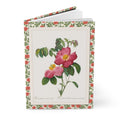
The Raphael of Flowers: Redouté, Les Roses, and the Art of the Stipple Engraving
In the summer of 1798, a Belgian painter named Pierre-Joseph Redouté was summoned to the Château de Malmaison, a few miles west of Paris, to document the rose collection of Joséphine Bonaparte. Joséphine had been assembling roses from across the world — from China, from Persia, from the Americas, from the gardens of England and the Low Countries — and she wanted them recorded with the same precision and beauty that Redouté had brought to his earlier botanical work. The result, published between 1817 and 1824 as Les Roses, is the most celebrated botanical publication in the history of natural history illustration. It is also, by any measure, one of the most beautiful books ever made.
Pierre-Joseph Redouté and the Court of Flowers
Redouté was born in 1759 in Saint-Hubert, in what is now Belgium, the son and grandson of painters. He came to Paris in his early twenties and found work as a theatrical scene painter before his talent for botanical illustration brought him to the attention of the botanist Charles Louis L'Héritier de Brutelle, who employed him to illustrate his publications and introduced him to the world of scientific natural history. From there, Redouté's career ascended rapidly. He became official draughtsman to the Cabinet of Marie Antoinette, survived the Revolution with his reputation intact, and went on to serve as court painter to the Empress Joséphine and later to the restored Bourbon monarchy.
He was called the Raphael of Flowers — a comparison that captured something real about his achievement. Like Raphael, Redouté combined technical mastery with an instinct for grace that made his work seem effortless. His roses are not merely accurate. They are beautiful in the way that the best portraits are beautiful: they capture not just the appearance of their subject but something of its character, its particular way of being in the world.
The Stipple Engraving
The technical achievement that made Les Roses possible was the stipple engraving — a printmaking technique in which the image is built up from a dense grid of dots rather than lines. Redouté did not invent stipple engraving, but he perfected its application to botanical illustration, working with a team of engravers to translate his watercolour originals into printed plates of extraordinary delicacy.
The process was laborious. Each plate required the engraver to work across the entire surface of the copper, building up the image dot by dot, varying the density and size of the dots to create the transitions of tone and colour that give Redouté's roses their characteristic luminosity. The plates were then printed in colour — a relatively new technique in 1817 — and finished by hand, with individual colourists adding the final touches to each impression. No two copies of Les Roses are exactly alike.
The result was a quality of surface that no other printmaking technique of the period could match. The petals of Redouté's roses seem to have depth — to be lit from within rather than from without. The transitions from shadow to light are so gradual as to be almost imperceptible. The colours are at once vivid and delicate, saturated and transparent. It is a technical achievement that has never been surpassed in botanical illustration.
Rosa Gallica: The Oldest Rose in Europe
The Rosa gallica — the Provins Rose, the Apothecary's Rose — is one of the oldest cultivated roses in European history. Native to southern and central Europe, it was grown by the ancient Greeks and Romans, used by medieval apothecaries for its medicinal properties, and cultivated in monastery gardens across the continent for centuries before the great rose breeding programmes of the nineteenth century transformed the genus beyond recognition.
Joséphine grew it at Malmaison. It was among the roses she most prized — not for its novelty, but for its history, its fragrance, and the simplicity of its five-petalled flower. Redouté's plate of Rosa Gallica Rosea Flore Simplici shows it in two stages of bloom: the bud just opening, and the fully open flower with its five simple pink petals arranged around prominent golden stamens. It is a portrait of a rose that has been cultivated for two thousand years, rendered with the same care and attention that Redouté gave to the most exotic novelties in Joséphine's collection.
Rosa Eglanteria: The Wild Sweet Brier
The Rosa eglanteria — the Sweet Brier, the Eglantine — is a wild rose of European hedgerows, its small pink flowers appearing in early summer, its foliage releasing a distinctive apple-like fragrance when bruised. It is a rose that has been celebrated in English poetry since Chaucer, associated with the wild and the uncultivated, with the hedgerow rather than the garden.
Its inclusion in Les Roses is characteristic of Redouté's approach. He was not interested only in the exotic and the cultivated. He documented the full range of the genus — from the most ancient species to the newest hybrids, from the wild roses of European hedgerows to the tea roses newly arrived from China. The Rosa Eglanteria Sub Rubra plate shows a flowering branch with bright pink single-petalled roses and detailed green foliage, the arching habit of the wild rose captured with the same precision that Redouté brought to the most elaborate double-flowered varieties.
Malmaison and the Rose Collection
Joséphine Bonaparte's rose collection at Malmaison was, at its height, the most comprehensive in the world. She employed agents across Europe and beyond to acquire new varieties, corresponded with botanists and nurserymen in England, Holland, and Germany, and maintained a greenhouse that allowed her to grow roses from climates far warmer than the Île-de-France. By the time of her death in 1814, she had assembled more than 250 rose varieties — a collection that served as the foundation for the great rose breeding programmes of the nineteenth century.
Redouté documented this collection over many years, producing the watercolours that would eventually become Les Roses. The publication appeared after Joséphine's death, dedicated to her memory, and it preserved in print what the garden at Malmaison could not preserve in living form: the roses of an extraordinary collection, rendered with the precision of science and the beauty of art.
A Legacy in Ink and Petal
Redouté died in 1840, at the age of eighty, reportedly while examining a white lily that a student had brought him. He had outlived Joséphine by twenty-six years, survived three regimes, and continued teaching and painting almost to the end. His students included some of the most accomplished botanical illustrators of the nineteenth century, and his influence on the genre has never entirely faded.
Les Roses remains in print. Original copies appear at auction regularly, commanding prices that reflect both their rarity and their beauty. The roses Redouté painted are still grown — the Rosa gallica in heritage rose gardens across Europe, the Sweet Brier in hedgerows from Cornwall to the Carpathians. The stipple engravings are still the standard against which botanical illustration is measured.
The Raphael of Flowers made beauty last. That was always the ambition.

If you would like to carry something of that legacy with you, our Rose Journal reproduces Redouté's Rosa Gallica and Rosa Eglanteria plates from Les Roses (1817–1824) on its covers.
References
Redouté, P.-J. (1817–1824). Les Roses. Firmin Didot, Paris.
Blunt, W. & Stearn, W. T. (1994). The Art of Botanical Illustration. Antique Collectors' Club.
Hepper, F. N. (Ed.) (1990). Kew Gardens' Illustrated Encyclopaedia of Plants. Royal Botanic Gardens.
Quest-Ritson, C. (2003). The English Rose. Cassell.