The Pomegranate and Its Symbols: Five Thousand Years of Meaning
There are few fruits as laden with meaning as the pomegranate. It has been cultivated in the Mediterranean and the Middle East for at least five thousand years, and in that time it has accumulated a symbolic weight that no other fruit can match. It appears in the oldest written literature, in the decoration of Solomon's Temple, in the myths of ancient Greece, in the iconography of the Christian church, in the textile patterns of Persia and Byzantium, in the heraldry of Granada and the arms of Catherine of Aragon. It is simultaneously a fruit of death and of fertility, of abundance and of loss, of the underworld and of paradise. To hold a pomegranate is to hold five millennia of human meaning in your hands.
The Oldest Cultivated Fruit
Punica granatum is native to a region stretching from Iran to northern India, and it has been cultivated since at least 3000 BC. It spread westward through the ancient Near East, reaching Egypt, the Levant, and the Mediterranean basin in the second millennium BC. The Egyptians buried pomegranates with their dead — a dried pomegranate was found in the tomb of Tutankhamun — and depicted them in tomb paintings as symbols of prosperity and the afterlife. The ancient Phoenicians carried the fruit to Carthage and to the Iberian Peninsula, where the city of Granada takes its name from the Arabic gharnata, itself derived from the fruit.
The pomegranate's appeal is not difficult to understand. It is extraordinarily productive — a single fruit can contain up to a thousand seeds, each enclosed in a jewel-like aril of deep red juice. It is also remarkably durable: the thick, leathery rind protects the seeds for months without refrigeration, making it an ideal food for long journeys and dry climates. And it is beautiful — the crimson flower, the burnished rind, the extraordinary interior of glistening arils arranged in chambers like a natural jewel box. It is a fruit that rewards attention.
Persephone and the Underworld
The most famous pomegranate in Western literature is the one that Persephone ate in the underworld. The myth, told most fully in the Homeric Hymn to Demeter (probably composed in the seventh century BC), recounts how Persephone, daughter of the harvest goddess Demeter, was abducted by Hades and taken to the underworld. Demeter, grief-stricken, caused the earth to become barren. Zeus intervened and negotiated Persephone's return — but before she left the underworld, she ate six pomegranate seeds, and this act bound her to Hades for six months of every year.
The myth is an explanation of the seasons: when Persephone is in the underworld, Demeter mourns and the earth is barren (winter); when she returns, the earth blooms (spring and summer). But the pomegranate's role in the myth is more complex than a simple seasonal metaphor. In Greek culture, eating the food of the dead was understood to bind the living to the realm of the dead — Persephone's consumption of the pomegranate seeds was not an accident but a kind of marriage, a permanent connection to the underworld that no divine intervention could fully undo. The pomegranate was the fruit of the dead, and also the fruit of the marriage bond.
This double meaning — death and marriage, loss and fertility — runs through the pomegranate's symbolic history. It was carried by brides in ancient Greece. It was placed in tombs. It decorated the columns of temples dedicated to Hera, goddess of marriage. The same fruit that bound Persephone to the underworld was also the symbol of the abundance that her return brought to the earth.
The Pomegranate in Jewish Tradition
In Jewish tradition, the pomegranate is one of the seven species of the Land of Israel mentioned in Deuteronomy, and it carries a weight of religious significance that extends across millennia. The hem of the robe of the High Priest was decorated with pomegranates of blue, purple, and scarlet thread, alternating with golden bells — a description given in Exodus 28:33–34 with a precision that suggests the fruit's deep ritual importance. The capitals of the two great bronze pillars that stood at the entrance to Solomon's Temple — Jachin and Boaz — were decorated with four hundred pomegranates arranged in two rows.
The pomegranate's seeds gave rise to one of the most enduring traditions in Jewish symbolism: the belief that a pomegranate contains 613 seeds, corresponding to the 613 commandments of the Torah. The number is not botanically accurate — pomegranates vary considerably in their seed count — but the symbolic correspondence is powerful, and the pomegranate became an emblem of righteousness, of the fullness of the law, of the aspiration to fulfil every commandment. It appears on Torah finials, on synagogue decorations, on Rosh Hashanah tables where it is eaten as a symbol of the hope for a year as full of good deeds as the pomegranate is full of seeds.
Christian Iconography
The pomegranate entered Christian iconography through multiple routes — from the Hebrew Bible, from classical antiquity, and from the Byzantine artistic tradition that the early church inherited. In Christian art, the pomegranate became a symbol of the resurrection and of eternal life: the fruit that appears to be dead on the outside but contains within it a multitude of living seeds. It was also a symbol of the church itself — the many seeds enclosed within a single rind representing the unity of the faithful within the body of the church.
The pomegranate appears frequently in Renaissance painting, often held by the Christ child or by the Virgin Mary. Sandro Botticelli's Madonna of the Pomegranate (c. 1487, Uffizi Gallery) shows the Virgin and Child surrounded by angels, with the infant Jesus holding an open pomegranate — the exposed seeds a reference to the Passion, the red juice to the blood of the crucifixion. In Raphael's Madonna of the Goldfinch and in dozens of other Renaissance works, the pomegranate appears as a quiet but insistent reminder of mortality and redemption.
The Enlightenment Botanists
By the eighteenth century, the pomegranate had accumulated centuries of symbolic meaning, but it was also the subject of rigorous scientific attention. The Enlightenment's project of systematic natural history documentation brought a new kind of scrutiny to the fruit — not symbolic or mythological, but anatomical. What exactly were the structures of the flower? How were the seed chambers arranged? What was the precise relationship between the external form and the internal architecture?
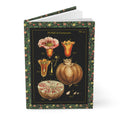
John Miller — born Johann Sebastian Müller in Germany in 1715, trained as a botanical illustrator, and settled in England where he anglicised his name — was one of the finest botanical engravers of the eighteenth century. His 1779 copperplate engravings of Punica granatum document the pomegranate with the precision and beauty that defined Enlightenment natural history illustration at its best: the crimson flower with its crumpled petals, the whole fruit with its leathery rind, the cross-section revealing the jewel-like arils and seed chambers within. These engravings were later incorporated into Friedrich Johann Bertuch's Bilderbuch für Kinder (1790–1830), a twelve-volume educational encyclopedia that brought natural history to a general audience across the German-speaking world.
To look at Miller's engravings now is to see the pomegranate as the Enlightenment saw it — with wonder and precision, with the conviction that careful observation of the natural world was both a scientific and an aesthetic act. The fruit that Persephone ate, that decorated Solomon's Temple, that Botticelli placed in the hands of the Christ child, is here rendered in copperplate with the same devotion that earlier artists brought to its symbolic dimensions. The science and the symbol are not opposites. They are two ways of paying attention to the same extraordinary object.

Our Pomegranate Journal reproduces Miller's 1779 hand-colored copperplate engravings of Punica granatum across its covers, set against a dramatic black background that transforms Enlightenment botanical science into gallery-quality art.
References
Foley, H. P. (1994). The Homeric Hymn to Demeter. Princeton University Press.
Levy, N. (2006). The Pomegranate: A New Look at an Ancient Fruit. University of California Press.
Lipinska, A. (2015). “The Pomegranate in Art and Symbolism.” Journal of Art History, 84(2), 112–134.
Stern, E. (2001). Archaeology of the Land of the Bible, Volume II. Doubleday.
Wilkins, E. H. (1969). “The Coronation of Petrarch.” Speculum, 18(2), 155–197.