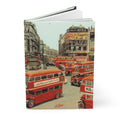
Piccadilly Circus: London's Most Famous Crossroads
There are intersections, and then there is Piccadilly Circus. Few places on earth have concentrated so much energy, spectacle, and human drama into a single roundabout. For well over a century, this corner of the West End has served as London's unofficial living room — the place where the city comes to celebrate, to mourn, to advertise, and simply to be seen.

A Circus in the Roman Sense
The word circus here has nothing to do with acrobats or big tops. It derives from the Latin for a circular open space — the same root that gives us the Circus Maximus in Rome. Piccadilly Circus was laid out in 1819 as a junction connecting Regent Street (then newly built by John Nash as a grand processional route) with Piccadilly, the road that had taken its name from the piccadill, a type of stiff collar manufactured nearby in the early 17th century.
From its earliest days, the Circus occupied a liminal position in London's geography: neither quite the aristocratic calm of Mayfair to the west, nor the theatrical bustle of Covent Garden to the east, but something in between — a threshold, a meeting point, a place of transition and possibility.
The Victorian Pleasure District
By the mid-19th century, Piccadilly Circus had become the gateway to London's entertainment district. The surrounding streets were lined with music halls, supper clubs, and theatres. The Criterion Theatre, opened in 1874 on the south side of the Circus, became one of London's most fashionable venues — and remains open to this day. The Pavilion, the Trocadero, and dozens of restaurants and cafés drew crowds from every class of society.
The installation of the Shaftesbury Memorial Fountain in 1893 — topped by the winged figure popularly (and incorrectly) known as Eros — gave the Circus its most enduring landmark. The aluminium statue, actually representing the Angel of Christian Charity in memory of the philanthropist Lord Shaftesbury, became an immediate gathering point. Londoners and visitors alike arranged to meet under Eros, a tradition that persists to this day.
The Age of Neon: Piccadilly Circus Lights Up
The transformation that would define Piccadilly Circus for the 20th century began in 1908, when the first electric advertising signs appeared on the buildings of the north-east corner. By the interwar years, the illuminated advertisements had become a spectacle in their own right — a British answer to Times Square, drawing tourists and Londoners alike simply to stand and watch the lights.
The names that blazed above the Circus became part of the cultural fabric of Britain: Bovril, the beef extract drink that had warmed the nation since the 1880s; Schweppes, the tonic water that had been refreshing gin drinkers since 1783; Guinness, whose advertising campaigns were among the most beloved in British history; and Wrigley's Chewing Gum, the American import that had conquered British mouths. These were not merely advertisements — they were landmarks, navigation points, proof that you had arrived at the centre of things.
It is precisely this constellation of signs that G.S. (Sid) Cooper immortalised in his celebrated Piccadilly Circus 1949 painting, produced as a Mayfair postcard and now one of the most recognisable images of postwar London. Cooper's slightly exaggerated perspective — a hallmark of his transport paintings — places the viewer in the thick of the roundabout, surrounded by red double-decker buses, a green Green Line coach, black taxicabs, and pedestrians in period dress, all beneath the glow of those iconic neon signs.
Postwar Piccadilly: A City Rebuilding Itself
The late 1940s, when Cooper painted his famous scene, were a particularly charged moment for Piccadilly Circus. London had survived the Blitz, and the West End — though damaged — had endured. The red and cream bus livery visible in Cooper's painting dates the scene precisely to between 1947 and 1951, placing it in the era of postwar reconstruction and cautious optimism.
Piccadilly Circus in 1949 was a place of contrasts: rationing was still in effect, yet the theatres and cinemas were full. The Circus had always thrived on the tension between austerity and spectacle, between the everyday and the extraordinary. The neon signs — Bovril, Guinness, Schweppes — burned as brightly as ever, a reassurance that the city's commercial and cultural life had not been extinguished.
The surrounding streets offered every form of entertainment: the Criterion and the Pavilion for theatre; the Café Royal on Regent Street for literary and artistic society; the Lyons Corner House on Coventry Street for a democratic cup of tea. Piccadilly Circus was, as it had always been, a place where all of London could meet.
A Living Landmark
Today, Piccadilly Circus remains one of the most visited sites in London, its LED screens having replaced the old neon signs while preserving the tradition of illuminated spectacle. The Shaftesbury Memorial still presides over the roundabout, and the underground station — opened in 1906 — continues to disgorge thousands of visitors daily into the heart of the West End.
But it is the postwar Piccadilly Circus — the one captured by G.S. Cooper in 1949, alive with red buses and neon glow — that endures most vividly in the collective imagination. It represents a particular moment of London: battered but unbroken, commercial but communal, always in motion, always at the centre of things.

If you want to carry a piece of that energy with you, our London Journal — G.S. Cooper Piccadilly Circus 1949 brings Cooper's iconic painting to the cover of a hardcover journal, ready to accompany your own stories wherever the city takes you.
References
- Weightman, G. & Humphries, S. The Making of Modern London. Sidgwick & Jackson, 1983.
- Gray, A. S. Edwardian Architecture: A Biographical Dictionary. Duckworth, 1985.
- Weightman, G. Bright Lights, Big City: London Entertained 1830–1950. Collins & Brown, 1992.
- London Transport Museum. Moving London: A History of Transport in the Capital. London Transport Museum, 2004.
- Mayfair Postcard Archive. G.S. Cooper transport paintings collection, c. 1945–1960.