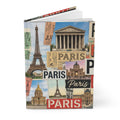
Paris by Postcard: The Monuments That Made a City Legendary
There is a particular kind of Paris postcard that anyone who has ever browsed a bouquiniste stall along the Seine will recognise immediately. The colours are slightly too saturated — the sky a deep, confident blue, the stone of the monuments a warm honey gold, the Seine a ribbon of turquoise that no actual river has ever quite matched. The typography is bold and unhesitating: PARIS, in capital letters, as if the city required no further introduction. These are the postcards of the 1960s, 1970s, and 1980s — the golden age of mass tourism and chromogenic colour photography — and they capture something true about Paris even in their exaggeration: the city really is that beautiful, and it really does inspire that kind of certainty.

If you are planning a trip to Paris, or if you simply love the city from a distance, what follows is a guide to the monuments that appear on those postcards — and that have been appearing on postcards, in one form or another, since the first tourist mailed a card home from the 1900 Exposition Universelle.
The Eiffel Tower: The Monument That Almost Wasn't
The Eiffel Tower was built as a temporary structure — a demonstration of French engineering prowess for the 1889 Exposition Universelle, to be dismantled after twenty years. Gustave Eiffel's iron lattice tower was controversial from the moment it was proposed: a petition signed by three hundred artists and intellectuals, including Guy de Maupassant and Charles Gounod, described it as a “blot on the cityscape” and a “dishonour to Paris.” Maupassant, it is said, lunched regularly at the tower's restaurant because it was the only place in Paris from which he could not see it.
The tower survived its scheduled demolition because it proved useful as a radio transmission antenna, and by the time the question of its removal arose again, it had become so thoroughly identified with Paris that the idea was unthinkable. Today it receives approximately seven million visitors a year, making it the most visited paid monument in the world. The best time to see it is at dusk, when the city lights begin to come on and the tower's own illumination — twenty thousand light bulbs, switched on every hour on the hour after dark — transforms it from an engineering achievement into something closer to a jewel.
Practical note: Book tickets online well in advance, especially for the summit. The queues for walk-up tickets can be several hours long in high season. The view from the Trocadéro gardens, directly across the Seine, is the classic postcard angle — and it is free.
Notre-Dame: The Cathedral Reborn
Notre-Dame de Paris has been under construction, renovation, or repair for most of its eight-hundred-year history. The cathedral was begun in 1163 under Bishop Maurice de Sully and took nearly two centuries to complete. By the eighteenth century it was in a state of considerable disrepair — the Revolution had not been kind to it, and much of its medieval sculpture had been damaged or destroyed. It was Victor Hugo's novel Notre-Dame de Paris (1831) that saved it: the book's enormous popularity created a public demand for the cathedral's restoration, and the architect Eugène Viollet-le-Duc spent twenty-five years, from 1844 to 1869, rebuilding and reimagining it — adding the famous spire that collapsed in the fire of April 2019.
The fire that destroyed the spire and much of the roof shocked the world, and the outpouring of donations — over a billion euros pledged within days — was a measure of how deeply Notre-Dame is embedded in the collective imagination. The cathedral reopened in December 2024, after five years of extraordinary restoration work, and it is more beautiful than it has been in generations: the medieval stonework cleaned and repaired, the interior luminous in a way that photographs from before the fire do not quite capture.
Practical note: Entry to the cathedral is free but timed entry tickets are required and must be booked in advance. The towers — from which you can see the gargoyles up close and the city spread below — require a separate ticket. The best view of the exterior is from the Pont de l'Archévêché, the bridge behind the cathedral, where the flying buttresses are most dramatic.
The Arc de Triomphe: Napoleon's Unfinished Monument
Napoleon commissioned the Arc de Triomphe in 1806, after his victory at Austerlitz, to honour the armies of France. He did not live to see it completed: the arch was finished in 1836, fifteen years after his death, and his body passed beneath it in 1840 during the return of his remains to Paris. The arch stands at the centre of the Étoile — the star-shaped junction where twelve avenues meet, including the Champs-Élysées — and it is the focal point of one of the great urban vistas in the world: the perspective that runs from the Louvre through the Tuileries, across the Place de la Concorde, up the Champs-Élysées, through the arch, and on to the Grande Arche de la Défense in the distance.
The reliefs on the arch's four pillars include François Rude's La Marseillaise — one of the great works of French Romantic sculpture, depicting the volunteers of 1792 marching to defend the Republic — and the Tomb of the Unknown Soldier, with its eternal flame, lies beneath the arch. The rooftop terrace offers one of the best panoramic views of Paris, and the perspective down the Champs-Élysées toward the Tuileries is the one that appears on more postcards than almost any other view in the city.
Practical note: Access to the rooftop is via a spiral staircase of 284 steps. Do not attempt to cross the Étoile on foot — there is an underground passage from the Champs-Élysées side. Book tickets online to avoid queues.
The Louvre: From Royal Palace to the World's Greatest Museum
The Louvre began as a medieval fortress, built by Philippe II in the 1190s to defend Paris against English attack. It became a royal palace under Charles V in the fourteenth century, was expanded and embellished by successive French monarchs over four centuries, and was converted into a public museum during the Revolution, opening to the public in 1793. Today it is the largest art museum in the world, with a permanent collection of over 380,000 objects and 35,000 works on display across 72,735 square metres of exhibition space.
I.M. Pei's glass pyramid, completed in 1989 for the museum's bicentennial, was as controversial in its time as the Eiffel Tower had been a century earlier — and has been as thoroughly vindicated. The pyramid is now one of the most recognisable architectural images in the world, and its juxtaposition with the classical stone of the Louvre palace is one of the great visual pleasures of Paris. The Winged Victory of Samothrace, the Venus de Milo, and the Mona Lisa are the three works that every visitor feels obliged to see; the works that reward the most are the ones you find by accident, in the quieter galleries away from the main tourist routes.
Practical note: Book tickets online — the queues at the pyramid entrance can be very long. Wednesday and Friday evenings, when the museum is open until 9:45 pm, are the least crowded times to visit. Allow at least half a day; a full day is better.
The Opéra Garnier: A Palace for Music
Charles Garnier's Opéra — the Palais Garnier, completed in 1875 — is the most extravagant building in Paris, which is saying something. Garnier was a young, relatively unknown architect when he won the competition to design Napoleon III's new opera house, and he responded to the commission with a building of such theatrical excess — marble, gilding, velvet, mirrors, a grand staircase of white marble that is itself a kind of performance — that it became the defining monument of the Second Empire style. The auditorium ceiling, painted by Marc Chagall in 1964, adds a note of dreamlike colour to the Beaux-Arts grandeur.
The Opéra Garnier is the building that inspired Gaston Leroux's The Phantom of the Opera (1910) — the underground lake is real, or at least the underground cistern that inspired it is — and it remains one of the great opera houses in the world, home to the Paris Opéra Ballet. The building can be visited independently of a performance, and the grand staircase and auditorium are among the most spectacular interiors in Paris.
Sacré-Cœur and Montmartre: The Village Above the City
Montmartre is the hill that rises above the northern edge of Paris, crowned by the white Romano-Byzantine domes of the Basilique du Sacré-Cœur. The basilica was built between 1875 and 1914 as a monument of national penance after the Franco-Prussian War and the Paris Commune, and its white travertine stone — which self-cleans in the rain, maintaining its brightness — makes it one of the most distinctive silhouettes on the Paris skyline. The view from the parvis in front of the basilica, looking south over the rooftops of Paris, is one of the finest in the city.
Montmartre itself — the neighbourhood that surrounds the hill — was the centre of Parisian artistic life in the late nineteenth and early twentieth centuries. Picasso, Modigliani, Utrillo, Toulouse-Lautrec, and Renoir all lived and worked here. The Place du Tertre, the square just below the basilica, is now given over almost entirely to portrait artists and tourist restaurants, but the streets around it — the Rue Lepic, the Rue des Abbesses, the Rue Norvins — retain something of the village character that made Montmartre so attractive to artists a century ago.
The Postcard as Travel Companion
The Paris postcard reached its commercial and aesthetic peak in the decades between 1960 and 1985, when mass tourism and colour photography combined to produce millions of cards that captured the city's monuments with a confidence and vividness that earlier black-and-white photography could not match. These cards — with their saturated colours, their bold typography, their multiple-image collage layouts that tried to fit the whole city onto a single card — are now collected as artefacts of a particular moment in the history of travel and popular visual culture.
They are also, in their way, accurate. Paris really does look like that — or it can, on the right afternoon, in the right light, when the stone is warm and the sky is that particular shade of blue and the Seine is catching the last of the sun. The postcard does not lie. It simply selects, and edits, and saturates, and presents the city at its most itself. Which is, when you think about it, exactly what a good travel journal does too.

Our Paris Journal reproduces a vintage postcard collage of Paris's great monuments — the Eiffel Tower, Notre-Dame, the Arc de Triomphe, the Louvre, the Opéra Garnier, and Sacré-Cœur — across its covers, in the bold, saturated style of the golden age of the Paris postcard.
References
Harvie, D. (2006). Eiffel: The Genius Who Reinvented Himself. Sutton Publishing.
Hugo, V. (1831). Notre-Dame de Paris. Gosselin.
Kerry, P. (2010). The Phantom of the Opera. Reaktion Books.
Loyer, F. (1988). Paris Nineteenth Century: Architecture and Urbanism. Abbeville Press.
Robb, G. (2010). Parisians: An Adventure History of Paris. Picador.