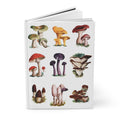
Nine Species, One Page: The Mycological Plate of El Tesoro de la Juventud
El Tesoro de la Juventud — The Treasure of Youth — was first published in 1912 and became one of the most widely distributed encyclopedias in the Spanish-speaking world, reaching homes across Latin America and Spain through successive editions well into the second half of the twentieth century. As we explored in our earlier piece on its botanical legacy, the encyclopedia’s ambition was never exhaustive scholarship — it was something more delicate: the cultivation of curiosity in young readers through carefully chosen images and accessible prose.

Its mycological plate is a masterclass in that ambition.
A Grid of Nine
Arranged in a 3×3 grid, the plate presents nine species drawn from the canon of classical European mycology — a selection that is at once pedagogically deliberate and visually stunning.
The top row opens with Russula virescens, the Green Russula, its distinctive grey-green cap mottled and cracked like old porcelain. Beside it, Cantharellus cibarius — the Chanterelle — glows in warm golden-yellow, one of the most prized edible fungi of European forests. The row closes with Lactarius deliciosus, the Saffron Milk Cap, its reddish-orange flesh stained with the colour of autumn light, long celebrated in Mediterranean cuisine.
The central row delivers the plate’s most dramatic contrast. Amanita muscaria — the Fly Agaric — dominates with its iconic scarlet cap and white spots, one of the most recognisable fungi in the world and one of the most toxic. Beside it, Laccaria amethystina, the Amethyst Deceiver, offers a startling violet that seems almost implausible in nature. The row closes with what appears to be Pleurotus ostreatus or a related bracket fungus — shelf-shaped, leathery, growing in overlapping fans from wood.
The bottom row turns quieter and stranger. Morchella elata or Morchella esculenta — the Morel — rises in its honeycombed tower, one of the most sought-after fungi among foragers and chefs alike. Coprinus comatus, the Shaggy Ink Cap, stands white and fringed, its cap dissolving into black ink as it matures — a fungus that carries its own obsolescence. The grid closes with what may be Cantharellus tubaeformis or young Lactarius specimens, clustered and brown, modest beside their more theatrical neighbours.
The Pedagogy of Beauty
The selection is not random. Edible species — Chanterelle, Saffron Milk Cap, Morel, Oyster Mushroom — appear alongside the deadly Fly Agaric and the deceptively named Amethyst Deceiver. The implicit lesson is one of careful attention: the forest offers abundance, but demands discernment. Beauty is not a guarantee of safety. Colour is not a reliable guide.
Yet the encyclopedia’s approach was never primarily cautionary. The plate was designed to make children want to know more — to spark the kind of wonder that sends a reader back to the page, and eventually, perhaps, into the woods. The illustrations achieve this not through scientific precision alone, but through a quality that is harder to name: a sense that each species has a character, a presence, a story worth knowing.
This is what the great encyclopedic tradition understood, and what digital databases have largely lost: that knowledge begins not with information, but with attention. And attention begins with beauty.
Our Mushroom Journal features this plate on both its front and back covers — nine species, one page, a lifetime of curiosity waiting to begin.
References
- Tesoro de la Juventud: Enciclopedia de Conocimientos. W.M. Jackson, Inc., 1912 (1962 edition consulted).
- Bon, Marcel. The Mushrooms and Toadstools of Britain and Northwestern Europe. Hodder & Stoughton, 1987.
- Ramsbottom, John. Mushrooms and Toadstools: A Study of the Activities of Fungi. Collins, 1953.