Nicholas Culpeper and the Complete Herbal: Medicine for the People
In 1652, a thirty-five-year-old apothecary and astrologer named Nicholas Culpeper published a book that would make him the most beloved and most controversial figure in the history of English medicine. The English Physician — later known as Culpeper’s Complete Herbal — was not the first herbal ever written, nor the most scientifically rigorous. But it was the first to be written in plain English, for ordinary people, at a price they could afford. In doing so, Culpeper committed what the medical establishment of his day considered an act of outright sedition.
The Radical Act of Writing in English
The world of seventeenth-century medicine was a closed guild. Physicians trained at Oxford and Cambridge, read their texts in Latin, and guarded their knowledge with professional jealousy. The College of Physicians in London held a monopoly on medical practice in the city, and it prosecuted unlicensed practitioners with vigour. Culpeper, who had trained as an apothecary and set up practice in Spitalfields — then a poor neighbourhood on the eastern edge of London — was fined and harassed repeatedly for practising medicine without a licence.
His response was characteristically defiant. In 1649, he published an unauthorised English translation of the College of Physicians’ own pharmacopoeia — the Pharmacopoeia Londinensis — which had previously existed only in Latin, accessible only to those who could read it. The College was furious. Culpeper was unrepentant. Three years later, he published the Complete Herbal, which went further still: a comprehensive guide to the medicinal uses of English plants, written in the language of the people who needed it, sold cheaply enough that they could buy it.
The Man and His Method
Nicholas Culpeper was born in 1616 in Ockley, Surrey, the son of a clergyman who died before his birth. He studied at Cambridge but left without a degree after the death of the woman he intended to marry — she was struck by lightning on her way to elope with him, a loss from which he never fully recovered. He apprenticed to an apothecary in London, set up his own practice, and threw himself into the political and religious upheavals of the 1640s with the same passionate intensity he brought to everything else. He fought on the Parliamentary side in the Civil War, was wounded at the Battle of Newbury in 1643, and returned to his practice with his health permanently damaged.
His method was a fusion of traditional herbal knowledge and astrological theory that was already old-fashioned by the standards of his day. Each plant in the Complete Herbal is assigned to a planet — Mars, Venus, Jupiter, Saturn, the Sun, or the Moon — and its medicinal properties are explained in terms of the astrological correspondences that governed seventeenth-century natural philosophy. Modern readers sometimes find this framework eccentric, but it was the coherent theoretical system of its time, and Culpeper deployed it with genuine learning and practical experience accumulated over years of treating the poor of Spitalfields for little or no payment.
The Plates
The original 1652 edition of the Complete Herbal was a text without illustrations — Culpeper died in 1654, aged thirty-seven, before the book had been fully established in the form we know today. The illustrated editions that became the standard reference for English herbalists were produced in the decades and centuries after his death, as publishers recognised the commercial and practical value of adding botanical plates to his descriptions.
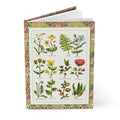
The hand-coloured plates that appear on the covers of this journal are from editions published around 1789 and 1815 — more than a century after Culpeper’s death, but entirely faithful to his spirit. Each plate presents twelve medicinal plants, labelled with their traditional English names: Spicknel and Spikenard, Periwinkle and Pennyroyal, Pomegranate Tree and Primroses, Male Peony and Pear Tree. The colourists who worked on these plates brought to them the same careful attention that Culpeper had brought to his descriptions — a desire to make botanical knowledge visible, accurate, and beautiful.
Three Centuries of Use
The Complete Herbal never went out of print. It was the standard household medical reference in England for over three hundred years — consulted by country housewives, village healers, and self-taught apothecaries who had no access to trained physicians and no money to pay for them. It was carried to the American colonies, where it remained in use well into the nineteenth century. It was translated into multiple languages. It was plagiarised, adapted, and republished in dozens of editions, each one testifying to the enduring usefulness of Culpeper’s original vision: that the knowledge of how to heal should belong to everyone.
Today, Culpeper is remembered as a folk hero of English medicine — the people’s herbalist, the apothecary who took on the medical establishment and won, not in the courts or the lecture halls, but in the homes and kitchens of ordinary English people who kept his book on the shelf and consulted it when they needed it. His Complete Herbal is still in print, still consulted, still loved.
References: Tobyn, G., Denham, A., & Whitelegg, M. The Western Herbal Tradition. Edinburgh: Churchill Livingstone, 2011. — Griggs, B. Green Pharmacy: The History and Evolution of Western Herbal Medicine. Rochester: Healing Arts Press, 1997. — Culpeper, N. The Complete Herbal. London, 1652 (facsimile editions widely available).
The hand-coloured plates from Culpeper’s Complete Herbal — Plates 10 and 11, c.1789–1815 — are reproduced on the covers of the Culpeper’s Herbal Journal, a hardcover journal with 150 lined pages for your own notes, observations, and reflections.