The Smile That Conquered the World: The Mona Lisa from Leonardo’s Studio to the Louvre Heist
She has been the most famous painting in the world for just over a century. Before 1911, the Mona Lisa was celebrated but not uniquely so — one masterpiece among many in the Louvre’s vast collection, admired by connoisseurs and art historians but not yet the global icon she would become. It took a theft, a two-year disappearance, and the first great media frenzy in art history to transform Leonardo da Vinci’s portrait of Lisa Gherardini into the most recognizable image on earth.

This is the story of how that happened.
Leonardo and the Portrait
Leonardo da Vinci began painting the Mona Lisa around 1503, in Florence, at the commission of Francesco del Giocondo — a silk merchant who wanted a portrait of his wife, Lisa Gherardini, to celebrate the birth of their second son and their new home. It was, in other words, a domestic commission: a family portrait, the kind of thing that wealthy Florentine merchants routinely ordered from the artists of their city.
What Leonardo made of it was something else entirely.
The painting — oil on poplar wood, 77 by 53 centimeters — is a technical achievement of the first order. Leonardo’s sfumato technique, the soft imperceptible blending of tones that eliminates hard outlines and creates an almost atmospheric sense of depth, was at its most refined in the Mona Lisa. The transitions between light and shadow on Lisa’s face are so gradual as to be almost imperceptible — the result of dozens of thin glazes of paint applied over years, each layer adding depth and luminosity to the one beneath.
The effect is uncanny. Lisa Gherardini’s gaze follows the viewer with a persistence that no contemporary could fully explain — a consequence of the way Leonardo positioned her eyes in relation to the picture plane. Her smile — the most analyzed expression in the history of art — shifts between warmth and enigma depending on where the viewer looks: direct gaze produces one reading, peripheral vision another. Neuroscientists have since explained this as a consequence of the way the human visual system processes information differently in its central and peripheral fields, but Leonardo achieved the effect through intuition and observation alone.
He never delivered the painting to Francesco del Giocondo. He carried it with him for the rest of his life — from Florence to Milan, from Milan to Rome, from Rome to France, where he spent his final years at the Château du Clos Lucé at the invitation of King Francis I. When Leonardo died in 1519, the Mona Lisa was still in his possession. Francis I acquired it, and it passed eventually to the French royal collection, then to the Louvre when the Revolution transformed the palace into a public museum.
Four Centuries in the Louvre
For most of the 19th century, the Mona Lisa was a celebrated but not uniquely famous painting. Art historians admired it; the Romantics were fascinated by it — Walter Pater’s famous 1869 description of Lisa as “older than the rocks among which she sits” and “a vampire who has been dead many times” established the painting’s reputation for enigmatic beauty in the popular imagination. But it was one masterpiece among many, and the Louvre’s collection contained dozens of works that attracted comparable attention.
The painting’s security arrangements reflected this status. In 1911, the Louvre’s security was, by modern standards, almost nonexistent. Paintings were not alarmed. The museum was closed on Mondays for maintenance, and workers moved freely through the galleries. The Mona Lisa hung on the wall of the Salon Carré, secured by four iron hooks.
The Theft
On the morning of Monday, 21 August 1911, a 31-year-old Italian handyman named Vincenzo Peruggia arrived at the Louvre before it opened. He had worked at the museum the previous year, helping to install protective glass cases on some of the paintings — including, it is believed, the Mona Lisa. He knew the building, knew the routines, and knew that Monday was the day when the museum was closed to the public.
Peruggia hid in a storage closet overnight. In the early morning, he walked to the Salon Carré, lifted the Mona Lisa from its hooks, carried it to a stairwell, removed it from its frame, wrapped it in his smock, and walked out of the museum. The entire operation took a few minutes. No one saw him leave.
The theft was not discovered until the following day, when a painter named Louis Béroud arrived to make a copy of the Mona Lisa and found an empty space on the wall. The museum director assumed the painting had been taken to the photography studio. It took several hours before anyone realized it was gone.
The Search
The reaction was immediate and global. The Louvre was closed for a week. The French police launched the largest art theft investigation in history. The borders were watched. Suspects were questioned — including, famously, Pablo Picasso and the poet Guillaume Apollinaire, who had been involved in a previous theft of Iberian statuettes from the museum. Both were released without charge.
The media coverage was unprecedented. Newspapers across Europe and America ran daily updates. The Mona Lisa’s image — previously known mainly to art lovers and museum visitors — was reproduced on front pages around the world. Crowds gathered at the Louvre to stare at the empty space where the painting had hung. Postcards of the missing painting sold in their millions.
It was the first great media frenzy in art history, and it transformed the Mona Lisa forever. The painting that had been celebrated but not uniquely famous became, through its absence, the most talked-about image in the world. When it was recovered, it would return to the Louvre not as one masterpiece among many but as the masterpiece — the painting that everyone knew, that everyone wanted to see, that had become a symbol of art itself.
Achille Beltrame’s illustration for La Domenica del Corriere — the Italian illustrated weekly that was one of the most widely read publications in Italy — captured the moment of the theft with the dramatic clarity that made his work famous. Beltrame was the master of the illustrated news event, and his depiction of Peruggia walking out of the Louvre with the painting hidden under his coat became one of the defining images of the affair.
The Recovery
Vincenzo Peruggia was caught in Florence in December 1913, more than two years after the theft. He had kept the painting in a trunk in his apartment in Paris, then carried it with him when he moved back to Italy. He was caught when he contacted an art dealer in Florence, offering to sell the painting. The dealer alerted the authorities.
Peruggia’s motive, as he explained it at his trial, was patriotic: he believed the Mona Lisa had been stolen from Italy by Napoleon and wanted to return it to its homeland. In fact, Leonardo had brought the painting to France himself, and it had never been in Italy since. Peruggia was convicted and sentenced to one year and fifteen days in prison — a remarkably lenient sentence that reflected the sympathy many Italians felt for his stated motives.
The Mona Lisa was returned to the Louvre in January 1914, where it has remained ever since — now behind bulletproof glass, in a climate-controlled case, protected by the most sophisticated security systems in the world. It attracts approximately 10 million visitors a year, most of whom spend a few seconds in front of it before moving on. It is the most visited, most reproduced, and most parodied artwork in history.
Leonardo would have been astonished.
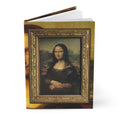
Our Mona Lisa Journal carries Leonardo’s portrait on the front cover and Beltrame’s 1911 illustration on the back — the Renaissance genius that created her, and the audacious theft that made her immortal, in a journal you can carry to every museum and every café in Paris.
References
- Sassoon, Donald. Becoming Mona Lisa: The Making of a Global Icon. Harcourt, 2001.
- Scotti, R.A. Vanished Smile: The Mysterious Theft of Mona Lisa. Knopf, 2009.
- Kemp, Martin. Leonardo da Vinci: The Marvellous Works of Nature and Man. Oxford University Press, 2006.
- Zöllner, Frank. Leonardo da Vinci: The Complete Paintings and Drawings. Taschen, 2019.