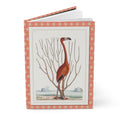
Mark Catesby and the First Great Portrait of the American Flamingo
We’ve already met John James Audubon’s flamingo — that life-size coral marvel from Plate 431 of The Birds of America. But before Audubon, before anyone else, there was Mark Catesby. And it is Catesby who gave the American Flamingo its first great scientific portrait, in a book that is the founding document of American natural history illustration.

The Natural History of Carolina, Florida and the Bahama Islands was published between 1731 and 1743. It was the first systematic account of the flora and fauna of Britain’s North American colonies and Caribbean territories, and it was produced by a man who, in many ways, invented the genre as he went along.
Mark Catesby: The Self-Taught Naturalist
Mark Catesby (1683–1749) was born in Essex and came to natural history through curiosity rather than formal training. He made two extended journeys to North America — the first from 1712 to 1719, the second from 1722 to 1726, sponsored by Sir Hans Sloane and a group of Fellows of the Royal Society — during which he collected specimens, made drawings, and observed the natural world with a patience and precision that no European naturalist had previously brought to the American continent.
When he returned to England with his drawings and notes, he faced a problem: the cost of engraving and printing a work of this scale was enormous, and no publisher would take it on. Catesby’s solution was characteristically practical. He taught himself to etch, and produced the plates himself — 220 of them, over more than a decade of work. The result was a book unlike anything that had come before: a work of science and art produced almost entirely by one man, from the field observations to the finished plates.
Later naturalists, including John James Audubon, would acknowledge Catesby as the “father of American ornithology.” It is a title he earned not just through priority but through the quality of his vision.
Plates 73 and 74: The Flamingo in Two Studies
The American Flamingo appears in The Natural History of Carolina across two complementary plates — a complete portrait in two acts.
Plate 73 presents the full bird: Phoenicopterus bahamensis standing in its characteristic wading posture, its coral-pink plumage rendered with the hand-colored etching technique Catesby had developed himself, alongside a Keratophyton sea fan coral that documents the Caribbean marine environment in which the flamingo lives. Catesby had observed the bird in the shallow lagoons and salt flats of the Bahama Islands — and the plate captures not just the animal but its ecosystem, the relationship between the flamingo and the coral-rich waters it inhabits.
Plate 74 turns to anatomy. It presents a detailed study of the flamingo’s most extraordinary feature: its curved bill, uniquely bent downward at the midpoint, with the specialized filtering mechanism that allows the bird to feed on algae, diatoms, and small crustaceans by pumping water through lamellae. Alongside the bill, Catesby placed a gorgonian coral — another element of the Caribbean marine world. Together, the two plates offer what no single image could: the whole bird in its environment, and the anatomical detail that explains its extraordinary way of life.
The Hand-Colored Etching
Catesby’s technique was etching rather than the engraving that most botanical and natural history publishers used. Etching allowed for a freer, more expressive line — better suited to capturing the texture of feathers, the delicacy of coral branches, the particular quality of a bird observed in the field rather than in a cabinet. Each copy of The Natural History of Carolina was hand-colored, with the slight variations that hand-work always introduces. The coral pink of the flamingo’s plumage, the deeper rose of the wing coverts, the black of the flight feathers — all applied by hand, copy by copy, with a care that makes each plate a unique object.
It is this quality — the combination of scientific precision and the warmth of hand-work — that makes Catesby’s plates so enduring. They are records of observation, but they are also objects of beauty. The flamingo on Plate 73 is a scientific document and a work of art at the same time, in the way that the best natural history illustration always is.
Before Audubon
When Audubon came to paint his own flamingo — Plate 431 of The Birds of America, published a century after Catesby — he was working in a tradition that Catesby had founded. The life-size ambition, the attention to posture and habitat, the conviction that scientific accuracy and artistic beauty were not in conflict but were the same thing: all of this Catesby had established first.
The two flamingo journals from LeBonJournal — Catesby’s 1731 plates and Audubon’s 1838 plate — are a conversation across a century of American natural history illustration. Catesby gave the flamingo its first portrait. Audubon gave it its most famous one. Both understood that the coral wonder of the Caribbean deserved nothing less than their best work.