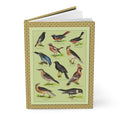
The Songbirds of Europe: Kurt Lampert, Chromolithography, and the Golden Age of Ornithological Illustration
Share
In the summer of 1905, a German zoologist named Kurt Lampert published a book about the songbirds of Europe. He was the director of the Royal Natural History Museum in Stuttgart, a man who had spent his career studying the natural world with the systematic rigour of the German scientific tradition, and his Die Singvögel Europas — The Songbirds of Europe — was the culmination of that tradition applied to the birds that filled the forests, meadows, and gardens of the continent.
It was also, though Lampert could not have known it, one of the last great works of the golden age of natural history illustration.
Chromolithography and the Art of the Bird Portrait
The chromolithographic process that Lampert’s artists used had been developed in the 1830s and had reached its technical peak by the 1880s and 1890s. Unlike the hand-coloured engravings that had dominated natural history illustration since the 17th century, chromolithography allowed for the mechanical reproduction of colour with a fidelity and consistency that hand-colouring could never achieve. The subtle gradations of a goldfinch’s plumage, the iridescent sheen of a bullfinch’s breast, the precise markings that distinguished one crossbill species from another — all could be reproduced with a scientific accuracy that made chromolithographic bird atlases the essential reference works of their era.
Lampert’s Plate 1 documents six European finch species with this precision: the Goldfinch (Carduelis carduelis) with its brilliant red face and yellow wing bars; the Linnet (Linaria cannabina) with its rosy breast; the Siskin (Spinus spinus) with its yellow-green plumage; the Serin (Serinus serinus), the smallest European finch; the Citril Finch (Carduelis citrinella) of the Alpine meadows; and the Twite (Linaria flavirostris) of the northern moorlands. Six species, six portraits, each one a small masterpiece of chromolithographic art.
The Crossbills and the Grosbeaks
Plate 2 turns to the grosbeaks and crossbills — the most spectacular members of the European finch family, and in some ways the most extraordinary. The Bullfinch (Pyrrhula pyrrhula) with its deep rose-red breast; the Scarlet Rosefinch (Carpodacus erythrinus) with its crimson head; the Pine Grosbeak (Pinicola enucleator), the largest European finch, a bird of the boreal forests that seems almost too magnificent for the continent it inhabits.
And then the crossbills: Common (Loxia curvirostra), Parrot (Loxia pytyopsittacus), and Two-barred (Loxia leucoptera) — three species whose uniquely crossed bills are one of the most extraordinary evolutionary adaptations in the avian world. The crossed mandibles, which appear at first glance to be a deformity, are in fact a precision instrument: perfectly designed for extracting seeds from the tightly closed cones of spruce, pine, and larch, the crossbill can open a cone that no other bird can access. It is a solution so elegant, so perfectly fitted to its purpose, that it seems almost designed — which is, of course, exactly what the naturalists of Lampert’s era were beginning to understand it was, in the Darwinian sense of the word.
The End of an Era
Lampert’s Die Singvögel Europas appeared at the very moment when chromolithography was being superseded by photographic reproduction. Within a decade, the great chromolithographic atlases would be replaced by photographic field guides, and the tradition of the hand-crafted bird portrait — whether engraved, hand-coloured, or lithographed — would effectively come to an end.
Lampert’s atlas is, in this sense, a farewell: a last, magnificent celebration of the art of the bird portrait, produced at the very moment when that art was about to be transformed beyond recognition. The finches and grosbeaks and crossbills that fill its plates are documented with a care and a beauty that the photographic field guide, for all its accuracy, has never quite been able to match.