Kate Greenaway and the Victorian World of Childhood
In 1879, a small book of verses and pictures called Under the Window sold 70,000 copies in its first edition. Its author and illustrator was Kate Greenaway, a thirty-three-year-old Londoner who had spent years producing greetings cards and magazine illustrations. The book made her famous overnight — and in doing so, it created an image of childhood that the Victorian world immediately recognised as its own ideal.
Greenaway's children inhabit a world that never quite existed: a perpetual English summer, somewhere between the Regency and the pastoral, where girls in white muslin dresses and boys in velvet suits wander through cottage gardens, pick flowers, play quiet games, and take tea on sunlit lawns. It is a world without poverty, without illness, without the industrial city that surrounded Greenaway's own childhood in Hoxton and Islington. It is, in the most precise sense, a fantasy — and it was a fantasy that the Victorians could not get enough of.
The Making of an Illustrator
Kate Greenaway was born in 1846, the daughter of a wood engraver. She grew up watching her father work, and the precision of engraving — the careful translation of a drawn line into a reproducible image — shaped her sensibility from the beginning. She studied at the Finsbury School of Art and later at the Slade, where she was one of the few women admitted to the life drawing classes.
Her early career was modest: valentines, Christmas cards, illustrations for minor publications. The breakthrough came when she began working with the printer and publisher Edmund Evans, who had also launched the careers of Walter Crane and Randolph Caldecott. Evans understood colour printing as an art form, and he recognised in Greenaway's delicate palette — soft pinks, sage greens, warm ochres, dusty blues — something that the new chromolithographic process could reproduce with unusual fidelity.
The combination of Greenaway's draftsmanship and Evans's printing produced books that looked unlike anything else on the market. The colours were gentle rather than garish. The compositions were spacious, with generous white margins that gave the images room to breathe. The children were not the rosy-cheeked cherubs of conventional Victorian illustration but something more considered: figures with weight and presence, dressed with an almost archaeological attention to historical costume.
The Greenaway Child
What made Greenaway's children distinctive was their self-possession. They are not performing for the viewer. They are absorbed in their own world — in conversation, in play, in the quiet rituals of a well-ordered afternoon. The girls in her illustrations wear the high-waisted, soft-draped dresses of the Regency period rather than the corseted, heavily trimmed fashions of the 1880s. This was a deliberate choice. Greenaway believed that the Regency silhouette was more becoming to children, more suited to movement and play. She was, in her quiet way, making an argument about how children should be dressed — and the argument was heard. The “Greenaway style” became a fashion, copied by dressmakers and department stores across Britain and America.
John Ruskin, who became one of her most devoted admirers and correspondents, wrote to her in 1880: “I think you are the first person who has ever drawn children as they really are.” This was not quite accurate — Greenaway's children are idealised, not observed — but it captures something true about the effect of her work. Her illustrations felt like recognition rather than invention. They showed the Victorians a version of childhood they wanted to believe in.
The Girl's Own Annual and the World of Print
The Girl's Own Annual, published by the Religious Tract Society from 1880, was one of the most widely read periodicals for young women and girls in late Victorian Britain. It combined fiction, practical advice, needlework patterns, and illustrations in a format that was both improving and entertaining — the Victorian ideal of useful pleasure.
Greenaway contributed illustrations to publications of this kind throughout the 1880s, and her work appeared in a variety of annuals, gift books, and magazines aimed at the growing market for quality illustrated print. The chromolithographic process — which allowed full-colour images to be reproduced at scale for the first time — made her work accessible to a middle-class audience that could not afford original art but could afford a well-produced annual or gift book.
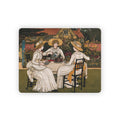
Her 1887 illustration of girls taking afternoon tea in a garden is characteristic of this period: the soft earth tones, the Regency-inspired dresses, the lush but orderly garden setting, the sense of a moment suspended in gentle pleasure. Afternoon tea had by then become a significant social ritual in Britain — a daily ceremony that marked the boundary between the working afternoon and the social evening. Greenaway's illustration captures it at its most idealized: unhurried, graceful, entirely removed from the pressures of the world outside the garden gate.
Legacy
Kate Greenaway died in 1901, the same year as Queen Victoria. Her reputation faded somewhat in the early twentieth century, as modernism made her pastoral idealism seem sentimental. But she never disappeared entirely, and in recent decades her work has been reassessed with fresh attention — not as naive escapism but as a sophisticated visual argument about childhood, femininity, and the relationship between art and everyday life.
The Kate Greenaway Medal, awarded annually since 1955 by the Chartered Institute of Library and Information Professionals, remains the most prestigious prize for children's book illustration in Britain. It is a fitting legacy for an artist who, more than anyone else, established the idea that illustration for children was a serious art form — one that deserved the same care, craft, and chromatic intelligence as any other.
Her children are still there in their muslin dresses, still taking tea in their sunlit gardens, still absorbed in their own unhurried world. They have outlasted the century that made them.

If you would like to bring a little of that world into your home, our Kate Greenaway Tea Party Puzzle — 30 large pieces for children ages 3–7 — reproduces her 1887 afternoon tea illustration in full colour.
References
Engen, R. K. (1981). Kate Greenaway: A Biography. Schocken Books.
Ruskin, J. (1880). Letter to Kate Greenaway. Pierpont Morgan Library, New York.
Dalby, R. (1991). The Golden Age of Children's Book Illustration. Michael O'Mara Books.
Chartered Institute of Library and Information Professionals. (2024). The Kate Greenaway Medal. cilip.org.uk.