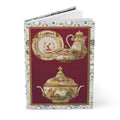
The White Gold of Saxony: Karl Berling and the Meissen Porcelain Plates of 1900
For nearly two centuries, the secret of porcelain was one of the most jealously guarded in the world. The Chinese had known how to make it since the Tang dynasty; the Japanese had mastered it in the seventeenth century; but in Europe, despite decades of experiment by alchemists and craftsmen in Venice, Florence, and the courts of France and Germany, the formula remained elusive. True porcelain — hard-paste porcelain, fired at temperatures that fused kaolin and feldspar into a translucent, resonant, impermeable material — could not be made in Europe, and the Chinese and Japanese pieces that arrived on Dutch and Portuguese trading ships were prized accordingly: collected by emperors and princes, displayed in purpose-built porcelain rooms, traded at prices that reflected their rarity and their mystery. When, in 1708, the Saxon alchemist Johann Friedrich Böttger finally cracked the formula — working under the supervision of the physicist Ehrenfried Walther von Tschirnhaus in the service of Augustus the Strong, Elector of Saxony — it was one of the most significant technological achievements of the early eighteenth century. The manufactory that Augustus established at Meissen in 1710 to exploit this discovery was the first true porcelain manufactory in Europe, and it remained, for most of the eighteenth century, the most prestigious.
Karl Berling’s Das Meissner Porzellan — published in 1900, at the bicentenary of Böttger’s discovery — was a chromolithographic documentation of the manufactory’s finest designs: the botanical services, the figure groups, the painted landscapes and harbour scenes that had made Meissen synonymous with the highest achievement of European decorative art. It is a work that carries within it two centuries of artistic ambition and technical mastery, and that remains, more than a century after its publication, one of the most beautiful documents of the European porcelain tradition.
Augustus the Strong and the Porcelain Obsession
The story of Meissen begins with an obsession. Augustus the Strong — Friedrich August I, Elector of Saxony and King of Poland — was one of the most powerful and extravagant rulers of early eighteenth-century Europe, and his passion for Chinese and Japanese porcelain was legendary. He is said to have exchanged a regiment of dragoons for a collection of Chinese vases; he built the Japanese Palace in Dresden specifically to house his porcelain collection, which numbered, at its height, more than thirty-five thousand pieces. When Böttger and von Tschirnhaus finally succeeded in producing true hard-paste porcelain in 1708, Augustus immediately recognised the commercial and political possibilities of the discovery, and moved quickly to exploit them.
The Meissen manufactory, established in the Albrechtsburg castle above the town of Meissen in 1710, was from the beginning a state secret. The workers were effectively imprisoned within the castle to prevent the formula from leaking to rival courts; the raw materials were transported under guard; and the finished pieces were sold at prices that reflected their status as the products of a unique and jealously guarded technology. For the first two decades of its existence, Meissen had no serious European competitor, and its pieces — first the red stoneware that Böttger had developed as a precursor to true porcelain, then the white hard-paste porcelain itself — were collected by the courts of Europe with the same enthusiasm that had previously been reserved for Chinese imports.
Johann Joachim Kändler and the Golden Age of Meissen
The artistic golden age of Meissen began in 1731, when Johann Joachim Kändler was appointed as the manufactory’s chief modeller. Kändler — a sculptor of extraordinary talent and productivity — transformed Meissen from a producer of tableware and decorative pieces into the leading centre of European porcelain sculpture. His figure groups — the commedia dell’arte characters, the court ladies and gentlemen, the animals and birds — set the standard for European porcelain sculpture for a generation, and many of his models remained in production at Meissen for more than two centuries.
It was also during this period that the botanical designs that appear in Berling’s documentation were developed. The “Indianische Blumen” — Indian flowers, the stylised floral designs derived from Chinese and Japanese originals — gave way, in the 1740s, to the “deutsche Blumen” — German flowers, naturalistic botanical designs based on the actual flowers of the European garden. These designs, developed by the painter Johann Gottfried Klinger and his colleagues, drew on the tradition of botanical illustration that had flourished in Europe since the sixteenth century, and they transformed the surface decoration of Meissen porcelain from a stylised orientalism into something more closely connected to the European natural history tradition. The botanical services that resulted — painted with roses, tulips, carnations, and the other flowers of the eighteenth-century garden — were among the most admired products of the manufactory, and they are among the most beautiful objects in the history of European decorative art.
Das Meissner Porzellan: Berling’s Chromolithographic Documentation
Karl Berling’s documentation of Meissen porcelain was published in 1900, at the bicentenary of Böttger’s discovery of the porcelain formula. It was a work of considerable ambition: a systematic chromolithographic record of the manufactory’s finest designs, from the earliest pieces of the Böttger period through the golden age of Kändler and the botanical painters to the neoclassical designs of the late eighteenth century. The chromolithographic technique that Berling used was, by 1900, a mature and highly developed medium, capable of rendering the subtle colours of hand-painted porcelain — the soft pinks and blues of the botanical designs, the rich gilding of the borders, the precise detail of the painted flowers and figures — with a fidelity that earlier illustration techniques could not achieve.
The result was a work that served both as a historical document and as a practical reference: a record of what Meissen had achieved in its first two centuries, and a guide for collectors, dealers, and connoisseurs who needed to identify and authenticate pieces from the manufactory’s long history. It is a work that carries within it the full weight of the Meissen tradition — the technical mastery, the artistic ambition, the commercial acumen — and that remains, more than a century after its publication, an essential document of European porcelain history.
The Crossed Swords: Meissen’s Mark and Its Imitators
One of the most important functions of Berling’s documentation was the systematic recording of Meissen’s marks — the crossed swords in underglaze blue that had been the manufactory’s trademark since 1723, and that had been imitated, copied, and forged by competitors across Europe almost from the moment of their introduction. The history of European porcelain in the eighteenth century is, in part, a history of industrial espionage: the workers who escaped from Meissen and carried the formula to Vienna, Venice, and the courts of Germany; the rival manufactories that produced pieces designed to be mistaken for Meissen; the forgers who applied the crossed swords mark to pieces that had nothing to do with the Saxon manufactory.
Berling’s documentation of the marks — their evolution over time, their variations, the periods in which different versions were used — was an essential tool for collectors navigating this complex market. It is a reminder that the history of Meissen is not only a history of artistic achievement but also a history of commercial competition, industrial secrecy, and the extraordinary lengths to which the courts of Europe were prepared to go in pursuit of the white gold of Saxony.
A Journal for Those Who Find Beauty in Fine Porcelain

Our Karl Berling Meissen Porcelain Journal carries these 1900 chromolithographic plates across its full wraparound cover — the botanical designs and decorative arts of Europe’s most prestigious porcelain manufactory, documented at the bicentenary of Böttger’s discovery with the precision and visual richness of the finest German chromolithography. It is a journal for those who find beauty in fine porcelain, who understand that a painted teacup can carry within it two centuries of artistic ambition and technical mastery, who appreciate the German decorative arts tradition that produced these designs.
Inside, 150 perforated lined pages await your collecting notes, art observations, daily reflections, or whatever form your engagement with beauty takes. The casewrap sewn binding opens completely flat. The matte laminated cover preserves every detail of Berling’s chromolithographs in a finish that rewards close examination.
In 1710, Augustus the Strong established the Meissen manufactory and changed the history of European decorative art. In 1900, Karl Berling documented what two centuries of that history had produced. Perhaps the pages inside will help you record what beauty you find in the world around you.
References & Further Reading
- Berling, Karl. Das Meissner Porzellan und seine Geschichte. Leipzig, 1900. [The primary source: Berling’s own chromolithographic documentation of the Meissen manufactory.]
- Cassidy-Geiger, Maureen (ed.). Fragile Diplomacy: Meissen Porcelain for European Courts ca. 1710–1750. Yale University Press, 2007. [On the diplomatic and political role of Meissen porcelain in early eighteenth-century Europe.]
- Gleeson, Janet. The Arcanum: The Extraordinary True Story of the Invention of European Porcelain. Bantam, 1998. [The most readable account of Böttger’s discovery and the founding of the Meissen manufactory.]
- Honey, William Bowyer. Dresden China: An Introduction to the Study of Meissen Porcelain. A. & C. Black, 1934. [The classic English-language study of Meissen, covering Kändler, the botanical painters, and the golden age of the manufactory.]
- Rückert, Rainer. Meissener Porzellan 1710–1810. Bayerisches Nationalmuseum, 1966. [The standard scholarly catalogue of Meissen porcelain, covering the period documented in Berling’s plates.]
- Savage, George. Porcelain Through the Ages. Penguin, 1954. [A comprehensive history of European porcelain, placing Meissen in its broader context.]
- Walcha, Otto. Meissen Porcelain. Putnam, 1981. [The most comprehensive single-volume study of the Meissen manufactory, its history, artists, and designs.]