The Transparent Solar System: John Emslie and the Victorian Art of Astronomical Illustration
In the middle decades of the nineteenth century, astronomy underwent a transformation. The development of more powerful telescopes, the application of mathematics to the study of celestial mechanics, and the discovery of new planets — Neptune was identified in 1846, the same year John Emslie produced his solar system diagrams — made the cosmos feel both larger and more knowable than it had ever been before. The public hunger for astronomical knowledge was intense, and a generation of scientific illustrators rose to meet it.
John Emslie (1813–1875) was an English cartographer and scientific illustrator who worked primarily for the London publisher James Reynolds, producing educational charts, maps, and diagrams designed to make complex scientific and geographical knowledge accessible to a general audience. Reynolds specialised in what the Victorians called “transparent” publications — large-format diagrams printed on translucent paper that could be illuminated from behind, creating a luminous effect that made the illustrations seem to glow. It was a medium perfectly suited to astronomical subjects, where the drama of light against darkness was both scientifically accurate and visually compelling.
Emslie’s two 1846 astronomical diagrams — the Transparent Solar System and The Central Sun and Theory of the Stellar Universe — were produced in this tradition. They were designed to be looked at as well as consulted, to inspire wonder as well as convey information, to make the scale and structure of the cosmos legible to anyone who cared to look.
The Transparent Solar System
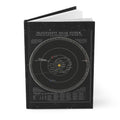
The Transparent Solar System is a diagram of the planetary system as it was understood in 1846 — the year of Neptune’s discovery, though the new planet may not yet have been incorporated into Emslie’s chart. The diagram shows the orbital paths of the known planets around the sun, with the relative distances and sizes rendered with the precision that the best Victorian scientific illustration demanded. The title refers to the original medium: the diagram was designed to be viewed as a transparency, illuminated from behind so that the orbital paths and planetary positions seemed to float in a luminous space.
For the journal covers, the original white background of the diagram has been inverted to black — a modification that restores something of the effect that Emslie’s transparency technique was designed to achieve. Against a black ground, the orbital paths and planetary details emerge with the clarity and drama of stars against the night sky, the diagram becoming something closer to what it was always meant to be: a window onto the cosmos.
The Central Sun and Theory of the Stellar Universe
The second diagram, The Central Sun and Theory of the Stellar Universe, addresses a question that preoccupied Victorian astronomers: the large-scale structure of the universe. The “central sun” theory — the idea that the stars of the Milky Way were arranged around a central gravitational body, as the planets of the solar system are arranged around the sun — was one of the dominant cosmological hypotheses of the mid-nineteenth century, associated with the work of the German astronomer Johann Heinrich Mädler, who had proposed in 1846 that the star Alcyone in the Pleiades cluster was the gravitational centre of the Milky Way.
The theory was eventually abandoned as observational evidence accumulated against it, but in 1846 it represented the cutting edge of astronomical thinking, and Emslie’s diagram rendered it with the visual authority that the best scientific illustration commands. The stellar universe is shown as a structured, ordered system — not the chaotic scatter of points that a naive observation of the night sky might suggest, but a cosmos with architecture, with hierarchy, with a centre. Like the solar system diagram, it has been inverted to black for the journal covers, the stellar arrangements emerging from darkness as they do from the actual night sky.
The Victorian Art of Making Knowledge Visible
What Emslie’s diagrams represent, beyond their specific astronomical content, is a particular Victorian conviction: that knowledge should be made visible, that the structures of the natural world — however vast, however abstract — could and should be rendered in forms that the eye could grasp and the mind could hold. This conviction drove the great tradition of Victorian scientific illustration, from the geological cross-sections of Henry De la Beche to the natural history plates of Philip Henry Gosse, from the anatomical diagrams of Henry Gray to the astronomical charts of John Emslie.
It is a conviction that has not lost its force. The cosmos is still vast, still largely beyond direct human experience, still known to us primarily through the representations that science and art together produce. Emslie’s 1846 diagrams — modified, inverted, printed on the covers of a journal — are still doing what they were always designed to do: making the universe legible, and beautiful, and worth looking at.

If John Emslie’s astronomical diagrams and the Victorian art of scientific illustration resonate with you, the Solar System Journal brings the Transparent Solar System and Central Sun to a hardcover journal — 150 lined pages, ready for stargazing notes, observations, or whatever the night sky inspires.
References
- Emslie, J. Transparent Solar System. James Reynolds, London, 1846.
- Emslie, J. The Central Sun and Theory of the Stellar Universe. James Reynolds, London, 1846.
- Mädler, J.H. Die Centralsonne. Dorpat, 1846.
- Lightman, B. Victorian Popularizers of Science: Designing Nature for New Audiences. University of Chicago Press, 2007.
- Daston, L. & Galison, P. Objectivity. Zone Books, New York, 2007.