The Flemish Eye on the English Countryside: Jan Siberechts and the Birth of British Landscape Painting
In 1672, a Flemish painter named Jan Siberechts crossed the Channel and arrived in England. He was forty-five years old, established in Antwerp, and had spent his career painting the Flemish countryside with the precision and atmospheric sensitivity that defined the great tradition of northern European landscape art. What he found in England — the rolling hills, the country estates, the particular quality of English light — would occupy him for the rest of his life. And what he left behind would change the course of British art.

Before Siberechts: The English Landscape Unseen
It is difficult, looking back from a tradition that includes Constable, Turner, and Gainsborough, to imagine a time when the English landscape was not considered a worthy subject for serious painting. But in the mid-seventeenth century, that was precisely the situation. English painting was dominated by portraiture — the faces of the aristocracy, rendered with varying degrees of skill by a succession of court painters, most of them foreign. The land itself, the countryside that surrounded the great houses and defined the lives of the people who worked it, was largely invisible in art.
There were maps, of course. The English had a long tradition of cartographic representation — estate surveys, county maps, bird's-eye views of towns and properties. But these were functional documents, not works of art. They recorded boundaries and acreages, not light and atmosphere. They showed what was owned, not what was seen.
What was missing was an artist who could bring to the English landscape the same quality of attention that the great Flemish and Dutch painters had brought to their own countryside: the ability to see a field, a river, a hillside not as a legal description but as a visual experience — something worth looking at for its own sake, something that could move a viewer the way a face or a history painting could.
Jan Siberechts was that artist.
A Flemish Master in the English Countryside
Jan Siberechts was born in Antwerp in 1627, into a city that was still one of the great centres of European art. He trained in the Flemish tradition, developing a specialty in rural landscapes — farm scenes, river crossings, cattle in fields — that showed the influence of the great Dutch landscapists while maintaining a distinctly Flemish warmth and solidity. His Antwerp paintings are accomplished works, but they give little hint of the transformation that would occur when he encountered the English countryside.
The circumstances of his move to England are not entirely clear. He was brought over, it seems, by the Duke of Buckingham — one of the great aristocratic collectors of the Restoration period — who had encountered his work and recognised in it qualities that suited his purposes. The English gentry of the late seventeenth century were engaged in a sustained project of estate improvement and self-documentation: they were building, planting, draining, and enclosing, and they wanted records of what they had made. Siberechts, with his Flemish eye for topographical precision and his ability to render landscape with both accuracy and beauty, was exactly what they needed.
What they got was rather more than they bargained for.
The Topographical Tradition and Its Transformation
The paintings Siberechts made in England belong to a genre known as the topographical landscape — a form that had its roots in Flemish and Dutch cartographic art but that, in his hands, became something considerably more ambitious. A topographical landscape was, in its most basic form, a record of a specific place: this house, these fields, this view from this particular vantage point. It was commissioned by the owner of the estate depicted, and its primary function was documentary — to show what the estate looked like, to celebrate its extent and improvement, to serve as a visual title deed.
Siberechts fulfilled these requirements with scrupulous care. His estate views are accurate in their topography, faithful in their architecture, precise in their rendering of the landscape features that defined each property. But they are also, unmistakably, works of art. The light in his paintings — the particular quality of English afternoon light, softer and more diffuse than the sharp Flemish sun — is rendered with a sensitivity that goes far beyond documentary necessity. The figures who populate his landscapes — farm workers, riders, women carrying loads — are observed with a sympathy and specificity that transforms them from staffage into characters. The sky, in painting after painting, is a masterwork of atmospheric observation.
In short, Siberechts took a functional genre and made it beautiful. In doing so, he laid the foundations for the great tradition of English landscape painting that would flourish in the following century.
Bayhall, Pembury, Kent: A Landscape Preserved
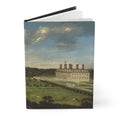
Among the finest of Siberechts' English works is his circa 1675 painting A View of Bayhall, Pembury, Kent, now in the collection of the Yale Center for British Art. The Bayhall estate, situated in the rolling hills of the Weald of Kent, was one of the great country properties of the region — a manor house surrounded by parkland, cultivated fields, and the characteristic landscape of southeast England that had been shaped over centuries by agriculture, woodland management, and the particular geology of the Kentish Weald.
Siberechts' view of Bayhall is a masterwork of the topographical genre. The composition is organised with the confidence of an artist who has fully absorbed the possibilities of his subject: the manor house sits in the middle distance, its architecture rendered with careful precision, while the foreground is animated by the figures and animals that give the landscape its human scale and social meaning. Farm workers move through the fields; livestock graze in the parkland; the ordered geometry of the estate grounds — the paths, the enclosures, the kitchen gardens — speaks of improvement and cultivation.
But what elevates the painting above mere documentation is the light. The Kentish afternoon light that falls across the Bayhall estate in Siberechts' painting is one of the great achievements of seventeenth-century landscape art — warm, golden, slightly hazy, the light of a specific season and time of day rendered with a fidelity that makes the painting feel not like a record of a place but like a memory of one. You feel, looking at it, that you have been there — that you know this particular quality of English afternoon, this particular way the light falls across rolling hills and cultivated fields.
The Bayhall estate itself has largely disappeared. The manor house is gone; the parkland has been absorbed into the suburban landscape of modern Kent. What survives is Siberechts' painting — a record of a place and a moment that would otherwise be entirely lost.
The Legacy: From Siberechts to Constable
Jan Siberechts died in London around 1703, having spent the last three decades of his life painting the English countryside with a dedication and sensitivity that had no precedent in British art. His influence on the painters who followed him was profound, if not always acknowledged. The tradition of English landscape painting that would produce Gainsborough's Suffolk scenes, Constable's Suffolk skies, and Turner's atmospheric transformations of the British landscape had its roots, in significant part, in the Flemish eye that Siberechts brought to England in 1672.
He is not a household name. The great survey histories of British art tend to mention him briefly, as a precursor, before moving on to the native-born painters who would develop the tradition he established. But for those who know his work — who have stood in front of a Siberechts landscape and felt the particular quality of attention it embodies — he is something more than a precursor. He is the artist who first looked at the English countryside and saw, in its hills and fields and particular quality of light, something worth painting for its own sake.
That is not a small thing. It is, in fact, the beginning of an entire tradition.
A Journal for Those Who See the Landscape

Our Jan Siberechts Bayhall View Journal carries his circa 1675 A View of Bayhall, Pembury, Kent across its full wraparound cover — the front presenting the manor house and its grounds, the back extending the panorama into the wider Kentish landscape. Inside, 150 perforated lined pages await your own observations: travel notes, landscape sketches, countryside reflections, or whatever form your attention takes when you are in the presence of a great view.
The casewrap sewn binding opens completely flat. The matte laminated cover preserves the painting's subtle atmospheric light. It is, we hope, a journal worthy of the landscape it carries.
Siberechts crossed the Channel with a Flemish eye and found, in the English countryside, a subject that would occupy him for the rest of his life. Perhaps you will find something similar — in Kent, or wherever your own landscape happens to be.
References & Further Reading
- Barrell, John. The Dark Side of the Landscape: The Rural Poor in English Painting 1730–1840. Cambridge University Press, 1980. [On the social dimensions of English landscape painting.]
- Bermingham, Ann. Landscape and Ideology: The English Rustic Tradition, 1740–1860. University of California Press, 1986.
- Harris, John. The Artist and the Country House: A History of Country House and Garden View Painting in Britain, 1540–1870. Sotheby Parke Bernet, 1979. [The essential reference on the topographical estate portrait tradition.]
- Ogden, Henry V. S. & Ogden, Margaret S. English Taste in Landscape in the Seventeenth Century. University of Michigan Press, 1955.
- Slive, Seymour. Dutch Painting 1600–1800. Yale University Press, 1995. [For the Flemish and Dutch landscape tradition that shaped Siberechts.]
- Yale Center for British Art. Collection Online: Jan Siberechts. Available at collections.britishart.yale.edu. [Primary source for A View of Bayhall, Pembury, Kent.]
- Waterhouse, Ellis. Painting in Britain 1530–1790. 4th ed., Penguin Books, 1978. [Standard survey of British painting, with coverage of Siberechts' role in the landscape tradition.]