Jacob Sturm and the German Tradition of Botanical Education
In nineteenth-century Germany, botanical education was a serious enterprise — and the illustrated plate was its primary instrument. The tradition of the Naturgeschichte — the natural history — as a genre of popular scientific publishing had deep roots in German intellectual culture, stretching back to the great encyclopaedic projects of the Enlightenment and forward into the systematic natural history education that became a feature of German schools and universities in the nineteenth century. Jacob Sturm’s Naturgeschichte des Pflanzenreichs (Natural History of the Plant Kingdom), published in 1887, was one of the finest expressions of this tradition — and its comparative botanical plates, showing multiple species from the same plant family arranged on a single page, remain among the most beautiful examples of scientific illustration ever produced for an educational purpose.

The Comparative Plate as Pedagogical Instrument
The central innovation of Sturm’s approach — and of the German natural history tradition more broadly — was the comparative plate: a single illustration showing multiple related species arranged together, allowing the reader to observe the similarities and differences between them at a glance. This was not merely an aesthetic choice. It reflected a particular understanding of how botanical knowledge was organised and how it should be taught.
The Linnaean system of plant classification, which had dominated European botany since the mid-eighteenth century, organised plants primarily by the number and arrangement of their stamens and pistils — a system that was useful for identification but that grouped together plants that were otherwise very different from each other. By the early nineteenth century, botanists had largely abandoned the Linnaean system in favour of the natural system developed by Antoine Laurent de Jussieu and later refined by Augustin Pyramus de Candolle, which grouped plants by their overall structural similarities rather than by a single characteristic. The comparative plate was the visual expression of this natural system: by showing related species together, it made visible the family resemblances that defined the natural groups.
Jacob Sturm and the Naturgeschichte des Pflanzenreichs
Jacob Sturm (1771–1848) was a Nuremberg engraver and naturalist who produced a series of illustrated natural history works that became standard references in German botanical education. His Deutschlands Flora in Abbildungen (Germany’s Flora in Illustrations), published in multiple volumes from 1798 onwards, established his reputation as one of the finest botanical illustrators of his generation. The Naturgeschichte des Pflanzenreichs of 1887 — published posthumously, in a revised and expanded edition that drew on Sturm’s original work — brought his illustrative approach to a broader educational audience.
What distinguished Sturm’s plates from those of many of his contemporaries was their combination of scientific accuracy and visual elegance. Each species is shown with the detail necessary for identification — flowers, leaves, stems, and often roots or seeds — but the arrangement of the species on the page is also carefully considered as a composition, with the different plants balanced against each other in a way that is pleasing to the eye as well as informative to the mind. The plates are works of art as well as works of science, and they were intended to be both: to educate the student and to cultivate in them an appreciation of the beauty of the natural world.
Plate XXVI: Rosaceae and Papaveraceae
Plate XXVI of the Naturgeschichte des Pflanzenreichs brings together eleven species from two of the most important families of European flora: the Rosaceae and the Papaveraceae. The choice of families is itself instructive. The Rosaceae — the rose family — is one of the largest and most economically important plant families in the temperate world, including not only roses but strawberries, blackberries, apples, pears, cherries, and almonds. The Papaveraceae — the poppy family — is smaller but no less significant, including the opium poppy (Papaver somniferum), the common red poppy (Papaver rhoeas), and the greater celandine (Chelidonium majus), all of which have long histories as medicinal plants.
The eleven species of Plate XXVI span the full range of these families’ diversity. From the Rosaceae: Fragaria vesca (wild strawberry), with its delicate white flowers and the promise of the small, intensely flavoured fruit that has been gathered from European woodlands since prehistory; Rubus fruticosus (blackberry), with its pink-white blossoms that will become the dark fruit of late summer; Potentilla anserina (silverweed), its bright yellow flowers and silver-backed leaves a familiar sight on roadsides and waste ground; Dryas octopetala (mountain avens), an alpine species whose eight-petalled white flowers are among the most beautiful of the high mountain flora; Rosa canina (dog rose), the wild rose of European hedgerows, its soft pink flowers one of the defining images of the English and German countryside; and Geum urbanum (wood avens), a modest plant of shaded places whose small yellow flowers belie its long history as a medicinal herb. From the Papaveraceae: Papaver rhoeas (common red poppy), the flower of agricultural fields and, since the First World War, of remembrance; Papaver somniferum (opium poppy), in its elegant purples and whites, one of the most beautiful and most historically significant of all flowering plants; Chelidonium majus (greater celandine), its golden-yellow flowers and orange sap used in traditional medicine for centuries; and Capparis spinosa (caper), the Mediterranean shrub whose flower buds have been pickled and eaten since antiquity. Together, they form a portrait of European plant life in its full diversity — from the alpine to the Mediterranean, from the woodland to the hedgerow, from the garden to the field.
The Poppy and the Rose
Two of the species in Plate XXVI deserve particular attention, because they carry meanings that extend far beyond their botanical significance. The red poppy (Papaver rhoeas) has been a symbol of the agricultural landscape of Europe since antiquity — its seeds lie dormant in the soil for years, germinating when the ground is disturbed, which is why it appeared in such abundance on the battlefields of the First World War and became, through John McCrae’s poem “In Flanders Fields” (1915), the flower of remembrance for the fallen. The dog rose (Rosa canina) has an equally long symbolic history: it is the wild ancestor of the cultivated rose, the flower that appears in medieval heraldry and Renaissance poetry, the plant whose hips were gathered for vitamin C during the Second World War when citrus fruits were unavailable. In Sturm’s plate, both flowers appear in their botanical reality — as members of plant families, as organisms with structures and relationships — but they carry their symbolic weight with them, as they always have.

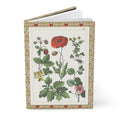
If Jacob Sturm and the German tradition of botanical illustration resonate with you, the Sturm Botanical Plate XXVI Journal brings his 1887 illustration of eleven European wildflowers to a hardcover journal — 150 lined pages, ready for field notes, botanical sketches, or whatever the flower meadow inspires.
References
- Sturm, J. Naturgeschichte des Pflanzenreichs. Stuttgart, 1887.
- Sturm, J. Deutschlands Flora in Abbildungen. Nuremberg, 1798–1862.
- Lack, H.W. A Garden Eden: Masterpieces of Botanical Illustration. Taschen, Cologne, 2008.
- Blunt, W. and Stearn, W.T. The Art of Botanical Illustration. Antique Collectors’ Club, Woodbridge, 1994.
- McCrae, J. “In Flanders Fields.” Punch, 8 December 1915.