Flags of the World in 1908: The Harmsworth Atlas and the Edwardian Political Imagination
A flag is a compressed history. In its colors and symbols, its proportions and devices, it carries the accumulated weight of national identity, imperial ambition, dynastic succession, and political revolution. To look at a flag chart from 1908 is to look at the world as it was on the eve of its transformation — a world of empires and kingdoms, of colonies and protectorates, of national boundaries that would be redrawn, in many cases beyond recognition, by the catastrophe that was six years away. The two flag charts from the Harmsworth Atlas and Gazetteer that wrap our journal are documents of that world: precise, educational, and, in retrospect, haunting.

The Harmsworth Atlas and the Edwardian Information Revolution
The Harmsworth Atlas and Gazetteer was published in 1908 by Amalgamated Press, the publishing empire founded by Alfred Harmsworth — later Lord Northcliffe — one of the most influential figures in the history of British journalism and popular publishing. Harmsworth had built his fortune on the insight that there was a vast, largely untapped market for affordable, accessible, high-quality information: newspapers, encyclopaedias, atlases, and educational publications that could bring the knowledge previously available only to the educated elite within reach of the newly literate mass public created by the Education Acts of the 1870s.
The Harmsworth Atlas was a product of this vision. It was designed to be comprehensive, accurate, and visually impressive — a reference work that could serve both the student and the general reader, both the professional who needed precise geographical information and the curious amateur who simply wanted to understand the world. Its maps were detailed and carefully produced; its gazetteer provided geographical and political information on countries, cities, and territories across the globe; and its supplementary charts — including the flag charts that appear on our journal — provided visual reference material that made the atlas genuinely useful as an educational tool.
The atlas appeared at a moment of particular significance in British cultural and political life. Edward VII had been on the throne since 1901, and the Edwardian era was, in many respects, the high-water mark of British imperial confidence. The Empire was at its greatest territorial extent; British trade and investment dominated the global economy; the Royal Navy was the most powerful in the world. And yet, beneath the surface of this confidence, the tensions that would eventually produce the catastrophe of 1914 were already visible to those who knew where to look.
Flags of the British Empire: A Visual Inventory of Power
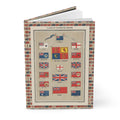
The front cover of our journal carries the Harmsworth Atlas's chart of the Flags of the British Empire — a visual inventory of the territories under British rule in 1908. The chart is, in its way, an extraordinary document: a compressed representation of an empire that spanned every continent and ocean, encompassing territories as different as Canada and Ceylon, Australia and Aden, Nigeria and Newfoundland.
The flags themselves tell a complex story. The Union Jack — the flag of the United Kingdom itself, combining the crosses of St George, St Andrew, and St Patrick — appears in various forms across the chart, incorporated into the flags of dominions, colonies, and protectorates in ways that signal their relationship to the metropolitan power. The dominions — Canada, Australia, New Zealand, South Africa — had their own distinctive flags that combined the Union Jack with local symbols, reflecting their status as self-governing territories within the imperial framework. The crown colonies and protectorates had simpler arrangements, often a blue or red ensign defaced with a colonial badge.
To read the chart is to read the structure of the Empire itself: the hierarchy of territories, the gradations of autonomy and dependence, the geographical reach of British power across the globe. It is also to encounter a world that has largely disappeared. Many of the territories represented on the chart — British India, the various African protectorates, the Caribbean colonies — would achieve independence in the decades following the Second World War, their flags transformed in the process. The chart captures them at a specific moment, before that transformation, when the imperial order seemed permanent and the flags that represented it seemed likely to endure.
European Flags in 1908: A Continent on the Eve of War
The back cover carries the chart of European Flags — a document that is, if anything, even more historically charged than its companion. In 1908, the political map of Europe was dominated by the great empires: the German Empire under Kaiser Wilhelm II, the Austro-Hungarian Empire under the aged Franz Joseph, the Russian Empire under Tsar Nicholas II, the Ottoman Empire in its long decline. The flags of these empires — the black, white, and red of Germany; the black and yellow of Austria-Hungary; the white, blue, and red of Russia; the red and white crescent of the Ottomans — appear on the chart alongside the flags of the smaller nations that existed in their shadow.
Six years after this chart was published, the assassination of Archduke Franz Ferdinand in Sarajevo would set in motion the chain of events that destroyed three of these empires and transformed the fourth beyond recognition. The flags of Germany, Austria-Hungary, and Russia that appear on the 1908 chart would all be replaced — the German imperial flag by the Weimar Republic's tricolor, the Austro-Hungarian double eagle by the flags of the successor states, the Russian imperial tricolor by the red flag of the Soviet Union. The Ottoman crescent would survive, but on a flag that represented a very different political entity.
The chart is, in this sense, a document of a world that was about to end. The flags it depicts are not merely symbols of nations; they are symbols of a political order — the European state system of the long nineteenth century — that would be shattered by the war that began in 1914 and definitively ended by the war that concluded in 1945. To look at the chart is to look at Europe in its last moment of apparent stability, before the catastrophe that would make the twentieth century what it was.
Vexillology and the History of Flags
The study of flags — vexillology, from the Latin vexillum, a military standard — is a discipline that sits at the intersection of history, heraldry, and political science. Flags are among the most powerful and enduring of political symbols: they are carried into battle, raised over conquered territories, lowered in mourning, and burned in protest. Their designs encode the histories of the nations and movements they represent, often in ways that are not immediately legible to the uninitiated.
The flag charts in the Harmsworth Atlas were designed to make this encoding legible — to provide the reader with a visual reference that would allow them to identify the flags of the world's nations and empires and understand their significance. They were educational tools in the most direct sense: instruments for teaching geography, history, and political awareness to a generation of students who were growing up in a world that was, for the first time, genuinely global in its interconnections.
That educational purpose gives the charts a particular kind of historical value. They are not just records of what flags looked like in 1908; they are records of what the Edwardian educational establishment thought it was important for students to know about the world. The selection of flags, the way they are grouped and presented, the relative prominence given to different territories — all of these choices reflect the assumptions and priorities of a specific historical moment, and reading them carefully reveals as much about Edwardian Britain as about the flags themselves.
Amalgamated Press and the Popular Atlas
The Harmsworth Atlas was one of many educational publications produced by Amalgamated Press in the early twentieth century. The company — which also published the Daily Mail, the Daily Mirror, and a wide range of popular magazines and encyclopaedias — was at the forefront of the Edwardian information revolution: the transformation of publishing by new printing technologies, rising literacy rates, and the growing demand for affordable, high-quality reference materials.
Alfred Harmsworth understood, better than almost anyone of his generation, that information was power — and that the democratisation of information, the making of knowledge accessible to people who had previously been excluded from it, was both a commercial opportunity and a social good. The Harmsworth Atlas was part of this project: an attempt to give the ordinary British reader the geographical knowledge that had previously been available only to those who could afford expensive reference works or had access to well-stocked libraries.
The atlas's flag charts were a particularly effective element of this project. Flags are immediately recognisable, visually striking, and historically resonant; a chart of the world's flags is both informative and aesthetically engaging, a document that rewards both study and contemplation. The Harmsworth Atlas's flag charts achieved both purposes with considerable success, and they remain, more than a century later, beautiful and historically significant objects.
A Journal That Carries History

Our Harmsworth Atlas Flags Journal carries these two charts — the Flags of the British Empire on the front, the European Flags on the back — across its full wraparound cover. It is a journal for those who find the history of nations and empires as compelling as the history of individuals — who understand that a flag is a compressed history, and that reading the flags of 1908 is a way of reading the world on the eve of its transformation.
Inside, 150 perforated lined pages await your travel notes, historical reflections, geographical observations, or whatever form your engagement with the world takes. The casewrap sewn binding opens completely flat. The matte laminated cover preserves every detail of the 1908 charts in a finish that rewards close examination.
The flags of 1908 document a world that was about to change beyond recognition. Perhaps the pages inside will document a world in the process of changing still.
References & Further Reading
- Brendon, Piers. The Decline and Fall of the British Empire, 1781–1997. Alfred A. Knopf, 2008. [Comprehensive history of the Empire whose flags appear on the front cover.]
- Ferguson, Niall. Empire: The Rise and Demise of the British World Order and the Lessons for Global Power. Basic Books, 2002.
- Fryer, Alfred C. Flags of All Nations. Various editions, late 19th–early 20th century. [Contemporary vexillological reference works of the period.]
- Harmsworth, Alfred (Lord Northcliffe). The Harmsworth Atlas and Gazetteer. Amalgamated Press, London, 1908. [Primary source.]
- MacMillan, Margaret. The War That Ended Peace: The Road to 1914. Random House, 2013. [On the political world whose flags appear on the back cover.]
- Tuchman, Barbara W. The Guns of August. Macmillan, 1962. [Classic account of the outbreak of WWI and the world it destroyed.]
- Znamierowski, Alfred. The World Encyclopedia of Flags. Lorenz Books, 1999. [Standard modern vexillological reference.]