Nature as the Ultimate Artist: Ernst Haeckel and the Sea Squirts of Kunstformen der Natur
Share
Ernst Haeckel (1834–1919) was many things: German biologist, naturalist, philosopher, and the foremost populariser of Darwin's theory of evolution in Germany. But he was also, in a very real sense, an artist — one who believed that the boundary between science and beauty was artificial, and that the natural world, properly observed, was the greatest work of art ever made.
Kunstformen der Natur — Art Forms in Nature — was his proof. Published in ten installments between 1899 and 1904, the series comprised 100 detailed chromolithographic plates documenting the extraordinary diversity of life on Earth: radiolarians, jellyfish, orchids, hummingbirds, and dozens of other organisms rendered with a precision and elegance that had never been achieved before. Working with master lithographer Adolf Glitsch, Haeckel transformed scientific documentation into visual poetry.
The Philosophy of Kunstformen
Haeckel's central argument was radical: that nature's forms possessed an inherent mathematical elegance — a geometric intelligence — that made them not merely beautiful but architecturally significant. He believed that artists and architects had as much to learn from biology as from classical antiquity, and that the organic forms of marine invertebrates, coral, and radiolarians offered a vocabulary of design that human imagination could never have invented.
He was right. Kunstformen der Natur became one of the most influential scientific publications of the 20th century — not primarily among biologists, but among artists and architects. René Binet used Haeckel's radiolarians as the basis for the monumental entrance gate to the 1900 Paris Exposition. Antoni Gaudí cited Haeckel's organic forms as a direct influence. The sinuous lines, the flowing symmetry, the sense of nature as an architect — all of it flowed directly from Haeckel's plates into the visual language of Art Nouveau.
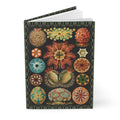
Plate 85: Ascidiae
Among the 100 plates of Kunstformen der Natur, Plate 85 — Ascidiae — is one of the most extraordinary. Sea squirts (tunicates) are marine invertebrates that filter seawater for nutrients, attaching themselves to rocks, coral, and the hulls of ships. To the casual observer, they are unremarkable. To Haeckel's eye, they were revelations.
The plate documents multiple Ascidiacea species with the chromolithographic richness and biological precision that defined Haeckel's method. The translucent bodies, the vibrant pigmentation, the geometric symmetry of the colonial forms — all of it is rendered with a meticulous attention to form that reveals the hidden architectural beauty of organisms most people would never encounter. The flowing organic shapes, the jewel-like colours, the sense of alien elegance: this is Haeckel at his most compelling.
Adolf Glitsch and the Art of Lithography
Behind every plate in Kunstformen der Natur stood Adolf Glitsch, the master lithographer whose technical skill made Haeckel's vision possible. Chromolithography — the process of printing in multiple colours from separate stone plates — was the most demanding printing technology of the era, requiring extraordinary precision and an intimate understanding of colour. Glitsch's ability to render the translucent bodies of sea squirts, the iridescent surfaces of radiolarians, and the delicate pigmentation of marine organisms with such fidelity was a technical achievement as remarkable as Haeckel's scientific vision.
Together, Haeckel and Glitsch created something that neither could have achieved alone: a work of science that is also, unmistakably, a work of art.
Explore the journal: