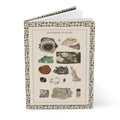
The Stones of the Empire: Gustav von Hayek and the Mineral Chromolithographs of 1887
The Austro-Hungarian Empire of the late nineteenth century was, among many other things, a great producer of natural history. Its universities — in Vienna, Prague, Graz, and Innsbruck — were among the leading centres of geological and mineralogical research in Europe. Its natural history museums — above all the Naturhistorisches Museum Wien, opened in 1889 — housed collections of minerals and geological specimens that were among the finest in the world. And its tradition of illustrated natural history publication — sustained by the imperial patronage of the Habsburgs and the scientific ambition of a generation of Austrian naturalists — produced, in the second half of the nineteenth century, some of the most beautiful and scientifically rigorous works of natural history illustration ever made. Gustav von Hayek’s mineral chromolithographs of 1887 belong to this tradition: images that document the mineral kingdom — opal, jasper, onyx, quartz, fluorite, apatite — with the precision of a scientist and the visual ambition of an artist, in the service of an empire that understood the documentation of the natural world as both a scientific and a cultural imperative.

The minerals that von Hayek illustrated were not merely scientific specimens. They were, in the context of the Austro-Hungarian Empire, objects of considerable economic and cultural significance. The opals of Hungary — among the finest in the world, mined at Cerná Hora in what is now Slovakia — were prized across Europe for their extraordinary play of colour. The jaspers and onyxes of the Alpine regions were worked by craftsmen whose traditions stretched back to the Renaissance. The quartz crystals of the Austrian Alps were collected by naturalists and sold to museums and private collectors across the continent. To document these minerals with chromolithographic precision was to assert the scientific and cultural richness of the empire that produced them.
Gustav von Hayek and Austrian Natural History
Gustav von Hayek worked within the tradition of Austrian natural history that had developed, over the course of the nineteenth century, into one of the most productive scientific traditions in Europe. Austrian natural history in this period was characterised by a combination of imperial patronage and scientific rigour that had produced, by the 1880s, a remarkable body of illustrated natural history literature. The tradition stretched back to the great naturalists of the Enlightenment — to Nikolaus Joseph von Jacquin, whose botanical illustrations for the imperial gardens at Schönbrunn had set the standard for Austrian natural history illustration, and to the geological surveys of the imperial geological institute, the k.k. Geologische Reichsanstalt, founded in 1849 — and had been sustained, through the nineteenth century, by a succession of illustrated works that combined scientific accuracy with visual ambition.
Von Hayek’s mineral plates were produced in this context: as part of the broader project of documenting the natural resources of the Austro-Hungarian Empire with the precision and visual richness that the imperial scientific tradition demanded. The chromolithographic technique he used was, by 1887, a mature and highly developed medium, capable of rendering the subtle gradations of colour in a mineral specimen — the play of colour in an opal, the banding of an onyx, the transparency of a fluorite crystal — with a fidelity that earlier illustration techniques could not achieve.
Opal: The Stone of the Hungarian Mines
Of all the minerals that von Hayek documented, opal is perhaps the most extraordinary — and the most challenging to illustrate. Opal is not a crystalline mineral in the strict sense: it lacks the regular atomic lattice that defines a crystal, and its remarkable optical properties — the play of colour, or opalescence, that makes it one of the most prized gemstones in the world — arise not from crystal structure but from the diffraction of light by the regular arrangement of silica spheres within the stone.
The finest opals of the nineteenth century came from the mines of Hungary — specifically from Cerná Hora (Schwarzenberg) in what is now Slovakia, which had been producing opals since the fourteenth century and which supplied the imperial court and the gem markets of Europe with stones of extraordinary quality. Hungarian opals were distinguished by their vivid play of colour — the shifting reds, greens, and blues that appear and disappear as the stone is turned in the light — and by their large size, which made them suitable for the elaborate jewellery settings that were fashionable in the courts of Europe. To render this play of colour in a flat chromolithographic image was a considerable technical challenge, and von Hayek’s plates address it with the full resources of the chromolithographic press.
Jasper, Onyx, and the Silica Family
Jasper and onyx are both varieties of chalcedony — the microcrystalline form of silica that also includes agate, carnelian, and chrysoprase. Jasper is an opaque, fine-grained rock that owes its characteristic red, yellow, and brown colours to the presence of iron oxides; onyx is a banded variety of chalcedony in which alternating layers of black and white (or other colours) create the distinctive striped pattern that has made it a favourite of gem-cutters and cameo-makers since antiquity.
Both minerals had been worked in the Alpine regions of the Austro-Hungarian Empire for centuries. The jaspers of Bohemia and Moravia were among the finest in Europe, prized for their rich colours and fine grain. The onyxes of the Alpine regions were worked by craftsmen in Vienna and Prague whose traditions of gem-cutting and cameo-making stretched back to the Renaissance. Von Hayek’s documentation of these minerals was, in this sense, a contribution not only to mineralogical science but to the cultural heritage of the empire: a record of the stones that had been worked by Austrian craftsmen for generations.
Quartz, Fluorite, and Apatite: The Crystals of the Alps
Quartz — silicon dioxide, SiO₂ — is the most abundant mineral in the earth’s crust, and one of the most varied in its forms and appearances. Rock crystal — colourless, transparent quartz — was collected in the Austrian Alps by crystal hunters (Strahler) whose traditions stretched back to the Middle Ages, and was sold to museums, collectors, and craftsmen across Europe. Amethyst, citrine, rose quartz, and smoky quartz are all varieties of the same mineral, distinguished by the trace elements and structural defects that give each its characteristic colour. Von Hayek’s plates document this variety with the systematic thoroughness of the Austrian mineralogical tradition.
Fluorite — calcium fluoride, CaF₂ — is one of the most visually striking minerals in the world: its crystals, which form in the cubic system, occur in a remarkable range of colours — purple, green, yellow, blue, and colourless — and its perfect octahedral cleavage produces fragments of extraordinary geometric regularity. It was an important industrial mineral in the nineteenth century, used as a flux in metallurgy and as a source of fluorine for the emerging chemical industry. Apatite — calcium phosphate — is the mineral that forms the hard tissue of bones and teeth, and was an important source of phosphorus for the fertiliser industry that was transforming European agriculture in the second half of the nineteenth century. Together, these minerals represent the intersection of scientific interest, industrial importance, and visual beauty that characterised the best Austrian mineralogical illustration of the period.
The Naturhistorisches Museum and the Imperial Collections
The context within which von Hayek’s plates were produced was shaped, above all, by the great natural history collections of the Austro-Hungarian Empire. The Naturhistorisches Museum Wien — opened in 1889, two years after von Hayek’s plates were published — was the culmination of a century of imperial collecting: its mineral collection, which included specimens from across the empire and from the mineral-rich regions of the world, was one of the finest in Europe, and its illustrated catalogues and atlases were among the most important works of mineralogical documentation of the period.
Von Hayek’s plates belong to this tradition of imperial documentation: images produced in the service of a scientific culture that understood the systematic illustration of the natural world as both a scientific and a cultural imperative. They are images that carry within them the ambition and the precision of the Austrian natural history tradition — and that remain, nearly a century and a half later, among the most beautiful works of mineralogical illustration ever produced.
A Journal for Those Who Find Beauty in Stones

Our Gustav von Hayek Mineral Specimens Journal carries these 1887 chromolithographic plates across its full wraparound cover — opal, jasper, onyx, quartz, fluorite, and apatite documented with the scientific precision and visual richness of the Austro-Hungarian natural history tradition. It is a journal for those who find beauty in crystals, who understand that a mineral specimen is as worthy of sustained attention as a painting or a poem, who appreciate the imperial scientific culture that produced these images.
Inside, 150 perforated lined pages await your field notes, mineral observations, geological sketches, or whatever form your engagement with the crystalline world takes. The casewrap sewn binding opens completely flat — ideal for drawing alongside your notes. The matte laminated cover preserves every detail of von Hayek’s chromolithographs in a finish that rewards close examination.
In 1887, Gustav von Hayek looked at opal and jasper, quartz and fluorite, and documented what he saw with a precision and beauty that the Austrian imperial tradition demanded. Perhaps the pages inside will help you look a little more carefully at the stones beneath your feet.
References & Further Reading
- Bancroft, Peter. Gem and Crystal Treasures. Western Enterprises, 1984. [On the great mineral collections of Europe, including the Naturhistorisches Museum Wien.]
- Deer, W.A., Howie, R.A. & Zussman, J. An Introduction to the Rock-Forming Minerals. Longman, 1966. [The standard reference for the mineralogy of quartz, feldspar, and the silicate minerals documented in von Hayek’s plates.]
- Hochleitner, Rupert. Minerals: Identifying, Classifying, Collecting. Barron’s, 1994. [A comprehensive guide to mineral identification in the Central European tradition.]
- Lack, H. Walter. Garden Eden: Masterpieces of Botanical Illustration. Taschen, 2008. [On the broader tradition of Austrian natural history illustration within which von Hayek’s plates belong.]
- Nassau, Kurt. The Physics and Chemistry of Color. Wiley, 1983. [On the optical phenomena that produce the play of colour in opal and the colours of jasper, fluorite, and amethyst.]
- Niedermayr, Gerhard et al. Neue Mineralfunde aus Österreich. Carinthia II, annual. [The ongoing record of Austrian mineral discoveries, in the tradition of systematic documentation that von Hayek’s plates represent.]
- Spencer, Leonard James. A Key to Precious Stones. Blackie & Son, 1936. [A classic guide to gemstones including opal, jasper, onyx, and the other minerals in von Hayek’s plates.]