The Geometry of Life: Ernst Haeckel, Kunstformen der Natur, and the Algae That Inspired Art Nouveau
I. The Biologist Who Drew Like a God
Ernst Haeckel was, by any measure, one of the most controversial scientists of the nineteenth century. A zoologist, anatomist, and evolutionary theorist who had corresponded with Darwin and championed his ideas in Germany with an evangelical fervor that made him as many enemies as admirers, he was also something that very few scientists of his generation were: a draughtsman of extraordinary gifts.
Haeckel drew everything he studied. He drew radiolarians and jellyfish, sea anemones and siphonophores, diatoms and foraminifera — the microscopic and the macroscopic, the familiar and the utterly alien. He drew with the precision of a scientist and the eye of an artist, and the combination produced images that were unlike anything that had appeared in the history of natural history illustration.
Between 1899 and 1904, he published the results of a lifetime of looking in a single monumental work: Kunstformen der Natur — Art Forms in Nature. One hundred lithographic plates, produced in collaboration with the master lithographer Adolf Giltsch, documenting the hidden geometry of the living world. The book was not a scientific treatise in the conventional sense. It was an argument — a sustained, visual argument that beauty and truth were not separate categories, that the forms produced by evolution were also, and necessarily, works of art.
The argument was heard. Kunstformen der Natur became one of the most influential illustrated books of the twentieth century — not primarily in biology, but in design.

II. The Plates: A Visual Taxonomy of Wonder
The one hundred plates of Kunstformen der Natur are organized by organism type, but their logic is as much aesthetic as taxonomic. Haeckel arranged his subjects to reveal the underlying geometric principles that he believed governed all living form: radial symmetry, bilateral symmetry, the spiral, the lattice, the branching tree.
The algae plates are among the most striking. Plate 34, Melethallia, shows the social green algae Pediastrum — colonial organisms that arrange themselves into flat, star-shaped discs of extraordinary geometric regularity. Each colony is a single layer of cells, arranged in a pattern that looks designed but is the product of purely biological processes: cell division, adhesion, the physics of growth in two dimensions. The result is a form that Haeckel rendered with the care and precision of a jeweler drawing a brooch.
The Caulerpa plates show a different kind of wonder. Caulerpa is a genus of green algae remarkable for being, in biological terms, a single cell — but a single cell that can grow to the size of a hand, with multiple nuclei and no internal cell walls dividing it into separate compartments. It is one of the largest single-celled organisms on Earth, and its forms — feathery fronds, grape-like clusters, flat blades — are among the most varied and visually complex in the algal world. Haeckel rendered them with a delicacy that makes them look like botanical illustrations of miniature trees.
III. Adolf Giltsch and the Art of Lithography
The visual power of Kunstformen der Natur was not Haeckel’s alone. The lithographer Adolf Giltsch (1852–1911), who worked with Haeckel for decades at the University of Jena, was responsible for translating Haeckel’s drawings into the chromolithographic plates that gave the book its extraordinary visual quality.
Chromolithography — the process of printing in multiple colors using a series of stone or metal plates, one for each color — was at the height of its technical development in the late nineteenth century. In the hands of a master like Giltsch, it could produce images of extraordinary subtlety and precision: the delicate gradations of color in a radiolarian’s silica skeleton, the translucent quality of a jellyfish’s bell, the precise geometry of a Pediastrum colony’s cell walls.
Giltsch’s contribution to Kunstformen der Natur has been consistently undervalued. The plates are almost always attributed to Haeckel alone, as if the lithographer were merely a technical intermediary. But the quality of the chromolithography — the color choices, the tonal gradations, the management of the printing process — was itself a form of artistic interpretation, and Giltsch’s mastery of his craft was as essential to the book’s impact as Haeckel’s mastery of his.
IV. The Art Nouveau Connection
The influence of Kunstformen der Natur on the Art Nouveau movement was immediate, profound, and extensively documented. The book appeared at precisely the moment when Art Nouveau — the decorative style characterized by flowing organic lines, asymmetrical compositions, and nature-inspired ornament — was at its height across Europe, and its images provided designers with a vocabulary of natural form that was both scientifically grounded and visually inexhaustible.
The architect René Binet used Haeckel’s radiolarian illustrations as the basis for the monumental entrance gate he designed for the Paris Exposition Universelle of 1900 — one of the defining images of Art Nouveau architecture. The jeweler René Lalique drew on Haeckel’s marine organisms for his glass and enamel designs. The Belgian architect Victor Horta, the German designer Peter Behrens, the Czech artist Alfons Mucha — all were working in a visual environment saturated with Haeckel’s images.
What the designers found in Kunstformen der Natur was not merely a source of decorative motifs. They found a principle: that the forms produced by natural processes — growth, division, the physics of surface tension, the geometry of packing — were inherently beautiful, and that design that followed these principles would share in that beauty.
V. Haeckel’s Science and Its Complications
Any honest account of Ernst Haeckel must acknowledge the complications. He was a scientist of genuine brilliance and a draughtsman of extraordinary gifts, but he was also a man whose scientific work was shaped by ideological commitments that led him, at times, into serious error.
His theory of recapitulation — the idea that the embryonic development of an individual organism replays the evolutionary history of its species — was influential for decades but is now understood to be, in its strong form, incorrect. His famous embryo drawings were shown in his own lifetime to have been significantly idealized, and the controversy over their accuracy has never entirely subsided.
None of this diminishes the achievement of Kunstformen der Natur. The plates are what they are: documents of extraordinary visual intelligence, produced by a man who looked at the living world with an attention and a care that few scientists before or since have matched. The complications are part of the history, and they are worth knowing. But they do not change what happens when you look at Plate 34 and see Pediastrum arranged in its star-shaped colony, rendered with a precision and a beauty that makes you understand, for a moment, what Haeckel meant when he said that evolution was an artist.
VI. The Algae and the Oxygen
The green algae depicted in Haeckel’s plates — Pediastrum, Caulerpa, and their relatives — are among the most ancient and ecologically significant organisms on Earth. Green algae are the ancestors of all land plants: the evolutionary lineage that, some 500 million years ago, made the transition from aquatic to terrestrial life and in doing so transformed the planet’s surface from bare rock to the green world we inhabit.
Photosynthetic algae produce between 50% and 80% of the oxygen in Earth’s atmosphere — a contribution that dwarfs that of all the world’s forests combined. The Pediastrum colonies that Haeckel drew with such care are, among other things, oxygen factories of extraordinary efficiency, converting sunlight and carbon dioxide into the air that sustains all animal life on Earth.
What Haeckel chose to emphasize, in Kunstformen der Natur, was not their ecological function but their form — the extraordinary visual complexity that evolution had produced in organisms that most people had never seen. That choice was itself a kind of argument: that the value of the natural world is not exhausted by its utility, and that the attention he brought to these organisms was itself a form of respect.
VII. A Note on This Journal

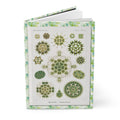
The cover of this journal carries Ernst Haeckel’s 1904 lithographs of Pediastrum and Caulerpa from Kunstformen der Natur — two of the algae plates that helped inspire the Art Nouveau movement and revealed the hidden geometry of the microscopic world. For naturalists, scientists, designers, and anyone who has ever looked at something small and found it extraordinary.
👉 Algae Journal — Ernst Haeckel 1904 Kunstformen der Natur
References
- Haeckel, E. (1899–1904). Kunstformen der Natur. Verlag des Bibliographischen Instituts, Leipzig.
- Richards, R.J. (2008). The Tragic Sense of Life: Ernst Haeckel and the Struggle over Evolutionary Thought. University of Chicago Press.
- Breidbach, O. (2006). Visions of Nature: The Art and Science of Ernst Haeckel. Prestel.
- Hopwood, N. (2015). Haeckel’s Embryos: Images, Evolution, and Fraud. University of Chicago Press.
- Nybakken, J.W. & Bertness, M.D. (2004). Marine Biology: An Ecological Approach. Pearson.
- Biodiversity Heritage Library. Kunstformen der Natur, 1904. biodiversitylibrary.org.