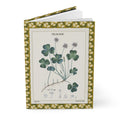
Flore Médicale: Turpin and the Art of French Botanical Illustration
In 1814, as Napoleon’s empire was collapsing and the map of Europe was being redrawn at the Congress of Vienna, a group of French botanists and artists were engaged in a quieter but no less ambitious project: the systematic documentation of the medicinal plants of France. The result was the Flore médicale, a multi-volume work that combined the botanical expertise of François-Pierre Chaumeton and Jean Louis Marie Poiret with the illustrative genius of Pierre Jean François Turpin — and produced one of the most beautiful works of scientific illustration of the nineteenth century.

The Flore Médicale and Its Authors
The Flore médicale was conceived as a comprehensive guide to the plants used in French medicine — a work that would be useful to physicians and pharmacists as well as to botanists, and that would present its subjects with the accuracy and completeness that the new scientific standards of the post-Enlightenment era demanded. François-Pierre Chaumeton (1775–1819), a physician and botanist, provided the medical and botanical text; Jean Louis Marie Poiret (1755–1834), one of the most prolific botanical writers of his generation and a contributor to the great Encyclopédie méthodique, contributed additional descriptions and commentary. Ernestine Panckoucke, the publisher’s wife, oversaw the production of the work and is credited on the title page alongside the authors — an unusual acknowledgement for a woman in early nineteenth-century French publishing.
The work was published in eight volumes between 1814 and 1820, with each plant documented through a combination of detailed text — covering its botanical characteristics, its medicinal properties, its preparation and dosage — and a hand-coloured engraved plate illustrating the complete plant: leaves, flowers, roots, and anatomical cross-sections that revealed the inner structure of flowers and seeds.
Pierre Jean François Turpin: Botanist and Artist
The plates of the Flore médicale were the work of Pierre Jean François Turpin (1775–1840), one of the most accomplished botanical illustrators of the nineteenth century and a figure who embodied the dual vocation of scientist and artist that the best botanical illustration requires. Turpin had trained as a soldier before discovering his vocation as a naturalist and draughtsman, and he brought to his botanical work both the precision of a scientist and the compositional intelligence of an artist.
What distinguished Turpin’s plates from those of many of his contemporaries was his insistence on showing the complete plant — not merely the flower or the leaf that might be used for identification, but the entire organism in its anatomical complexity. The plate of the Oxalide (Plate 261) shows the plant’s delicate trifoliate leaves, its cheerful yellow flowers, its intricate root system, and a series of anatomical details — cross-sections of the flower, isolated stamens and pistils, seed pods at various stages of development — that transform the illustration from a portrait into a complete scientific document. The plate of the Violette (Plate 348) achieves the same completeness with different means: the heart-shaped leaves, the distinctive purple blooms with their characteristic asymmetry, the root system, and the anatomical details that reveal the flower’s inner structure.
Oxalide and Violette: Two Plants and Their Histories
The two plants that appear on the covers of this journal are among the most familiar of the European flora — and among the most historically significant as medicinal plants.
The Oxalide — wood sorrel, Oxalis acetosella — was valued in traditional medicine for its cooling and diuretic properties, and its pleasantly sour taste (produced by oxalic acid, from which the genus takes its name) made it a popular addition to salads and sauces. It was also one of the candidates proposed by various antiquarians for the identity of the Irish shamrock, a claim that has never been definitively settled. In Turpin’s plate, the plant is shown with the delicacy and precision that its small scale demands — the trifoliate leaves folded along their midribs in the characteristic sleep movement that closes them at night, the flowers held on slender stems above the foliage.
The Violette — sweet violet, Viola odorata — has one of the longest histories of any medicinal plant in the European tradition, appearing in the pharmacopoeias of ancient Greece and Rome and remaining in use through the medieval period and into the nineteenth century. Its flowers were used to make syrups and conserves valued for their soothing properties; its leaves were applied as poultices; its roots, in larger doses, were used as an emetic. It was also, of course, one of the most beloved flowers of the Romantic era — Napoleon’s personal emblem, the flower that his supporters wore as a secret sign of loyalty during the Hundred Days, the flower that Josephine grew in abundance at Malmaison.

If the Flore médicale and the tradition of French botanical illustration resonate with you, the Flore Médicale Journal brings Turpin’s 1814 plates of Oxalide and Violette to a hardcover journal — 150 lined pages, ready for botanical notes, garden observations, or whatever the plant world inspires.
References
- Chaumeton, F.-P., Poiret, J.L.M., and Panckoucke, E. Flore médicale. Paris, 1814–1820.
- Lack, H.W. A Garden Eden: Masterpieces of Botanical Illustration. Taschen, Cologne, 2008.
- Blunt, W. and Stearn, W.T. The Art of Botanical Illustration. Antique Collectors’ Club, Woodbridge, 1994.
- Stafleu, F.A. and Cowan, R.S. Taxonomic Literature. Bohn, Scheltema & Holkema, Utrecht, 1976–1988.
- Pavord, A. The Naming of Names: The Search for Order in the World of Plants. Bloomsbury, London, 2005.