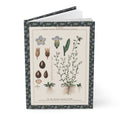
Emil Korsmo’s Unkrauttafeln: The Norwegian Scientist Who Made Weeds Beautiful
There is a particular kind of scientific devotion that transforms its subject. Emil Korsmo (1863–1953) — Norwegian agricultural scientist, professor at the Agricultural University of Norway, and one of the most meticulous botanical documentarians of the twentieth century — spent decades studying the weeds of Scandinavian agriculture. Not to celebrate them, exactly, but to know them completely: from root to seed, from germination to dispersal, from the fibrous tangle underground to the delicate flower that catches the light on a summer morning in a Norwegian field.

The result was the Unkrauttafeln — Weed Charts — published between 1934 and 1938, with illustrations by Knut Quelprud and Sara Mørk. They are among the most beautiful scientific documents ever produced in Scandinavia.
The Art of Knowing a Weed
The Unkrauttafeln were designed as educational wall charts — large-format plates intended to hang in agricultural schools and research stations, where students and farmers could study the complete botanical structure of each weed species. Each plate documents a species with extraordinary thoroughness: root systems, stem structures, leaf morphology, flower anatomy, seed dispersal mechanisms, and the complete life cycle from seedling to mature plant.
Plate LXVIII documents two members of the Boraginaceae family: the Field Forget-me-not (Myosotis arvensis) on the front, and the Small Bugloss (Anchusa arvensis) on the back. Both are blue-flowered annuals of arable fields and disturbed ground — modest plants, easily overlooked, whose tiny flowers carry a quiet beauty that Korsmo and his illustrators rendered with the same precision and care they brought to every species in the atlas.
The Field Forget-me-not
Myosotis arvensis — the Field Forget-me-not — is a small annual or biennial of arable fields, roadsides, and disturbed ground across Europe and western Asia. Its tiny sky-blue flowers with yellow eyes are among the most delicate and beautiful of all European wildflowers: five petals, perfectly symmetrical, arranged in the characteristic scorpioid cyme that uncurls as the flowers open, one by one, along the stem.
Korsmo’s plate documents the complete botanical structure — from the fibrous root system to the hairy leaves, from the flowering stem to the small nutlets that carry the seeds. It is a portrait of a plant that most people walk past without noticing, rendered with the attention and care of a scientist who understood that the most important thing in agricultural weed science is to know your subject completely.
The Small Bugloss
Anchusa arvensis — the Small Bugloss — is a bristly annual of sandy arable fields and coastal ground, whose small blue flowers with a distinctive white throat make it one of the most charming members of the Boraginaceae family. Less well-known than the forget-me-not, it shares the same family, the same blue flowers, and the same quiet presence in the agricultural landscape.
Korsmo’s plate documents the complete botanical structure — deep taproot, bristly stem and leaves, characteristic curved flowering stem, and four-lobed nutlets. Together, the two Boraginaceae species of Plate LXVIII offer a complete portrait of the blue-flowered wildflowers of the Norwegian agricultural landscape.
A Life’s Work in Plates
What makes the Unkrauttafeln remarkable is not just their scientific accuracy but their aesthetic ambition. Korsmo understood that a beautiful plate is a more effective teaching tool than an accurate but dull one — that the eye is drawn to beauty, and that beauty, once it has drawn the eye, can teach. The illustrations by Quelprud and Mørk achieve exactly this: they are scientifically precise and visually compelling, documents of botanical knowledge and works of art in their own right.
Emil Korsmo died in 1953, at the age of ninety, having spent most of his long life in the service of Norwegian agricultural science. The Unkrauttafeln are his most enduring legacy — a monument to the conviction that even the humblest weed deserves to be known completely, and that knowing it completely is itself a form of beauty.