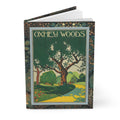
The Poster King's Debut: Edward McKnight Kauffer and the Railways of 1915
In 1915, a young American artist named Edward McKnight Kauffer arrived in London with little more than ambition and a modernist eye trained in Paris and Munich. Within months, he had produced four posters for the railways — among them Oxhey Woods and The North Downs — that would change the course of British graphic design forever.

Kauffer (1890–1954) had been born in Great Falls, Montana, and had spent years absorbing the lessons of Post-Impressionism and the Fauves in Europe before settling in London. He arrived at precisely the right moment: Frank Pick, the visionary commercial manager of the Underground Electric Railways of London, was in the middle of a campaign to transform the city’s transport network into a gallery without walls. Pick believed that art belonged in the daily life of ordinary people — not behind museum doors, but on the platforms and carriages of the city’s trains and buses. He commissioned the best artists of the age to produce posters that would encourage city dwellers to use public transport for leisure travel to the surrounding countryside.
Kauffer’s first commissions were Oxhey Woods and The North Downs, both produced in 1915 and printed by Waterlow & Sons Ltd. and Johnson, Riddle & Company Ltd. respectively. They are among the very first four posters he produced for the railways, and they mark the precise moment when modernist art entered the daily life of the British public.
Oxhey Woods, Hertfordshire
Oxhey Woods presents a tranquil escape at the edge of the city — a post-impressionist vision of the woodland in Hertfordshire rendered in bold, flat colour fields. Tall trees rise against a luminous sky, their forms simplified into decorative planes of green, amber, and gold that shimmer with the quiet promise of a Sunday afternoon beyond the city’s reach. The composition balances naturalistic observation with a graphic sensibility that was entirely new to British commercial art in 1915, announcing the arrival of a major artistic voice.
The poster was designed to be seen at speed — on a platform, from a moving carriage — and Kauffer understood this. The image works at a glance: the eye reads the trees, the sky, the light, and the invitation to escape, all in a single moment. It is a masterclass in the art of the poster, and it was only the beginning.
The North Downs
The North Downs moves decisively away from Victorian illustration. Kauffer employs simplified, bold forms and a restrained palette to evoke the expansive freedom of the chalk ridge of South East England — the open skies, the rolling hills, the sense of space that the city could never offer. The composition is panoramic and unhurried, an invitation to slow down and look at the landscape with fresh eyes.
Together, the two posters form a complete journey: from the woodland intimacy of Oxhey Woods to the open grandeur of the North Downs, from the edge of the city to the heart of the English countryside. They are, in the truest sense, an invitation to travel — and they remain, more than a century later, among the most beautiful travel posters ever produced.
Frank Pick and the Art of the Everyday
Frank Pick’s vision was radical for its time. He believed that the quality of the visual environment shaped the quality of daily life — that a well-designed poster, a well-proportioned station, a well-chosen typeface could make the experience of travelling through the city richer, more humane, more beautiful. He commissioned not only Kauffer but also Man Ray, Paul Nash, Graham Sutherland, and dozens of other major artists to produce work for the Underground and the railways.
The result was one of the most sustained and ambitious programmes of public art patronage in British history — and Kauffer was at its centre. Over the following decades, he would produce more than 140 posters for London Transport alone, becoming the defining visual voice of the network and earning the title “The Poster King” of the twentieth century.
A Legacy in the London Transport Museum
Today, Oxhey Woods and The North Downs are held in the collection of the London Transport Museum, where they are recognised as landmark works in the history of British poster art. They are defining images of the moment when modernism entered the daily life of the British public — not through gallery walls, but through the platforms and carriages of the city’s transport network.
They are also, in the most direct sense, an invitation: to travel, to look, to escape. To take the train to Oxhey Woods on a Sunday afternoon, or to walk the North Downs with the city far behind you. The countryside is always one stop away. The journey is always worth taking.