The Room Where Learning Happened: D. Englert and the German Schoolroom of 1867
Every generation learns in a room. The room changes — its furniture, its technology, its arrangement, the relationship it implies between teacher and student — but the fundamental fact of the classroom as a designed space, a physical environment shaped by pedagogical intention, remains constant. The history of education is, in part, a history of rooms: of the decisions made about how to arrange desks and chairs, where to place the blackboard, how much light to admit, how many students to seat, what relationship between teacher and taught the architecture of the space should express.
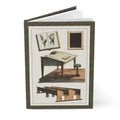
D. Englert’s 1867 illustration of a German schoolroom — titled simply “Schoolroom, furnishings” — is a document of one moment in this history. Produced in the tradition of German technical illustration that sought to document the designed objects and spaces of contemporary life with precision and clarity, it shows a mid-nineteenth-century German classroom in careful detail: the rows of wooden desks and benches, the teacher’s elevated desk at the front, the blackboard, the stove, the windows admitting the natural light that was the only illumination available. It is an image that rewards sustained attention — that reveals, the longer you look at it, the pedagogical assumptions and social values embedded in the design of the space.
German Education in 1867: Reform and Standardisation
The schoolroom that Englert documented in 1867 was the product of decades of educational reform. The early nineteenth century had seen a fundamental transformation of German education, driven by the educational philosophy of Wilhelm von Humboldt and the pedagogical theories of Johann Heinrich Pestalozzi and Friedrich Froebel. Where the schools of the eighteenth century had been primarily institutions of religious instruction, the reformed schools of the nineteenth century were conceived as instruments of national formation — institutions designed to produce citizens capable of participating in the intellectual and economic life of a modern state.
This transformation had profound implications for the design of the classroom. The reformed pedagogy demanded a different relationship between teacher and student — one based on active engagement rather than passive reception, on the development of understanding rather than the memorisation of catechism. The classroom had to be designed to support this new pedagogy: to allow the teacher to see and interact with all students, to provide each student with a workspace adequate for writing and drawing, to admit sufficient light for reading and close work.
By 1867, these requirements had been translated into a relatively standardised classroom design that was being implemented across the German states. The rows of individual desks — each with its own writing surface and inkwell — replaced the communal benches of the earlier period; the blackboard — a relatively recent innovation, introduced into German schools in the 1820s and 1830s — provided a surface on which the teacher could write and draw for the whole class to see; the teacher’s elevated desk at the front of the room expressed the authority of the teacher while allowing supervision of the whole class. It is this standardised classroom that Englert documented.
The German Tradition of Technical Illustration
The illustration that Englert produced belongs to a specifically German tradition of technical and documentary illustration that had developed over the course of the nineteenth century. Where the British tradition of illustration tended toward the picturesque — toward images that combined documentary accuracy with aesthetic appeal — the German tradition was more strictly technical: images designed to document objects and spaces with the precision of an engineering drawing, to provide a complete and accurate record of their subject rather than an aesthetically pleasing representation of it.
This tradition had its roots in the great German encyclopaedic projects of the eighteenth and nineteenth centuries — works like Krünitz’s Oeconomische Encyclopädie and Brockhaus’s Conversations-Lexikon — which sought to document the full range of human knowledge and practice in text and image. The illustrations produced for these encyclopaedias were characteristically precise and systematic: they showed objects and spaces from multiple angles, with details enlarged and labelled, in a manner that prioritised informational completeness over aesthetic effect.
Englert’s schoolroom illustration reflects this tradition. The classroom is shown in a three-quarter perspective that allows the viewer to see both the floor plan and the elevation — to understand the spatial arrangement of the room as well as the design of its individual elements. The furniture is shown with sufficient detail to allow its construction to be understood; the proportions of the room are carefully maintained. It is, in effect, a technical document — an image designed to record the design of the German classroom for posterity.
The Furniture of Learning: Desks, Benches, and Blackboards
The furniture shown in Englert’s illustration — the desks, benches, blackboard, and teacher’s desk — was not merely functional equipment. It was the material expression of a pedagogical philosophy — a set of decisions about how learning should happen, what relationship between teacher and student was appropriate, and what physical conditions were necessary for effective education.
The individual desk — with its sloping writing surface, its inkwell, and its attached bench — was a relatively recent innovation in 1867. Earlier schools had used communal tables or benches without individual writing surfaces; the individual desk expressed the reformed pedagogy’s emphasis on individual work and personal responsibility for learning. Each student had their own space, their own writing surface, their own inkwell — a physical expression of the idea that education was a personal achievement, not a collective experience.
The blackboard — shown prominently at the front of Englert’s classroom — was perhaps the most significant pedagogical innovation of the nineteenth century. Before its introduction, the teacher had no way of presenting written or drawn material to the whole class simultaneously; instruction was necessarily oral, or conducted through the circulation of printed texts. The blackboard transformed the possibilities of classroom teaching: it allowed the teacher to write and draw in real time, to build up an explanation step by step, to correct errors and revise formulations in front of the class. It was, in its way, as transformative a technology as the digital whiteboard that has replaced it in the twenty-first century.
Light, Space, and the Pedagogy of the Environment
One of the most striking features of Englert’s illustration is its attention to the windows — the large, regularly spaced openings that admit the natural light on which the classroom depended. In an era before electric lighting, the design of windows was a matter of genuine pedagogical importance: insufficient light made reading and writing difficult or impossible, and the direction of light affected the legibility of the blackboard and the comfort of students working at their desks.
The reformed German classroom of the 1860s had developed relatively precise standards for window design: windows should be on the left side of the classroom (to avoid casting shadows from the writing hand), should be large enough to admit adequate light even on overcast days, and should be positioned high enough to avoid glare and distraction. Englert’s illustration shows a classroom that meets these standards — a room designed with careful attention to the physical conditions of learning.
This attention to the physical environment of learning reflects a broader shift in educational thinking that had occurred over the course of the nineteenth century: a growing recognition that the conditions in which children learned — the light, the air, the temperature, the furniture — affected the quality of their learning, and that the design of the classroom was therefore a matter of educational as well as architectural concern. The schoolroom that Englert documented was not merely a room with desks in it: it was a carefully designed environment, shaped by pedagogical intention at every point.
A Journal for Those Who Never Stop Learning

Our D. Englert 1867 Schoolroom Journal carries this illustration across its full wraparound cover — the German classroom of 1867 rendered in the precise, documentary style of the German technical illustration tradition. It is a journal for those who find beauty in historical illustration, who understand that a classroom drawing is also a document of pedagogical philosophy, who appreciate the German tradition of educational reform that produced this image.
Inside, 150 perforated lined pages await your teaching notes, lesson plans, learning reflections, or whatever form your engagement with education takes. The casewrap sewn binding opens completely flat — ideal for lesson planning. The matte laminated cover preserves every detail of Englert’s illustration in a finish that rewards close examination.
In 1867, D. Englert drew a classroom so that the world could understand how learning happened. Perhaps the pages inside will help you record a little learning of your own.
References & Further Reading
- Albisetti, James C. Schooling German Girls and Women. Princeton University Press, 1988.
- Blackbourn, David. The Long Nineteenth Century: A History of Germany, 1780–1918. Oxford University Press, 1997.
- Froebel, Friedrich. The Education of Man. Appleton, 1887.
- Jeismann, Karl-Ernst & Lundgreen, Peter (eds.). Handbuch der deutschen Bildungsgeschichte. Beck, 1987–1992.
- Lawn, Martin & Grosvenor, Ian (eds.). Materialities of Schooling. Symposium Books, 2005.
- Pestalozzi, Johann Heinrich. How Gertrude Teaches Her Children. Swan Sonnenschein, 1894.
- Tyack, David & Cuban, Larry. Tinkering Toward Utopia. Harvard University Press, 1995.